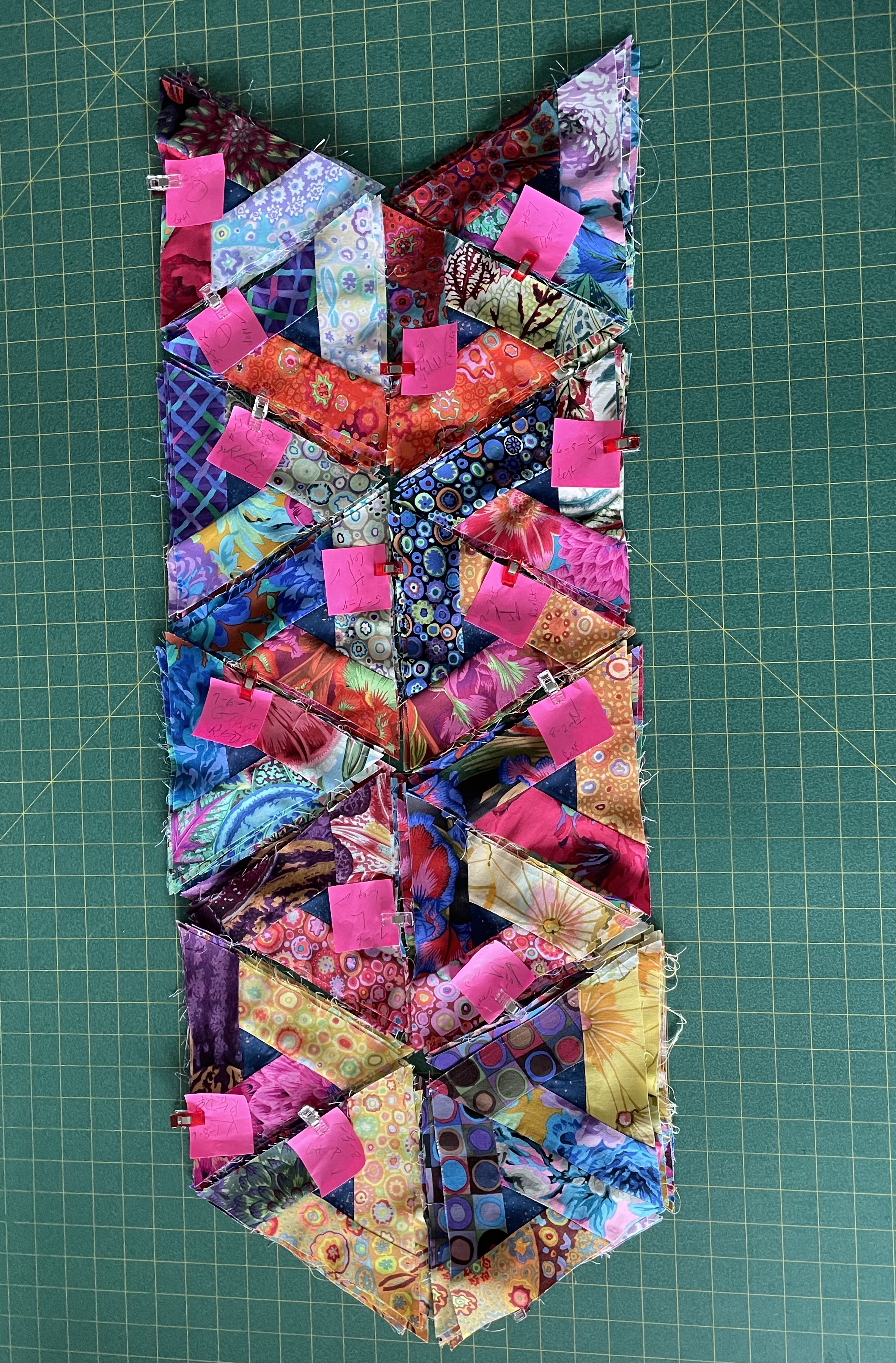
After I had the third diamond quilt underway I came across what’s called the “Escher” Quilt.
There are a lot of examples of this quilt online – I don’t know who developed the idea originally. The assembly creates the illusion of impossible interlocked elements. The quilter who’s photo I’ve shown below (whom I know only as “chiquitatarita”) posted photos of her quilt top in progress (she’d bought a kit using Kaffe Fassett Collective fabrics)- here she had two columns assembled where you can see the construction clearly. I even have quite a few of those particular fabrics!
I could make this simple and enrol in a class or I could buy a kit (which includes fabric, a pattern and instructions), but I decided to try on my own to see what I can construct using a relatively simple block.
Next I came across another blogger who also described how she worked with the kit she’d bought:
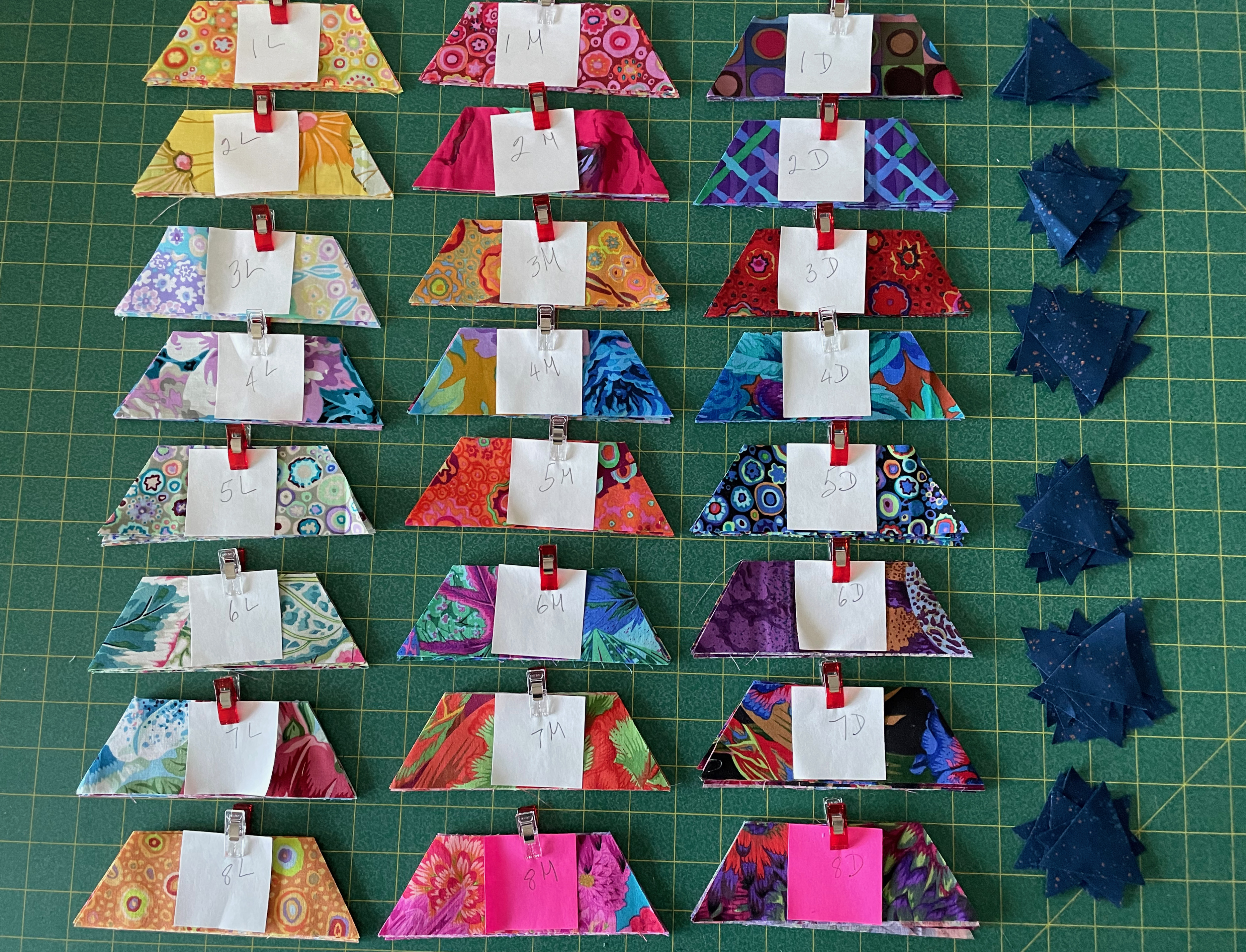
First we made a chart, and laid out all the fabrics, from one to eight down, and L/M/D across. After cutting, we needed to then pair up the pieces according to the chart. Each piece has a light, a medium, and a dark bar, but they’re different depending upon their relative location in the row.
I organized my fabric into eight sets of three groupings – light, medium, dark. I cut 2″ strips from each and cut the trapezoid shapes (16 from each fabric) plus the small dark triangles for other centre of the block.
This helps me figure out how to go through my fabrics and set up an 8 x 3 array as Sue describes above.
So I set out to create the basic block – it took several attempts to establish a size for the block using paper and pencil. Then I cut out bits of fabric to see if my calculations worked – they didn’t – not at first. However, I did finally manage to work out a reasonable size block which went together pretty well.
Triangle Unit 1
This block is one of a pair – the second one assembles in the opposite direction which lets you put the triangles together to form a connected “diamond” where the same fabric abuts to form a wide angle – you can see two in the photo below – one in brown, the second in green (I’m just working with scraps to see if I could set up a couple of blocks):
Three Triangle Units Sewn Together
The precision issues won’t be with my cutting – I now have the dimensions I know will work. It’s my sewing that will create issues – I will have to be extremely careful to sew a “scant” 1/4″ seam. When I attach the triangle to the first trapezoid I need to stitch a partial seam – which is completed when I add the third trapezoid. Then I need to carefully press each resulting triangle so the centre triangle seams are pressed outward. Finally, I will need to press the block-joining seams open, so the assembly will lay flat. I also have to remember to create my blocks in pairs – one block having the small triangle at the left of the first trapezoid, the second having it at the right end!
Now it’s time to go through my fabrics – I want 24 – set up in eight sets of Light, Medium, and Dark. I don’t have complete colour ways sets of three but I’m sure I have enough variety in my collection of Kaffe Fassett Collective fabrics to make something that will work.
Mar 29 2023:
Ina Veurink wanted more information about the size of the trapezoid elements. I just constructed one so I could answer her question.
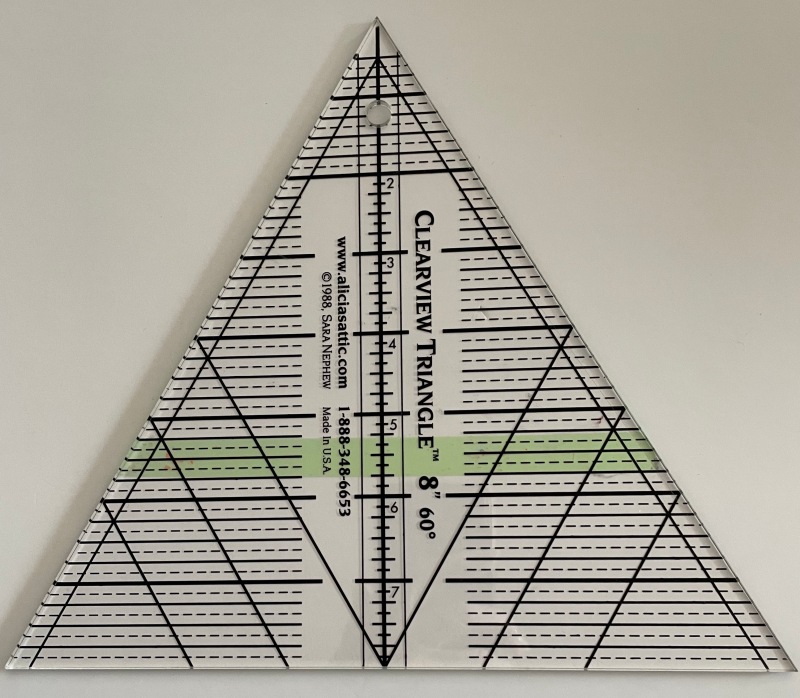
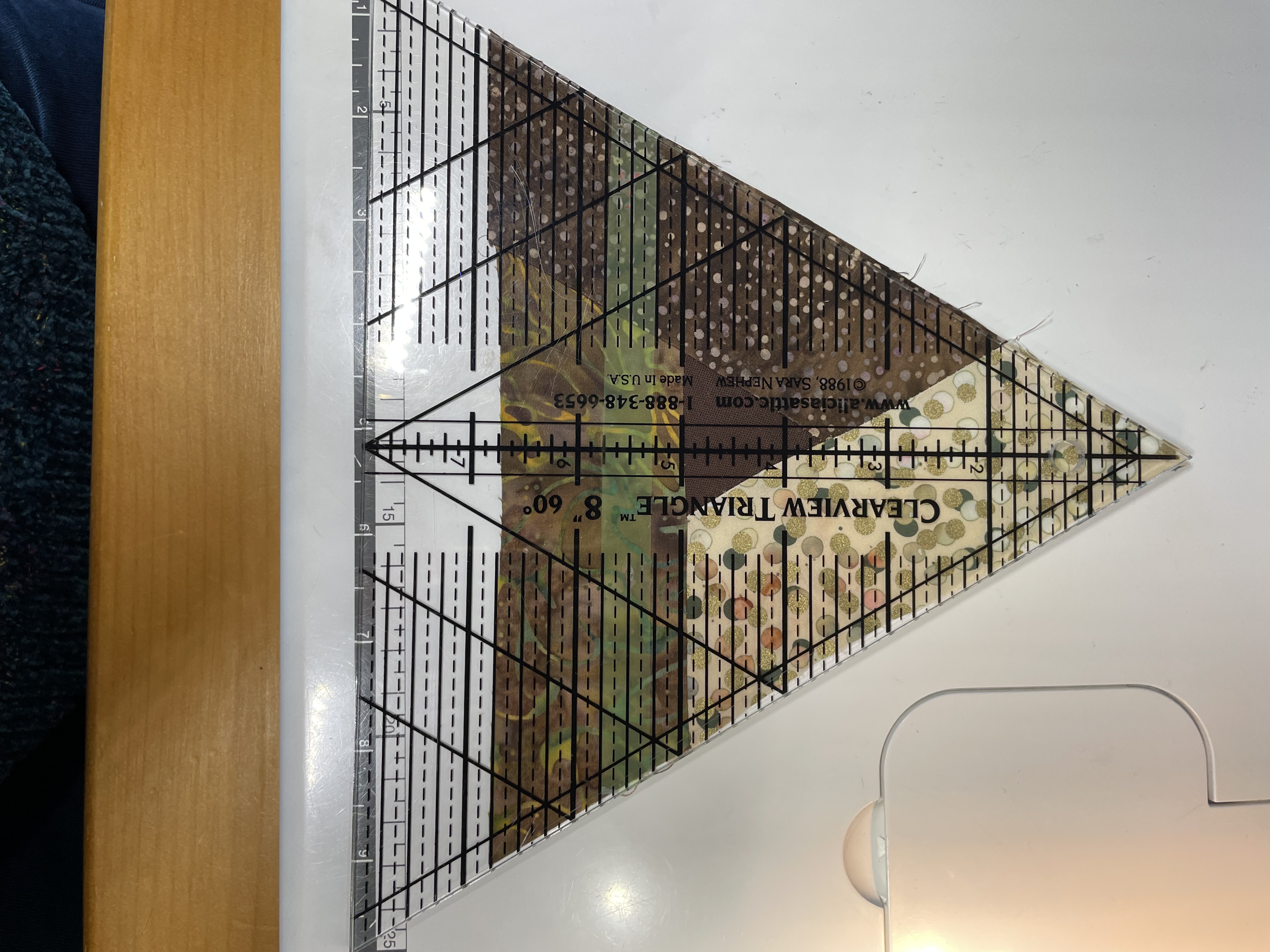
I cut 2″ fabric strips to start, from the fabrics I was going to use for the trapezoids. Next I trimmed the angles on each side using an acrylic equilateral triangle template which I’d marked with green tape at the 5 1/4″ line:
Trimmed Trapezoids From 2″ StripBlock Partially assembledAssembled Block
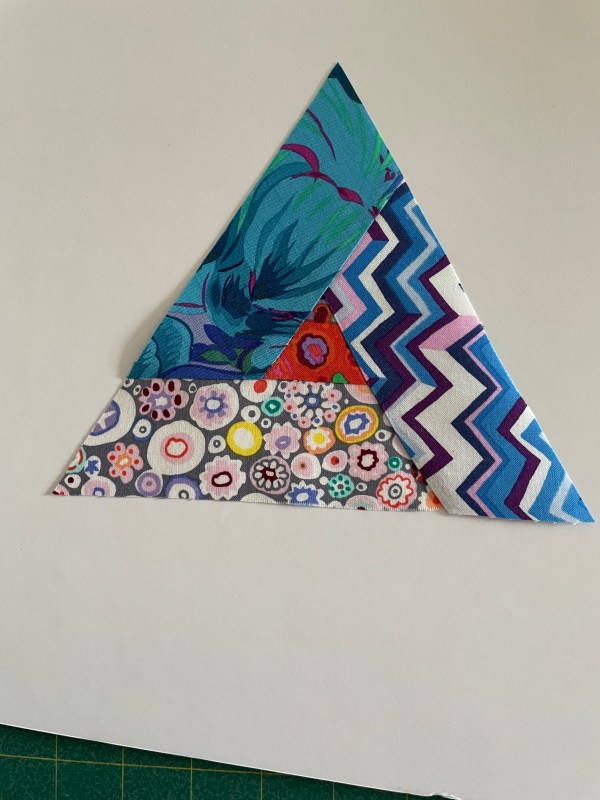
I laid out the 4 pieces: a 2″ triangle (in the quilt all the triangles are cut from the same dark fabric), 3 trapezoids (each 2″ tall, 5 1/4″ on the long, bottom side). I partially sewed the triangle to one end of one trapezoid
(NOTE: half the finished triangle blocks begin with the small triangle on the right, half on the left – I talked about that somewhere in the posts as I went along). It’s a partial seam because to fit the final trapezoid in, you have to be able to lift that first side of the small triangle to sew that seam. Next I attached a second trapezoid, then I fit in the third trapezoid, last I finished by completing the partial seam. Pressed and trimmed.
Finished triangle size: each side should end up at 6 3/8″ (although if your sewing was more accurate than mine on this test triangle you might actually end up closer to 6 1/2″). Whatever your final triangle size, all the triangles should finish the same size.
This is an advanced intermediate quilt (definitely not for a beginner, even with instructions).
Another note you wouldn’t pick up if you didn’t read through the comments is this one:
Just keep in mind you need 25 fabrics – one solid for the “background” triangles and any borders you plan on adding; 24 patterned fabrics – 8 light, 8 medium, 8 dark (https://jmncreativeendeavours.ca/2021/05/08/the-escher-quilt-2/)…. You’ll likely do a lot of auditioning to build a collection of 24 fabrics. As for the background, I suggest a navy (which is what I used given the colour blend of my fabrics) but black is certainly a good option (that was the background colour in the original photo I saw). All the best with this quilt. One other thought, because trying to pull together a collection of 24 fabrics can be daunting you might consider a kit that has selected fabrics for you (these quilt kits are reasonably priced: https://www.quilt-agious.com/shop/Kits/p/Escher—Batik-x46838321.htm).
Oct 28 2024
In reply to Jackie Fitch who had trouble making the triangle block (I’m doing this quick and dirty to illustrate how to assemble the block – my cutting/stitching/pressing is not absolutely perfect).
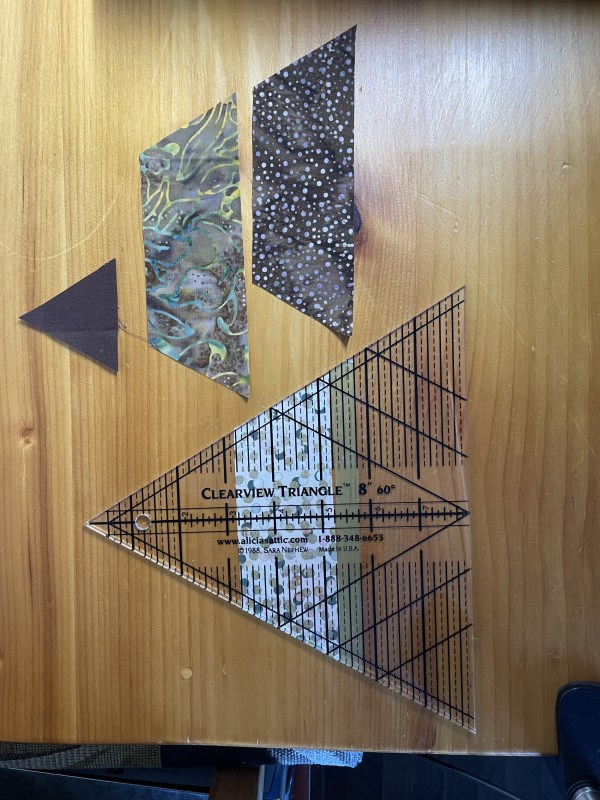
Here are the pieces: They’re all cut from 2″ strips – the trapezoids are cut with the 2″ strip positioned at the 5 1/4″ line on my triangle template (top at 2 1/4″ line). The triangle is cut from the tip with the base of the 2″ strip @ 2″.
You need to use a “scant” 1/4″ seam allowance – play around with the seam allowance until you can get the triangle outer edges to align for you (more or less).
The Pieces for the Triangle Block
You start sewing by placing the triangle on one end of the light trapezoid (half the blocks place it on the left and half on the right – when you add the next trapezoid in the second set of triangles you’re rotating in the opposite direction) [NB: I can’t remember, off hand, when adding the second trapezoid in the second set of triangles, whether you attach the medium or the dark as the second trapezoid – I’m sure I must have mentioned that.
Here it is: https://jmncreativeendeavours.ca/2021/05/09/i-was-being-so-careful/ “It turns out that four of the five finished stacks of triangles which build with the triangle on the right were sewn together counterclockwise – light strip attached to triangle, medium strip to that seam, dark strip to the remaining side – NOPE – should have been light attached to triangle, DARK next, and finally the medium – to give a clockwise rotation.”
1. Place the triangle on the left end of the light trapezoid. Sew a partial seam (click on image #1 below to see the partial seam).
2. Press triangle away from the trapezoid – NOTE: I’ve pressed the seam allowance the WRONG way – its should press toward the trapezoid!
3. Place the medium trapezoid against the side where you’ve sewn the triangle to the trapezoid [Note: When constructing the second set of triangles you sew the triangle to the right end to the light trapezoid, and add the DARK trapezoid second!]
123
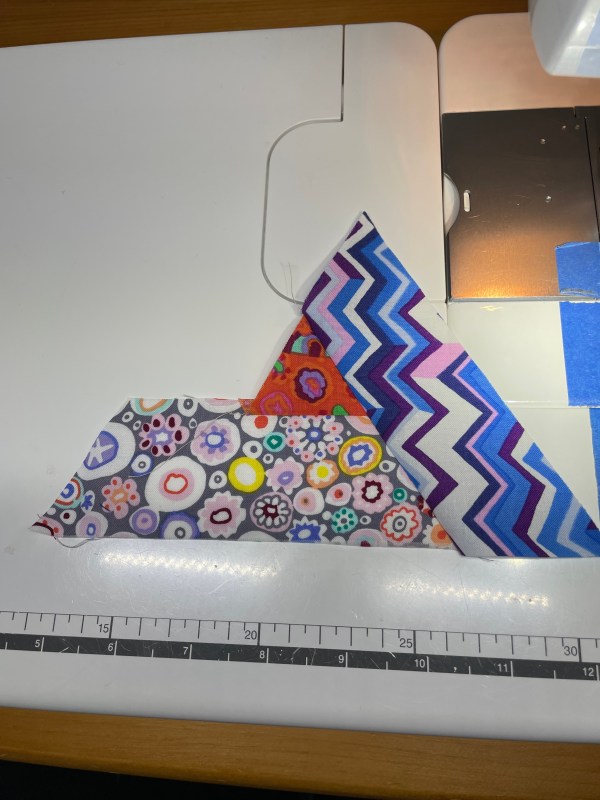
4. Sew this trapezoid in place – notice the dog-ears extend beyond the top edge of the trapezoid you’re adding.
5. Press this trapezoid seam allowance toward the trapezoid.
6. position the third trapezoid (you’ll notice it does fit).
456
7. Stitch the third (the dark) trapezoid in place – notice the dog-ears extending beyond the top edge of the trapezoid, be careful not to sew into the first trapezoid. Flip the trapezoid and press it (seam allowance toward the trapezoid.
8. This next seam is a tricky seam! Click on the image to see where the seam begins – at the end of the partial seam you sewed in #1.
9. Click on the image and you will see the finished seam which closes the trapezoid.
789
I can see now I missed one photo! The one showing how to fold the fabrics so you can see where you sew the final closing seam – you can infer how to do this by clicking on #8 and looking closely at how the pieces are laid out on the sewing machine bed.
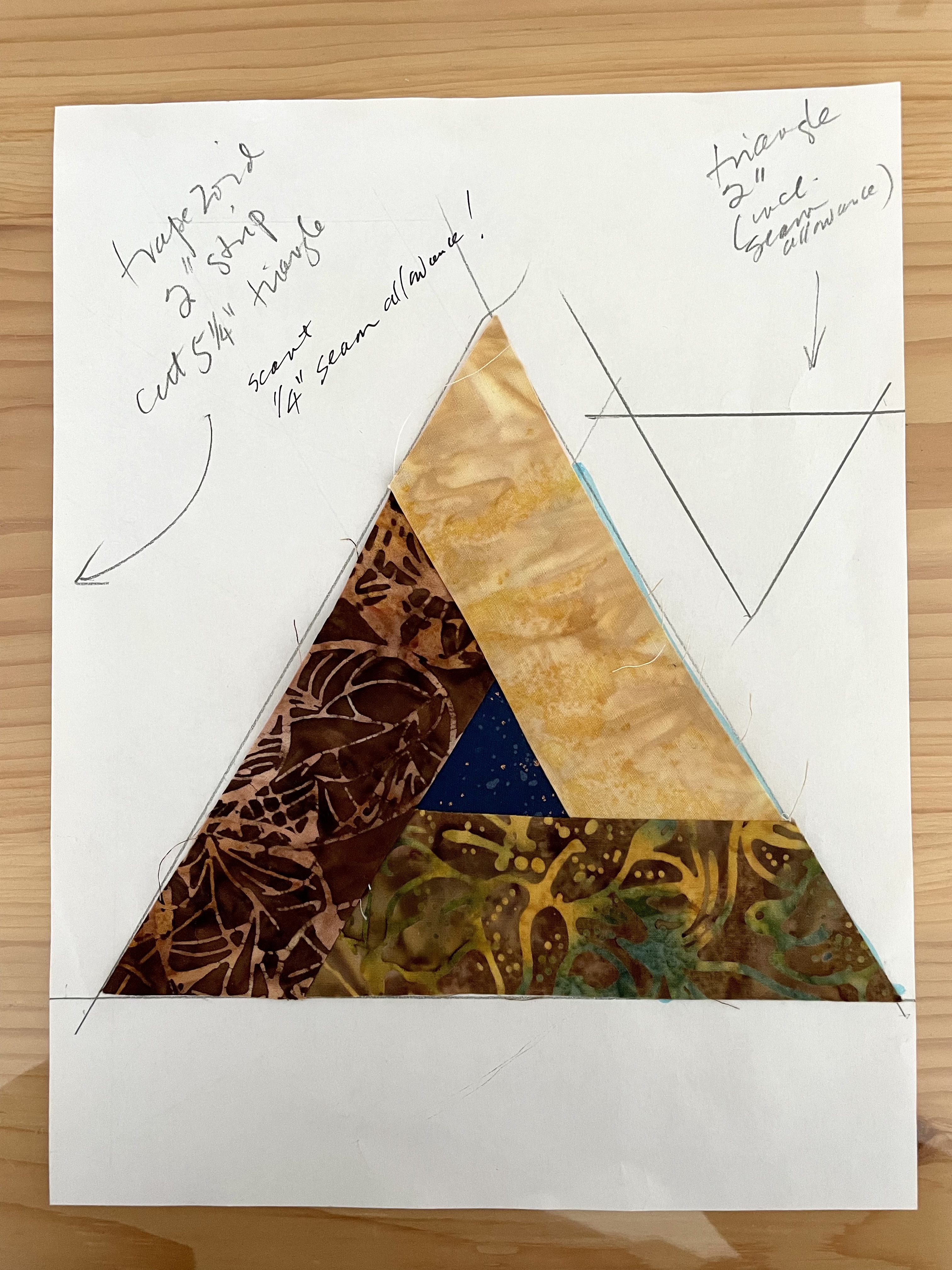
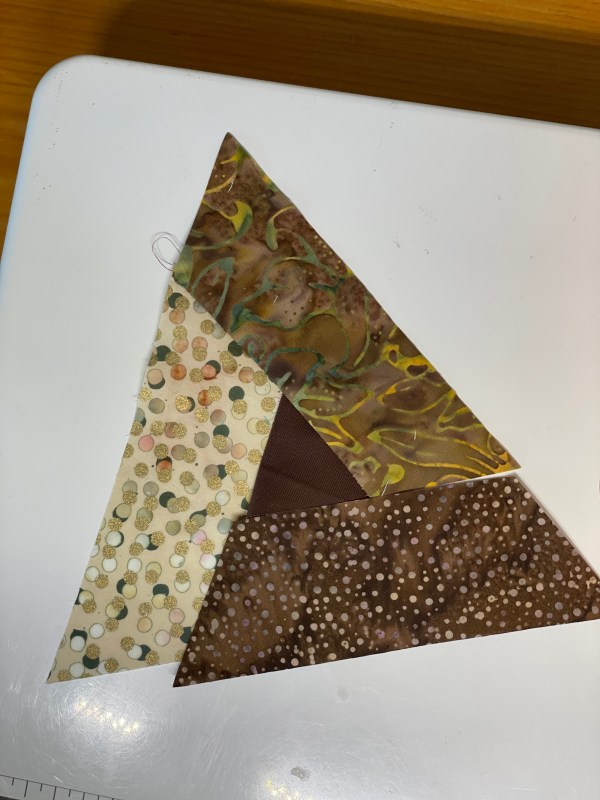
This last image should be rotated (I told you this was quick and dirty!) #10 shows the finished pressed block with the template on top. With a smidgeon of trimming, my block will end at 6 3/4″ (it’s shy a wee bit on the light trapezoid side and a smidgeon long on the medium trapezoid side).
This brown block is a bit larger than the more colourful triangle I created above – because I used a scant 1/4″ seam allowance here rather than a regular 1/4″. I advise making several practice blocks before you work on the triangles for the quilt top just to sort out what you need to do to get as close as possible to a consistent size.
10
Here’s what the finished triangle should look like on the wrong side (seam allowances pressed away from the triangle):
Back of block to show pressing
I hope this is helpful, Jackie. I can’t do you a video because I don’t have a setup to create them. Sorry.
Finished the quilt yesterday – at least for the moment I’m considering the quilt done. I’m still contemplating quilting the seams in the ditch but pressing has flattened the 6-point joins reasonably well – I may leave well enough alone.
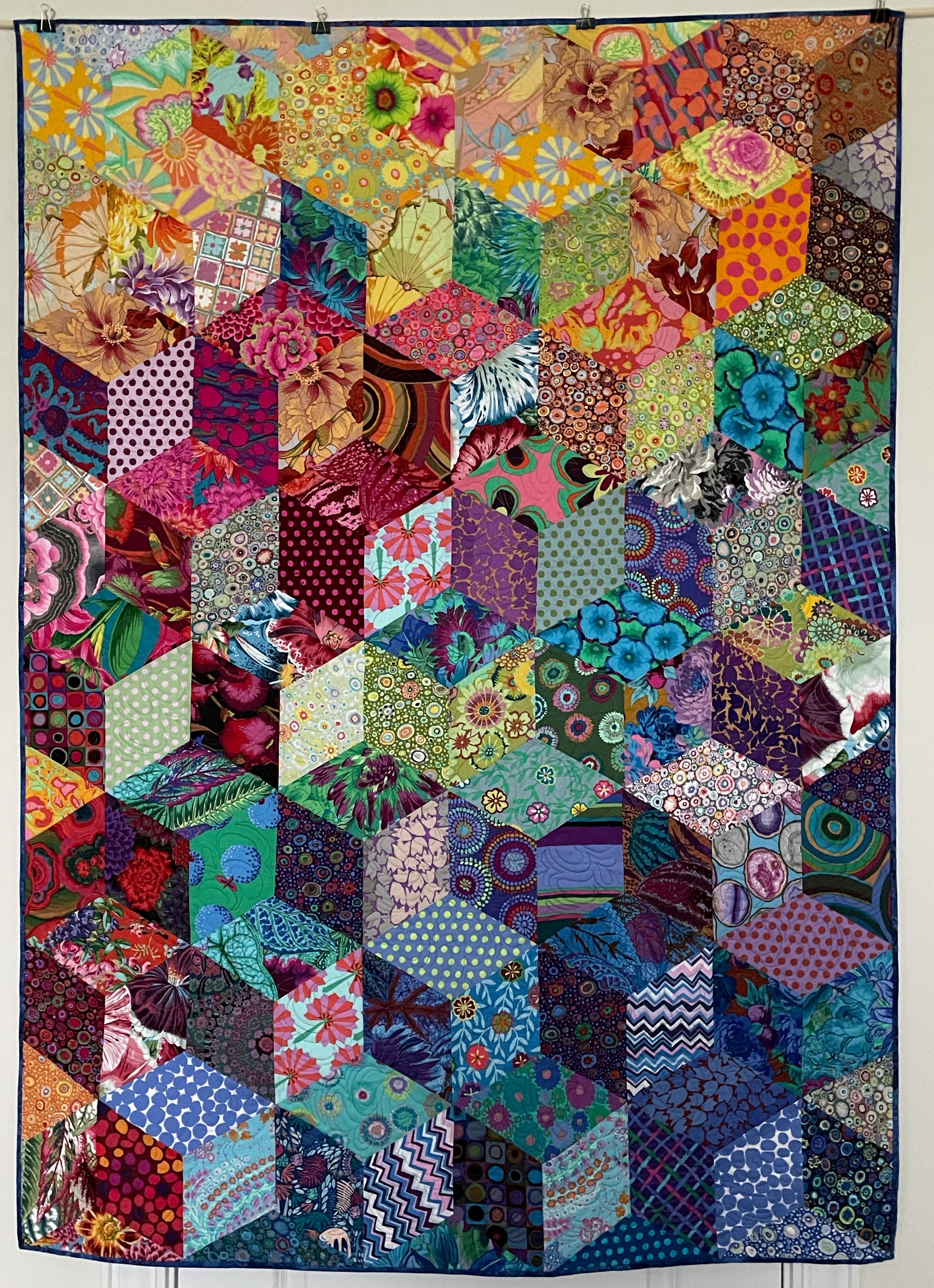
Diamonds III – Finished Top
Finished size: 47″ x 66″.
It’s hard to see in the photo but I finished with a 1/4″ binding using what scraps I could scrounge from the backing cut-offs (it was close – I have nothing left over!). In this case I stitched the binding to the front, hand stitched on the back (I usually stitch a binding to the back, fold over, and use a decorative stitch on the front). Stitching to the front with this quilt made sure I had an even 1/4″ dark edge to the quilt top.
Diamonds III – Finished Back
This is the seventh quilt finished since last August – I have time to work on one more for the showing in Parrsboro, scheduled to happen through July this summer. I have more than enough of the Kaffe Fassett Collective fabric to work with – no point in saving it because I have more KFC fabric ordered to arrive sometime in June.
I signed up for the July/August “Kaffe Quilt Along – Gathering No Moss” online workshop being offered through Hyggeligt Fabrics in St. Mary’s ON. It was the colour of the blue collection that caught my eye. I don’t expect I will construct the suggest quilt – if I do work on that quilt block, I won’t make it using just those fabrics – the blues need some kind of an accent to liven the array. I registered because I’m interested in seeing what Fassett has to say about choosing colour and planning layout.
I knew of Kaffe Fassett’s work through his knitting books and even tried a couple of his sweaters – first time I tried intarsia knitting (not my favourite kind of knitting – too fiddly).
From Fassett’s 1985 book “Glorious Knitting”
Then I as a novice quilter I came across the You Tube videos of his Tampa weekend workshop Oct 17/18 2008.
I watched all three sessions and learned a lot about colour flow. (Here is another video where he discusses colour.)
Over the next year or two I did a series of quilts with batiks (as well as large scale print fabrics) using what I’d picked up from watching the workshop videos. So I’m curious to see what he will have to say this time as people work through four different colour arrangements of the designated quilt.










 jmn
jmn