Bargello Table Runner #2 – Finished

After yesterday’s experiments with fabric face masks, today I went back to completing the bargello table runner. I had more than half to stitch in the ditch and because I was matching thread colour to the blocks it wasn’t straightforward sewing – lots of stitching a short distance, changing direction, a bit more stitching, then another turn…. Nevertheless, I was able to finish the quilting reasonably quickly (I looked at the clock – it was close to 1pm).

Then binding. I was planning to use a black “crackle” from my stash but I wasn’t totally happy with it. All fabric stores in the region are now closed so I was limited to what I had in the apartment. I was putting away the leftover fabrics from the bundle of strips I used to create the bargello to find two perfect bronze strips left. Each 5″ wide – I decided to cut one strip into three 1 5/8″, I cut one 1 5/8″ strip from the second. Joined the binding strips and attached them to the front of the runner.
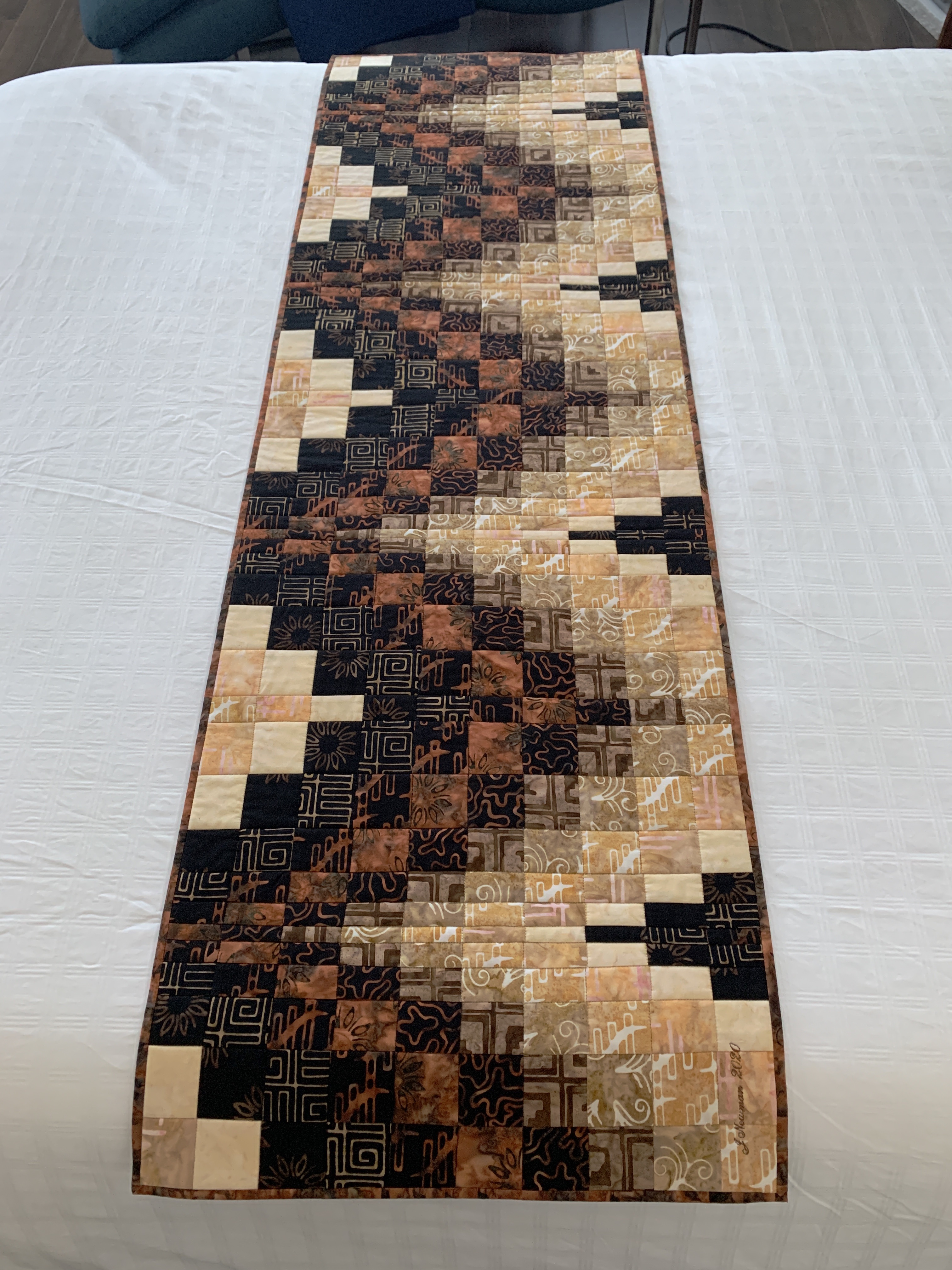
Finished Table Runner

Again, I wanted a very narrow binding (a smidge more than 1/4″) which left me with a 3/4″ binding on the back side – it had to be sewn by hand.

I realized once I’d put the binding on that I didn’t have a signature/date on the piece – on the previous table runners I was smart enough to embroider my name and year BEFORE I added the backing and quilted them. This time I forgot and had to embroider my name and year through all layers. (I hope having made this mistake here, I won’t make it again.)

Table Runner On My Glass Table

I auditioned the runner on my glass table – it’s either a bit long or a bit too short depending on how you look at it. It isn’t “just right”. Also (I can’t believe I’m actually saying this) it is too bright and strong for the room decor. Perhaps I’ve just become used to the more toned down runner I’ve been using on the table.

This piece is now stored away in my quilt closet along with the other wall art, table runners, quilts living there. I’m anticipating all the showing I was lined up to do this spring and summer will now not happen. If I’m lucky, some of those venues will come available when this period of quarantine comes to an end (whenever that might be).

Fabric Face Masks

Last evening, Rachael Maddow had an item on the surgical face mask crisis in the US and talked about Deaconess Health Centre’s call for crafters in the community to help build a supply of masks.

I’ve been looking for a way I could do more than self-isolate as a way of pitching in during this pandemic. I can’t do much because I’m “over 65”, with a preexisting cough that makes it difficult for me to be out in public at this particular time, but this was something I could do.

I found the link: https://www.deaconess.com/How-to-make-a-Face-Mask and this morning I printed out the instructions from the Turban Project Face Mask and gave it a try.

First, the instructions recommend using flannel for the inside layer. I have a relatively large fabric stash but no flannel – I did, however, have some densely woven muslin which I thought would work reasonably well. I also wanted to improve the impermeability so I added a layer of thin fusible batting to one sample, and a non-woven fusible interfacing to the second. The instructions also called for either “rope” elastic or 1/8″ elastic – neither of which I had on hand – remember I can’t go shopping and local fabric stores are closed anyway – so I improvised using some metallic-wrapped Christmas elastic I had in a drawer which was fine for a sample.


Then I sat down to sew. I quickly sewed the two layers together (elastic included in the side seams), turned the mask right side out. The rest should have been easy but trying to position the pleats and stitch them in place was a bit awkward. In my first attempt I made the pleats too narrow so the side of the mask was too long and the whole thing wouldn’t sit well over my face. I need to make a template marking the pleat position if I’m going to make a batch.

I then decided I needed a small bit of wire over the nose (like one of the commercial masks I found in a drawer in my bathroom – heaven knows where I got it). I dug around the apartment and came up with a set of twist ties in a box of garbage bags – I took two and stitched them to the top edge of the mask. This allowed me to pinch the mask to my nose! But the mask still gaped on the sides so I took the pleats apart and made them a bit bigger – turns out a good fit needs to reduce the side measurement by about a half. To finish off,  I added two small pleats to the bottom edge which made the mask fit snugly beneath my chin.

Inside of mask showing wire at top edge

I still don’t have the elastic length right – the pattern calls for 7″. Because they recommended tying a knot in the end (to prevent pulling it out from the seam) I cut the elastic a bit longer – turns out on the first (mauve) mask the ties are a bit too long.

With the second mask I cut the elastic to 6″ – too short!  6 3/4″ would be about right to allow me to tie knots and stitch the pieces into the side seam.

So my masks are actually three layers, not two – a firmly woven print (a batik would be even better), a fusible non-woven interfacing, and a closely woven muslin with a slightly brushed side for softness. The point of the mask isn’t to stop virus particles from coming in to me but to stop my coughing and sneezing droplets from getting out – in other words to protect other people.

I plan on making one for each of the gals in the Friday afternoon knitting group here in the building – the recommendation from health professionals is not to wear a mask if you’re not coughing/sneezing but it can’t hurt to have one one hand, in case. And for the ears I will cut lengths from my roll of 1/4″ elastic (of which I have quite a lot!).

The caveat, of course, is this face mask is not meant to replace a surgical face mask; it is a contingency plan for those who haven’t been able to find any surgical masks in the stores. And it’s washable – it can be cleaned repeatedly after every use.

Magical Butterflies

I came across this on Colossal this afternoon. Take a look at this magical embroidery – the butterflies are simply wonderful. Wish I had the patience to try something like this….

Magical Butterflies and Insects Stitched in Dense Thread Paintings by Emillie Ferris


Bargello Table Runner #2

I’ve been working on a second bargello table runner for a class I held last week (we’re supposed to meet again in a week and a half – not sure if the gals will come or not – not sure if the shop will even be open!) The government directives to “stay at home” may prevail and even this small group may not take place. If that should happen I may try a Google “Hang-Out” with the gals – (that’s if I can get it to work and write them some instructions for connecting) so we might talk about assembling their table runners. [PS: Everything has closed down here in NS – shop closed; classes cancelled… (Mar 19 2020)]

My fabric for this runner came from a 5″ wide 20 strip jelly roll with a lovely range of contrasting colours. I selected 10, deciding to use the bronze as the contrast fabric and situated it between two of the black/bronze strips. 5″ allowed me to cut 2 x 2 1/2″ set – precisely what I needed for 4 bargello blocks.

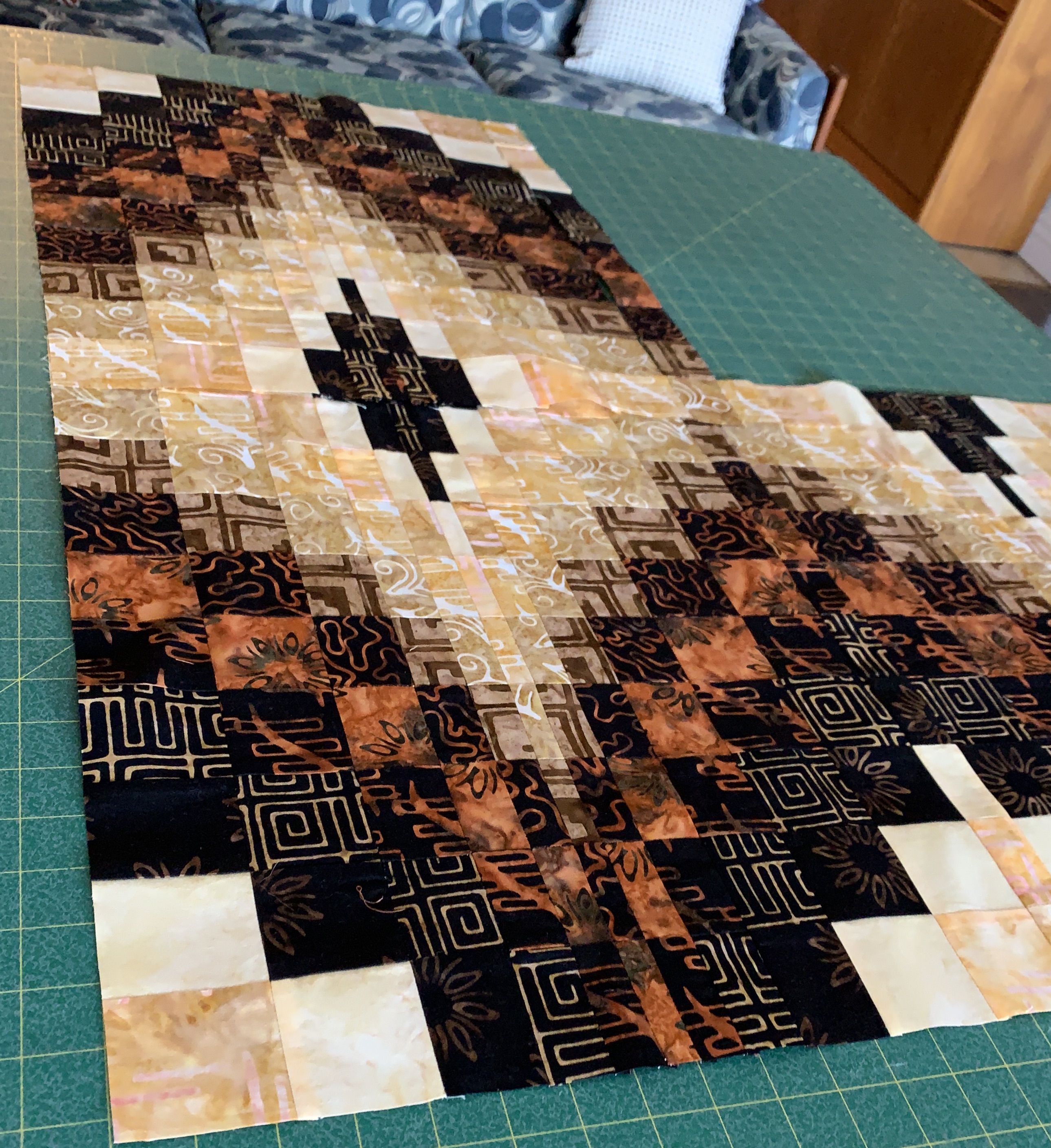
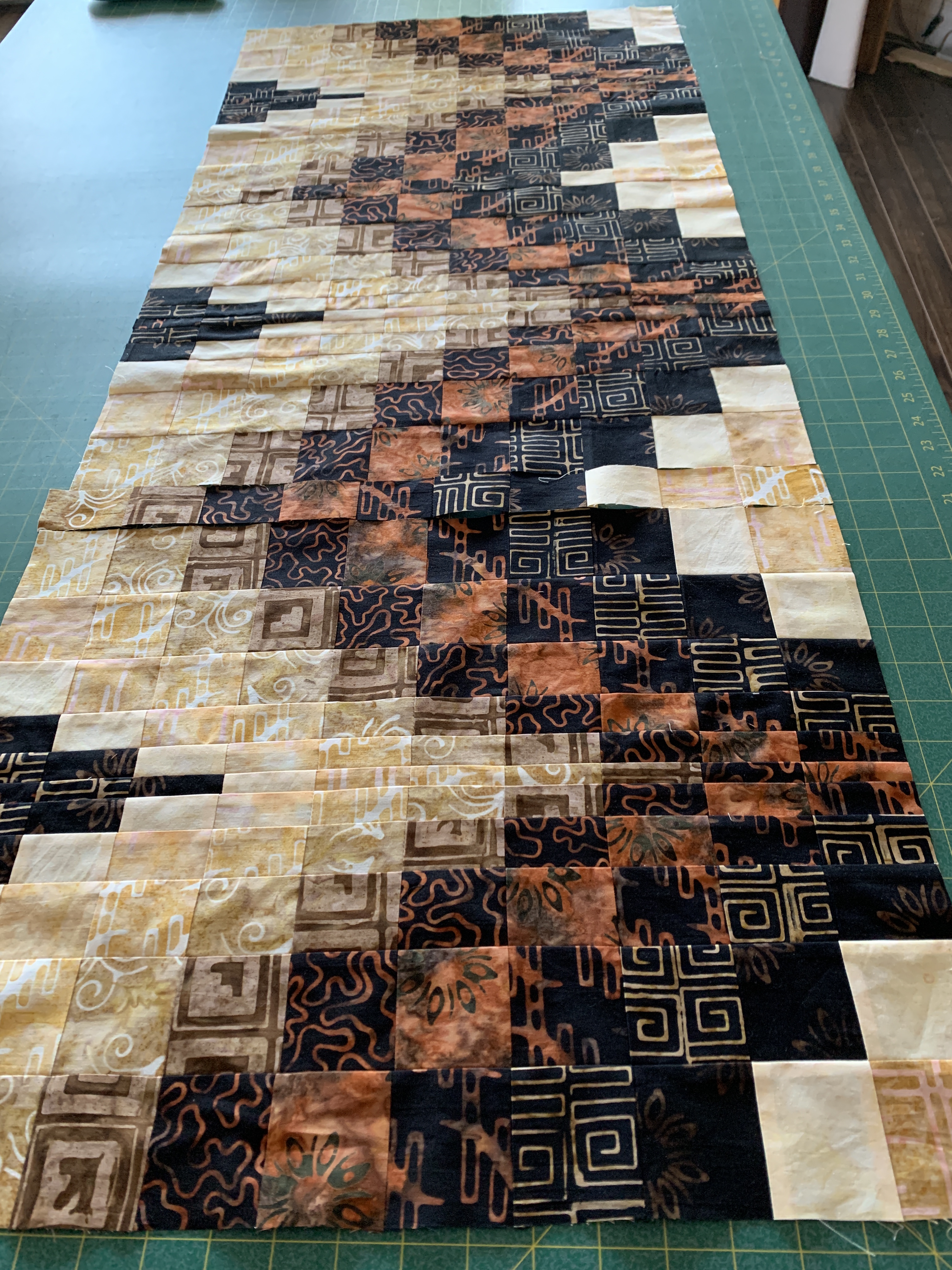
Bargello Table Runner II – Under Construction

Notice I said 2 1/2″ strips. The previous bargello table runner used 2″ strips. Using 2 1/2″ strips makes each block quite a bit taller – so much so that placed together end to end (as above) my table runner would turn out to be somewhere around 75″ long; too long for my table; too long to hang on my front door.

So, I’ve decided to join the blocks on the sides using a 1 1/2″ strip which allows me to generate a flowing wave pattern. The other thing I did was to use several narrower strips at the centre of the block which produced a more bargello-like curve to the layout (more obvious in the top image).

Three blocks laid out as a “wave”

I haven’t sewn all three blocks together yet – I want to be able to show the gals different ways of thinking about layout. So tomorrow I’ll assemble the 4th block (which is cut and laid out) and ready to go.

I should end by saying to anyone reading this “Stay safe.” Stay well!” I am staying at home for the most part – I went to pick up a prescription this afternoon. I tried to see my dentist (I just lost a small filling while eating lunch) but the office is only taking emergencies. My small filling doesn’t count – so heaven knows when I might be able to get it repaired. Months maybe?

I’m so grateful to have the sewing and knitting to keep my mind and hands busy. I’ve a lot of projects, including a spring jacket, I want to work on during the next while.

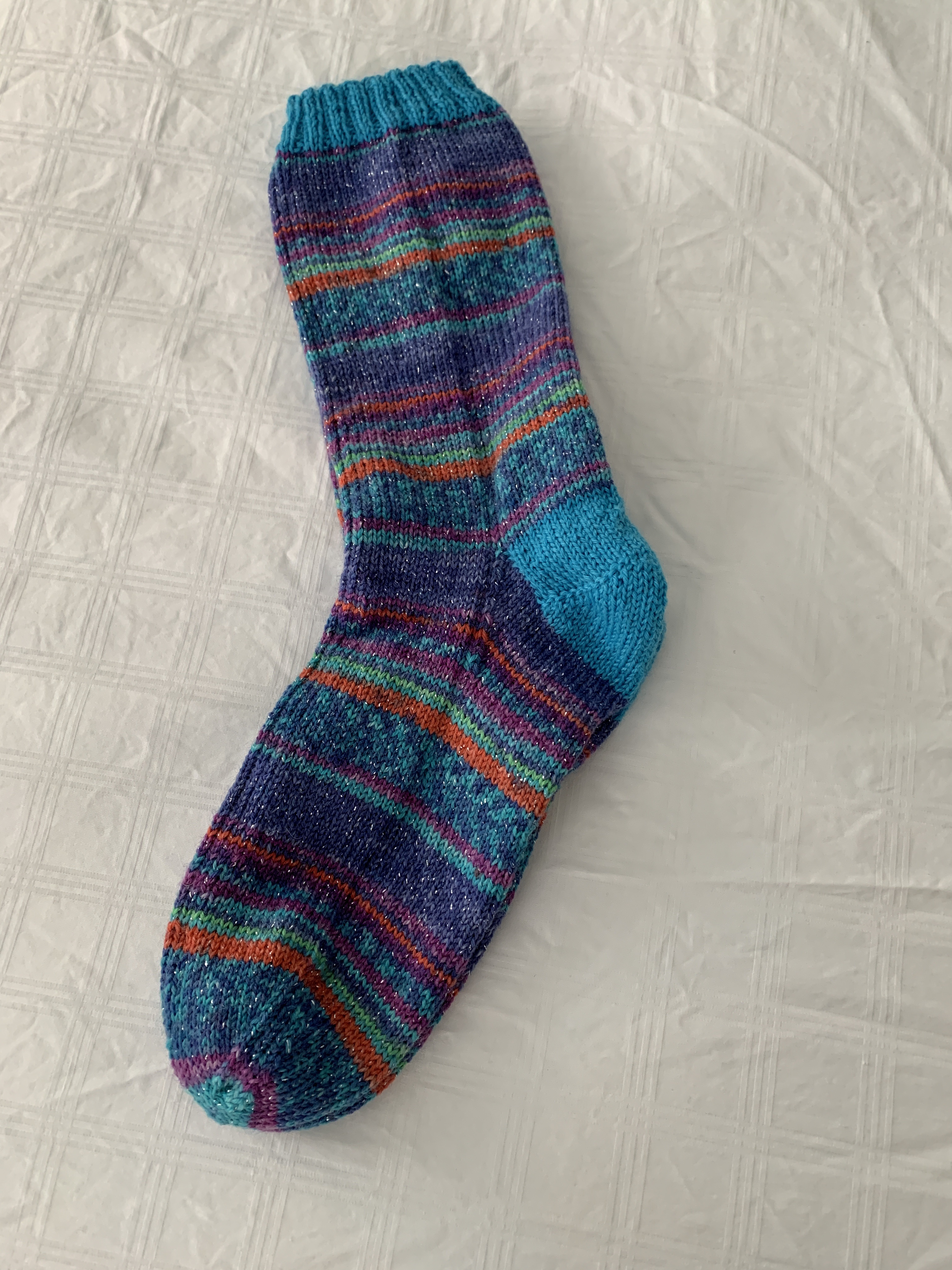
Sparkle Socks

The photograph is misleading because it doesn’t show the sparkle! However, the sock yarn has a fine mylar thread included in the 4 ply which produces a lovely sparkle in the socks!

Sparkle Socks

Some lucky friend will be gifted these socks. I don’t need any more right now in my sock drawer so these are in the give-away pile.

I’ve moved on to socks for my chiropractor who enjoys receiving them. He’s been a great help to me not only maintaining my back mobility but in advising on a wide range of other health related issues. A pair of socks is a small token of my appreciation. They’ll be done by my next appointment.

Kaleidoscope Table Runner II

After finishing the first kaleidoscope table runner I went shopping for fabric to try a second to learn more about what makes a good print design for constructing the octagons.

The pattern repeat in the butterfly fabric I bought was ~ 23in in length and although I bought 1.4m I decided to use just half of the fabric for the kaleidoscope since I didn’t want to end up with many more triangles than the 40 (5 x 8) I needed.

I was hampered by the fact that the printing of the fabric wasn’t precise and even though I aligned the 5.5″ fabric strips precisely, I wasn’t able to get 8 exact repeats of from any spot – just sets of 4. So I built my octagons from two sets of 4. That still gave me the kaleidoscope effect I was after.

Kaleidoscope Table Runner II

I cornered and bordered the octagons with a dark blue print and then used strips of the butterfly fabric for the outer border. The back used the leftover from both border fabrics as a simple bordered panel.

Again, I quilted the octagon blocks in the hoop, and stitched the borders in the ditch to stabilize the runner.

This piece might just be hung on my front door!

Bargello Table Runner IV

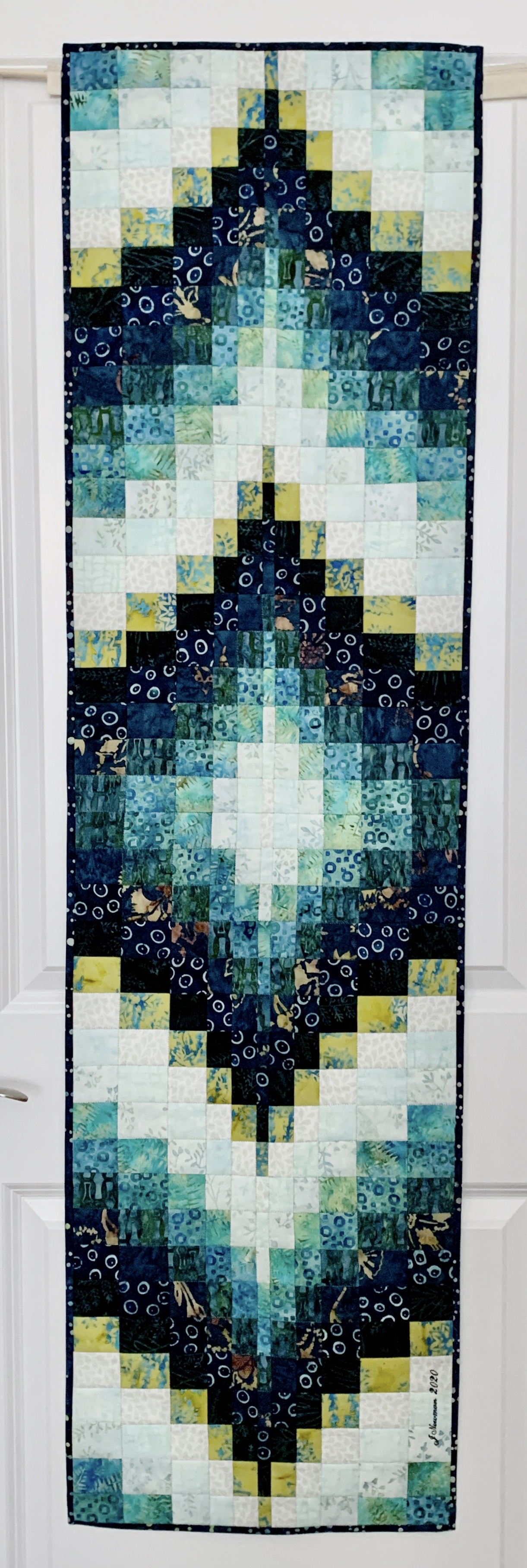
I finally finished the 57″ x 16″ Bargello table runner last evening. It took me several hours over two days to stitch the whole thing in the ditch – that was because I was changing thread colour and having to stitch on the zig-zag.

Bargello Table Runner – Finished

I thought about quilting the piece in the hoop for quite a while – doing an edge-to-edge style of design along the length – but I decided it would detract from the bargello detail. In this case, I also stitched through the backing, which meant I needed to add a binding. I chose a 1/4″ binding on the front but 3/4″ hand stitched down on the back.

The original Bargello piece is also finished – it’s the inverse of the longer table runner with a dark, rather than the light, centre.

Bargello Table Runner I

I’m teaching a class in two weeks on how to improvise a Bargello block and how to think about layout for a table or bed runner, a cushion, a wall hanging, or a quilt. The point will be to understand how the quilting version is derived from wool on canvas work and uses the same math principles.

For the class, I will need to set up another Bargello piece so I can demonstrate forming the tube stitched from 10 strips, cutting, and laying out the Bargello array. Better think about that in the next day or two.

Here are instructions for this table runner –  Download the PDF

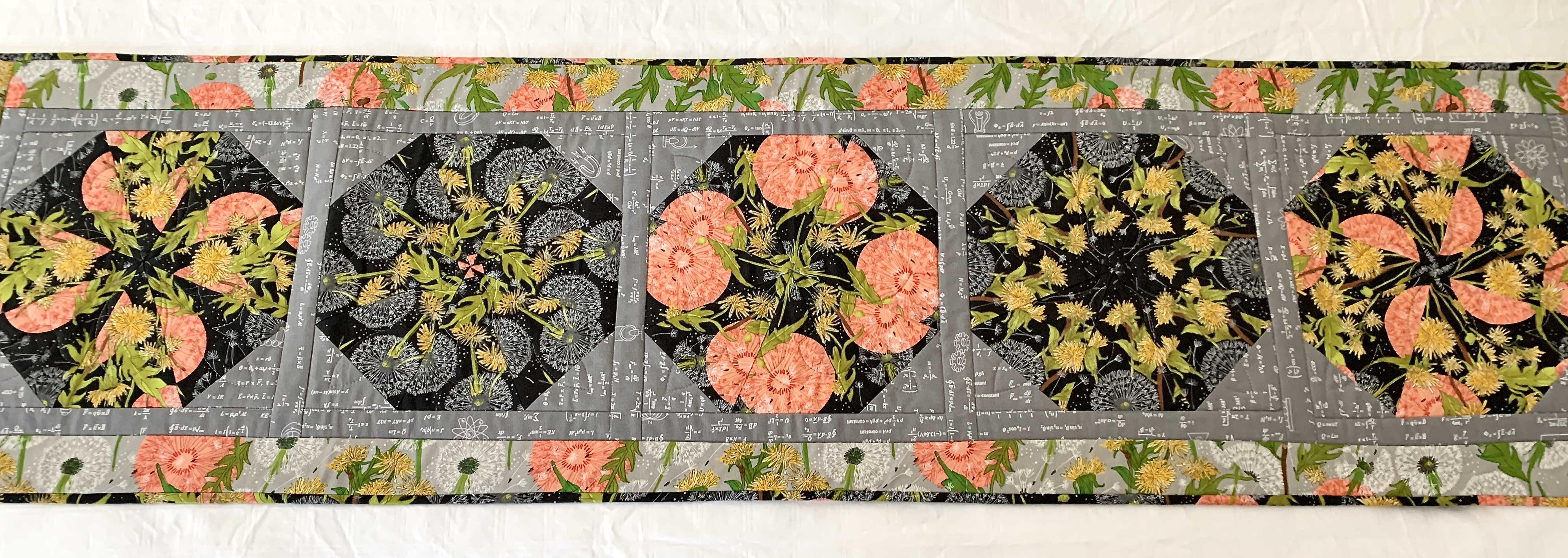
Kaleidoscope Table Runner – Finished

Finished the table runner last evening – hand stitching the binding to the back.  I don’t enjoy hand sewing but in this case I used a 1/4″ binding on the top with a 3/4″ binding on the back and the only way to attach it was to hand sew it in place since I didn’t want a line of machine stitching through the border on the front.

Completed Runner – Top

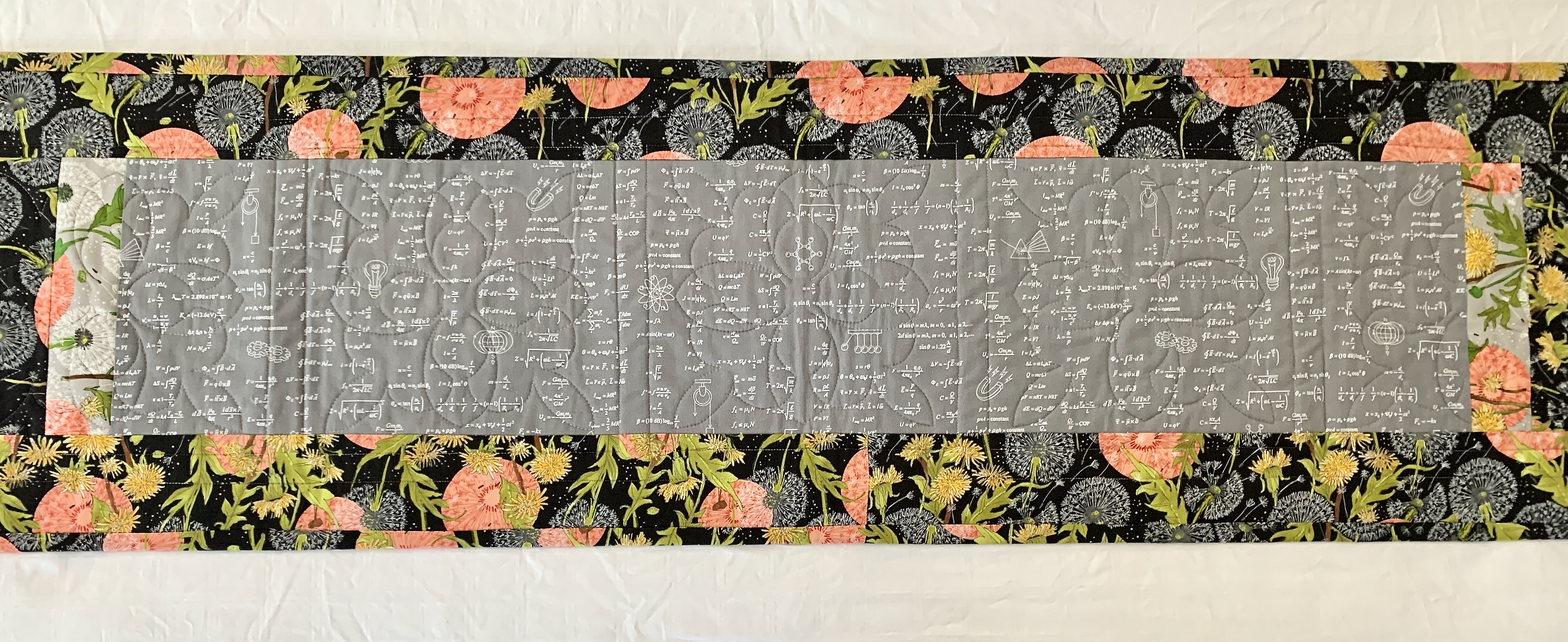
I constructed the back from leftovers – I hadn’t bought very much of either the grey for the sashing or the grey version of the printed fabric. Not much in the way of scraps left, I can tell you.

Completed Runner – Back

This idea would also make a decent bed runner probably with seven octagons to make it long enough so it drapes over the sides. Might even want to add another narrow light inner border as well. My runner is just a bit narrower than the width of my queen bed. I have no intention of using either is as a bed or a table runner; quite likely it’ll end up as a wall hanging and included in one of the showings I’m scheduled for this summer.

BTW:

 “A bed runner is a small, long piece of decorated cloth used to enhance the appearance of an otherwise plain bed. While some prefer the look solely for aesthetic reasons and would choose it even if it were more expensive than traditional decorative bedding, the primary reason to use one in the hospitality industry is to reduce costs while keeping the room attractive.

Kaleidoscope Table Runner

I’ve been looking for projects to try out that I can share with some of the other sewing gals. I’ve almost completed the Bargello Table Runner – it’ll get done over the weekend. The other day I came across another idea: a Kaleidoscope/Stack ‘n Whack octagon block for a quilt or table runner described on the Jordan Fabrics You Tube Channel. I decided to try it out.

Yesterday I picked up some large print fabric to see what’s involved. The tricky part of the whole project isn’t the piecing – it’s the cutting. I hadn’t bought enough fabric to end up with eight identical triangles (except in two cases) so I had to make do with 4 and 4 somewhat complementary triangles for three of the octagons; but it’s the construction of the block I was interested in trying out.

I laid out my dark fabric, found the pattern repeat, cut what I had into two repeats (I bought .7m – I should have bought 1.4m to get the eight repeats for cutting the triangles but with a bit of improvising I ended up with 4 layers instead of 8 which yielded enough triangles for the project), halved the width-of-fabric, then carefully aligned the printed pattern through the four layers as was demonstrated in Video #1 below.

Kaleidoscope Table Runner

Once I had my layers of fabric carefully aligned, I cut out 5.5″ strips, then cut out 45° angled triangles – in the blocks with the peach elements I had two sets of four triangles to sew together, in the predominantly dark blocks I was able to get eight matching triangles.

Next I stitched the octagons together. Today I added the corner triangles (cut from 3.75″ squares) and the sashing and added both to each of my five octagons. Finally, I added a 2.5″ outer border of a lighter grey version of the original fabric from which I cut the triangles.

All in all the project went together relatively easily – once I’d figured out the necessary size for the corner triangles! That took a bit of experimenting.

I’ve also figured out how I will piece the backing so I don’t have to buy any more fabric for this project. I’ll get that done tomorrow, then I’ll set up the quilt sandwich and get the table runner assembled.

It’s definitely do-able as a class project – I completed the runner in less than 6 hours.

I didn’t stop to take photos as I went along. The whole process is explained very clearly in the videos below. So if you’re interested in making a table or bed runner, or a full quilt using this kaleidoscope block watch Donna Jordan from Jordan Fabrics in Oregon as she explains the process.

The biggest hitch in the whole project is actually finding a suitable fabric for constructing the stack ‘n whack blocks – you really need a large print fabric with an open design and quite a bit of colour variation. I would say what I chose in the end wasn’t a colour combination I would normally choose but the selection was very limited at my local shop. I will look at a couple of other shops nearby to see what else I might find.

So here are the videos:


Charm Quilt – Finished

Finished the quilt last evening. When all the quilting in the hoop was done (it went reasonably quickly), I added the binding. I didn’t want much of a binding but in the end I finished with a 1/4″ binding on the front (3/4″ binding on the back) which had to be hand-sewn. I never do hand sewing if I can help it – but in this case the binding on the back was wider than on the top and I didn’t want a machine stitched seam next to the binding; so hand sewing it was.

Charm Quilt – Finished

I’m pleased with how the back turned out, as well. I was able to use the column of HST I’d taken from the panel on the front, added a few sashing pieces that evoked the colour pallet of the front with a slightly darker grey fabric.

Finished Charm Quilt Back

This could be a quilt top on its own!

Now, I’d intended working on this quilt as a demonstration for the “quilt in the hoop” class – it was cancelled a week ago, the gals couldn’t make it yesterday, so far only three are able to come next week. I just kept working on the quilt and I finished it. So for the class (whenever it happens) I’ll work on my sample muslin piece. For now, I’ll be back to working on the bargello table runner.