Bargello Table Runner III

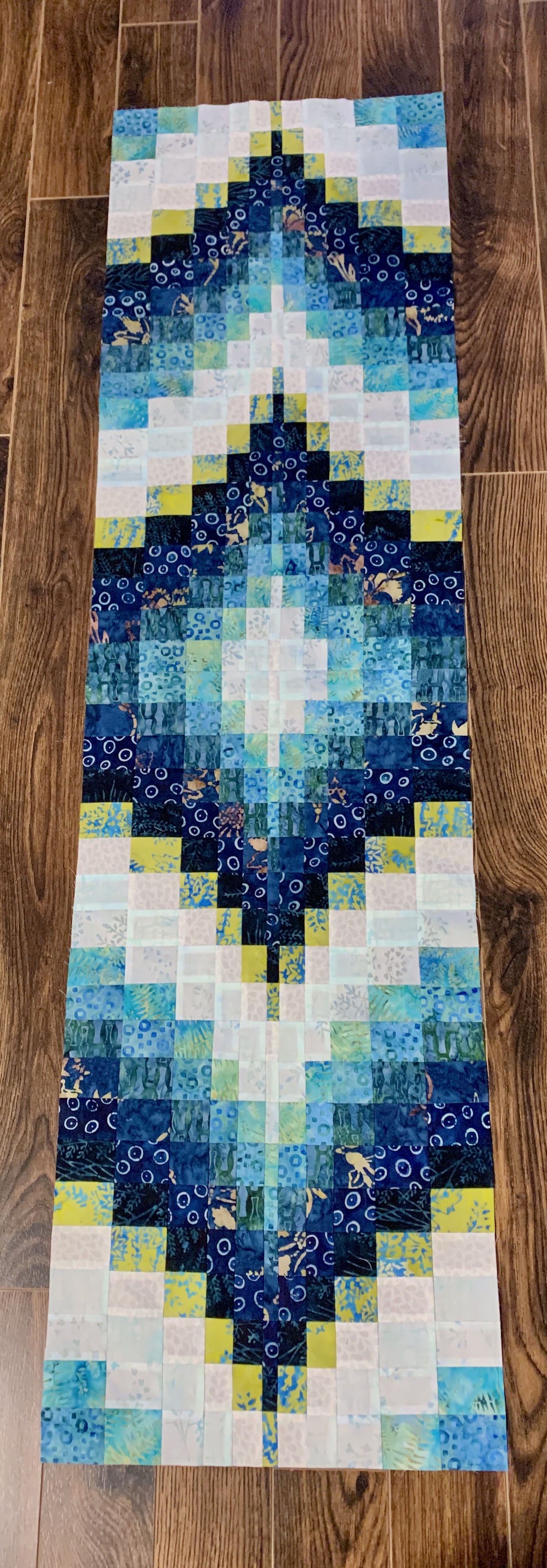
I’ve just finished piecing the bargello table runner top. The second pair of blocks went quite a bit faster than the original two because I was careful about pressing seams in the right directions so I would have no nesting problems as I assembled the blocks.

Bargello Table Runner Top – Finished

The unanticipated thing was pressing seams as I constructed the blocks – I discovered I had to press the seams in the opposite direction from the original two blocks so seams would nest when I went to attach the new ones.

Next I have to find a backing fabric. I’m going to do a pillow case finish without bindings to preserve the clean edge I have here.

Bargello Table Runner II

Years ago I did some wool on canvas bargello embroidery creating seat covers for several chairs.

Bargello done with wool and canvas

Bargello is done by stitching across a set humber of canvas threads – in this case I’d guess 4 threads – with adjacent stitches stepping down two threads. Also there are different numbers of stitches at different points – three consecutive stitches over the same threads, two, two, one, one, one, one… It’s the changing number of repeat stitches at any level that creates the interesting curved lines characteristic of bargello work.

It’s similar with creating bargello using fabric. Set up a panel from coloured strips, cut new strips of different widths from the panel, sew these strips together systematically staggering the colours to set up a bargello pattern.

Beginning to Lay Out The Pattern

Here is my completed bargello block:

Bargello “block”

Here are two blocks sewn together to make a curved diamond.

Bargello Double Block

Yesterday when I created a test block I wasn’t quite careful enough with my cutting, and my 1/4″ seam allowances weren’t perfect, so the finished panel was just a bit slanted. Instead of doing the same block using my second set of strips, I started a new layout and this time I made sure my ruler didn’t slip while cutting the initial strips, that I matched up my edges precisely when sewing them together, was particularly careful when cutting the panel into different width strips and nested the seam joins when sewing those strips together. My two blocks turned out pretty much the same dimensions (and although the photo doesn’t demonstrate it, this panel is straight).

The other thing I did this time was to add a 10th very dark strip next to my contrast colour. I ran into difficulty nesting the joins yesterday and that was because I had used just 9 strips initially – taking care to press my seams in alternate directions – but when I added in the contrast strip and joined it to the first (creating a tube) I ended up with a pressed seam not paired to another and as a result I was changing nesting direction for just about each join/point while assembling the block. With 10 initial strips I had the right number of seams that when pressed in opposite directions matched up.

Seams pressed in opposite directions

Sewing the different width staggered strips together was nearly effortless – the nestings were all just about exact. So in spite of some directions I’d found online calling for an odd number of strips to form the bargello layout, it turns out an even number of initial differently coloured strips makes the later sewing much easier.

Bargello Table Runner

The women in the last class I taught asked for another project. I thought they might be interested in bargello piecing. It looks complicated, but it’s another of those techniques where you sew strips together to set up a colour palette, then recut and re-sew to create some kind of a pieced pattern.

Bargello is a type of needlepoint embroidery consisting of upright flat stitches laid in a mathematical pattern to create motifs. The name originates from a series of chairs found in the Bargello palace in Florence, which have a “flame stitch” pattern. Traditionally, Bargello was stitched in wool on canvas; but bargello can also be created from fabric piecing.

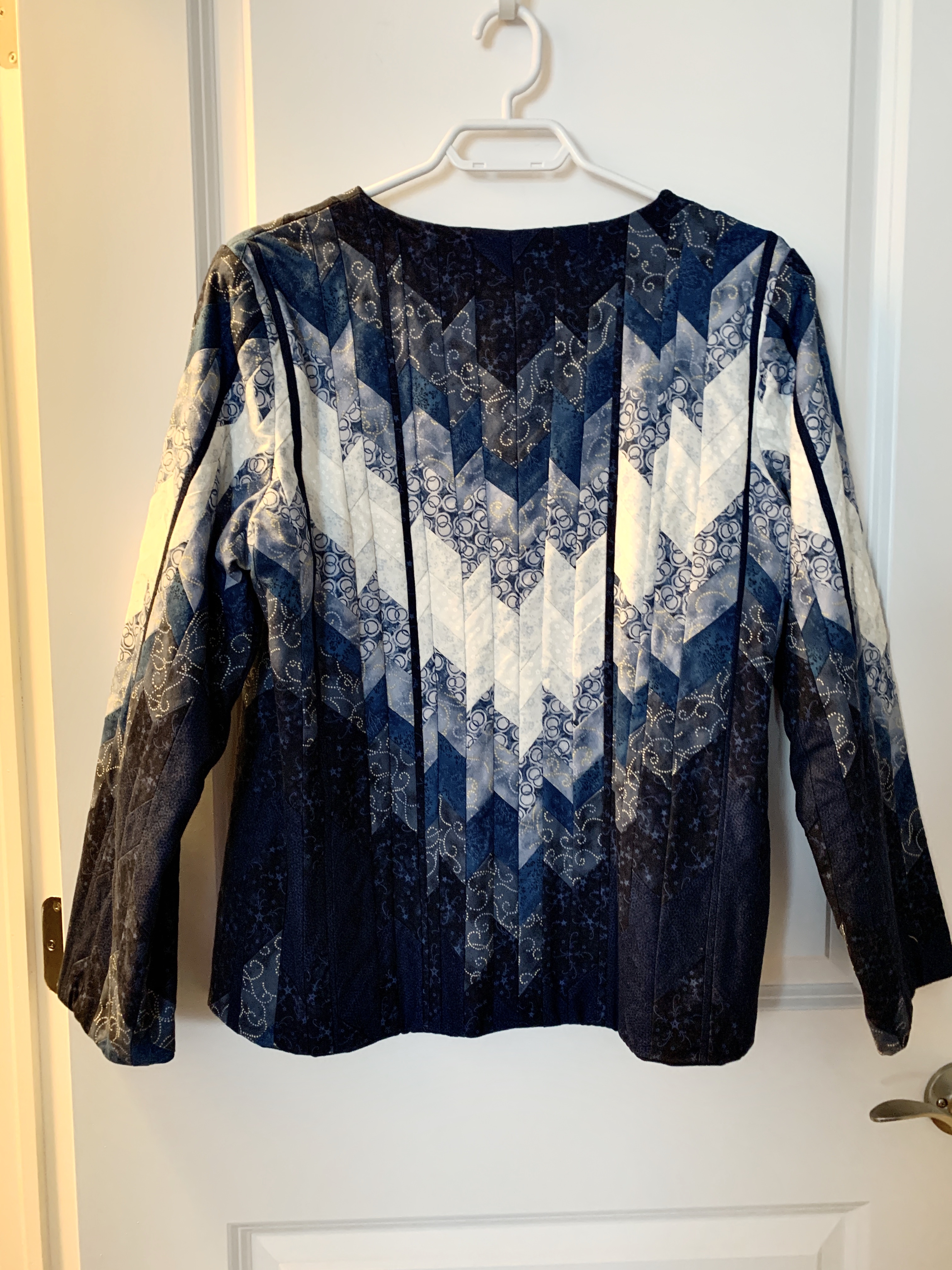
A number of years ago I made a bargello quilted jacket:

Bargello Quilted Jacket – Back

The jacket was cut from 6 panels constructed from pieced strips – 2 fronts, 2 sleeves, 2 backs (joined in the centre). In this case the second cut was done so that there were two sets of strips on opposite diagonals creating the zigzag effect.

There are simpler ways to piece bargello. Today, I took nine 2″ strips cut from the width of fabric graduated in colour from pale to dark blue with a contrasting yellow/green. I sewed the nine strips together from light to dark, then added the contrast strip and sewed the first and last strips together to form a tube.

Bargello Table Runner – In Progress

Next, I cut the tube into 11 strips of different width (1″ – 2 1/2″) and sewed them together to create the parabolic curve. I had enough fabric in the first sewn panel to make two blocks which I then stitched together in opposite directions to get the “diamond” in the panel above.

I started out by cutting two sets of 2″ strips – I will use the second set of strips to make two more bargello blocks to add to either end of the current piece to construct a table runner – the project I’m suggesting for a class.

I will need to take pictures as I construct the second two bargello blocks to record the steps in the process.

So far we’ve heard back from one person who is interested in doing the class. Hope there will be a few more.

Charm Quilt Top II

I spent a couple of days looking at the finished quilt top and decided it wasn’t finished after all – it needed something in the border below the panel to mirror the stripes in the left border.

Revised Quilt Top

So, I carefully unstitched the border below the panel, created two strips from scraps, inserted them into the border, trimmed the border (praying I was getting the size exact so it would fit back into the original space and lie flat).

It did.

The quilt top now has balance which it didn’t have before.

The quilt back is also done. I incorporated the column of HST I removed from the panel, added a border on the right, then two sets of pieced sashing on either side. I slit the backing fabric leaving 12″ to the right and inserted the strip.

Charm Quilt Back

The quilt sandwich is now pinned and ready to be quilted in the hoop. I extended the blocks into the borders by marking them using a Frixion pen (heat erasable). I’d planned the borders to equal multiples of the original 4.5″ quilt block so the quilting should work out relatively easily. That will get underway this weekend – I will do a few blocks to show how I do the quilting for my class on Wednesday.

Quilt Sandwich

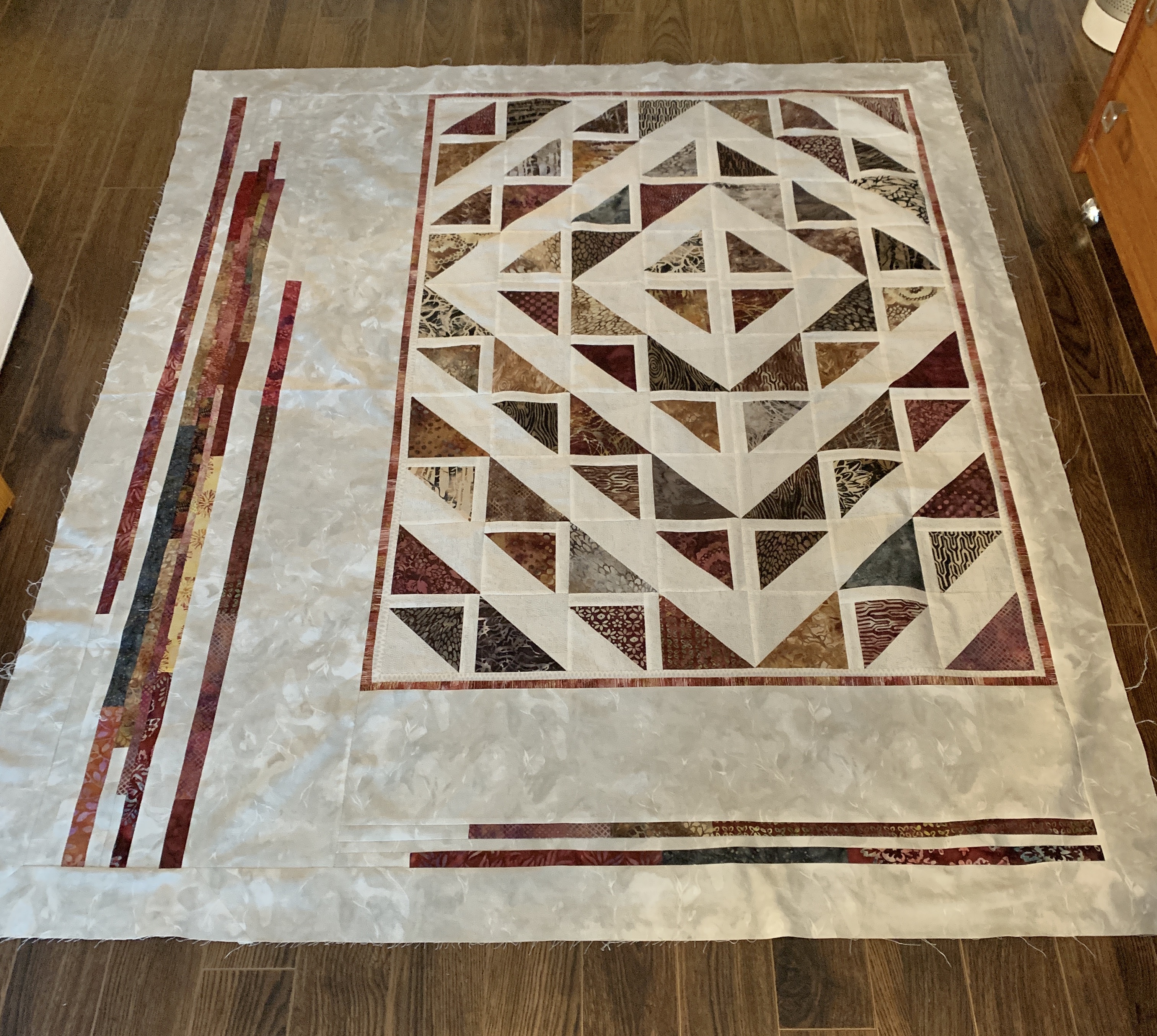
Charm Quilt Top

In the end I went with an on-point square layout set off-centre.

7 x 10 HST Panel

However, the finished panel was too small, even with 3.5″ borders, to be a good size throw quilt. So what to do with it…

I had used all of the white/grey background fabric I had, I had no batik charms left. I also thought the 8 x 10 array wasn’t rectangular enough, so I removed one of the columns – set it aside to use in the quilt back.

Next, I decided to use the panel offset to one corner and create narrow pieced stripes in the wide border to the left of the panel as an accent for the HST array.

Completed Quilt Top

To build out the quilt, I added 9″ of backing fabric (a different pale grey/white fabric which blended with the original fabric) to the bottom of the panel so I knew the length of the  side panel. Then I began building pieced strips from everything I could find in my stash which blended, or implied, burgundy – the focal colour of the batik charms. I offset the strips by varying amounts from either the top or the bottom of the side piece by inserting appropriate amounts of backing fabric into the piecing. I completed the wide side border with a wide strip cut from the length of backing fabric to avoid a large, obvious mitre across the middle of it.

Finally I added a 3.5″ mitred outer border.

Now I’m ready to construct the backing. I bought a darker grey/white printed fabric for backing. I have a 4.5″ strip of HST I removed from the panel. I haven’t measured the panel width but I’m guessing it’s close to 54″ wide. So my insert panel will need to be at least 12″ wide.

No idea yet how the back will shape up. That’s for tomorrow.

Another HST Quilt

Two weeks ago at class one of the gals gave me a batik charm pack in exchange for the materials I’d given her. The batiks – five related colours – all felt “burgundy”. I thought they’d work with a light background. I decided to create unequal half-square triangles.

I raided my stash of larger fabric pieces and found a remnant of a white with grey fabric from the Zen Chic Fragile Collection.  I measured it carefully – thought I had enough for 40 5″ squares, plus sashing pieces; I started cutting. Turns out I was close, but I had to hunt through boxes of scraps hoping to find a wee bit more – luckily I found exactly enough to scrounge 8 more 4 1/2″ sashing pieces. That was it – there are no scraps of any kind left! This fabric collection, this colour in particular, were popular and are nowhere to be found. Trust me, I looked for hours online.

Stitching Unequal HST

To construct the unequal HST I marked the diagonal, then another parallel line 1/2″ to one side. I chain stitched the diagonals, cut the blocks apart, chain stitched the second line, cut them apart. Then cut between the two lines of stitching. After pressing the blocks open, I added a 1″ sashing to two sides of the smaller triangles.

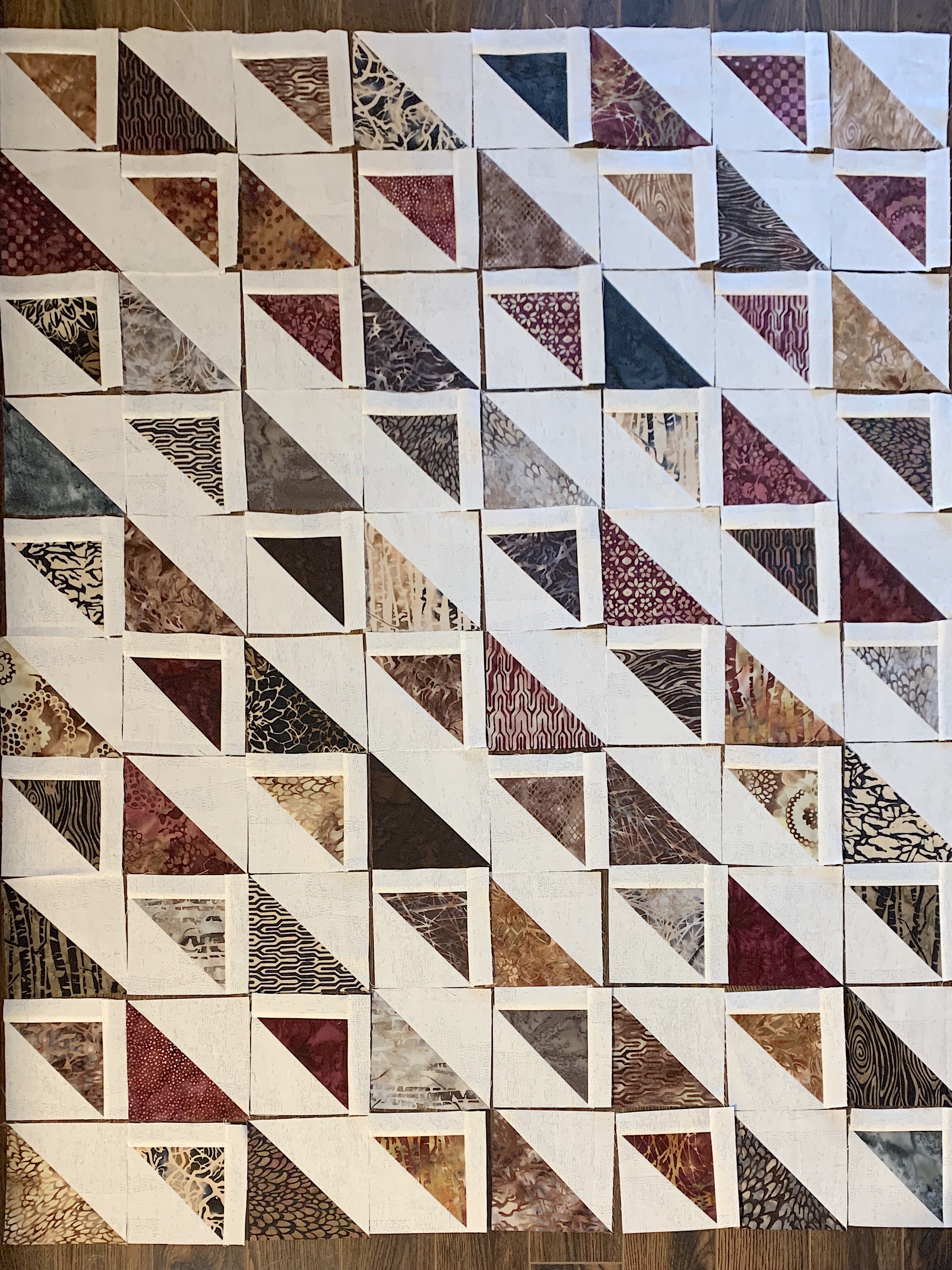
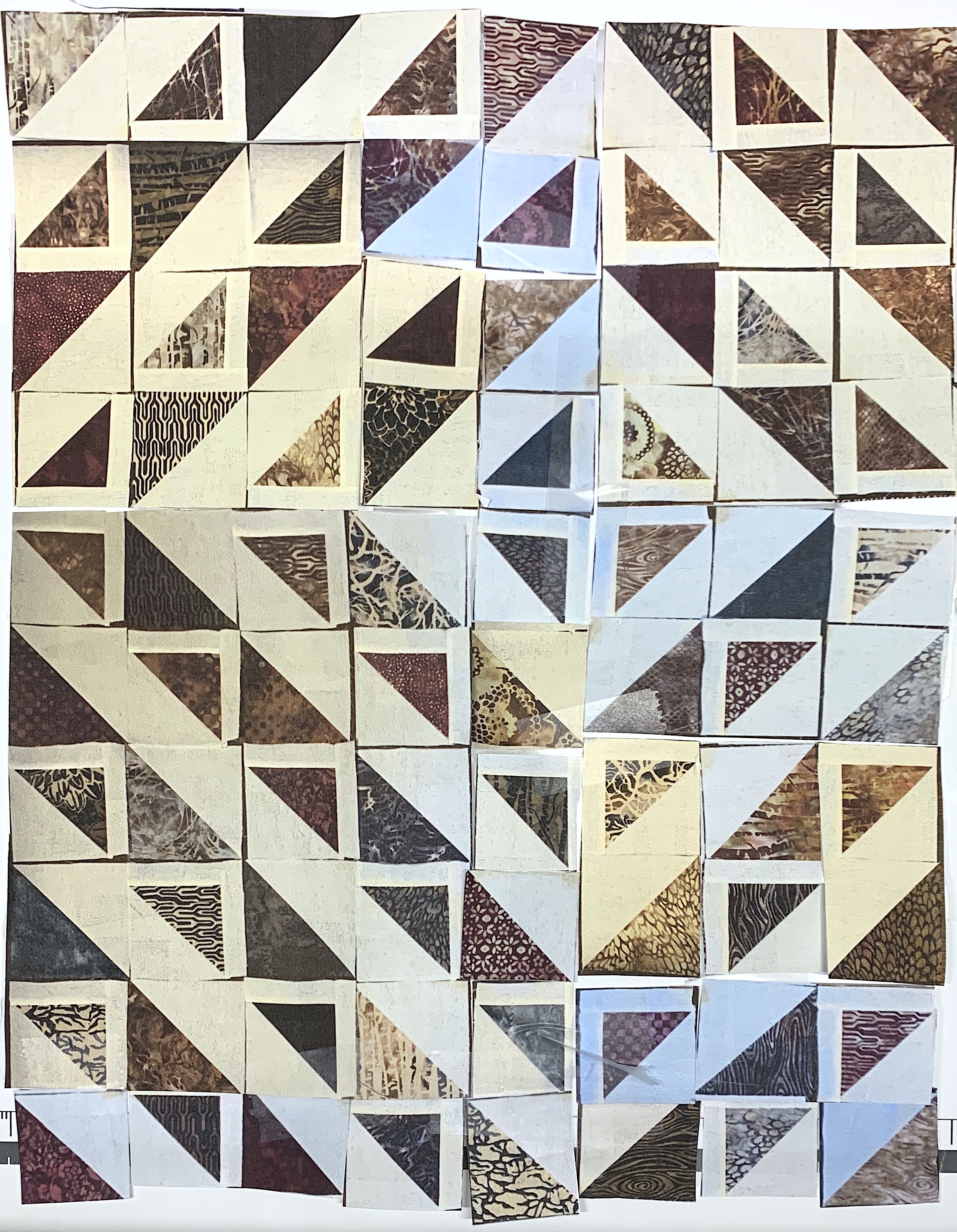
I’ve interleaved larger and smaller triangles and this is the 8 x 10 array I currently have on my floor. Kinda interesting….

Current Layout On The Floor

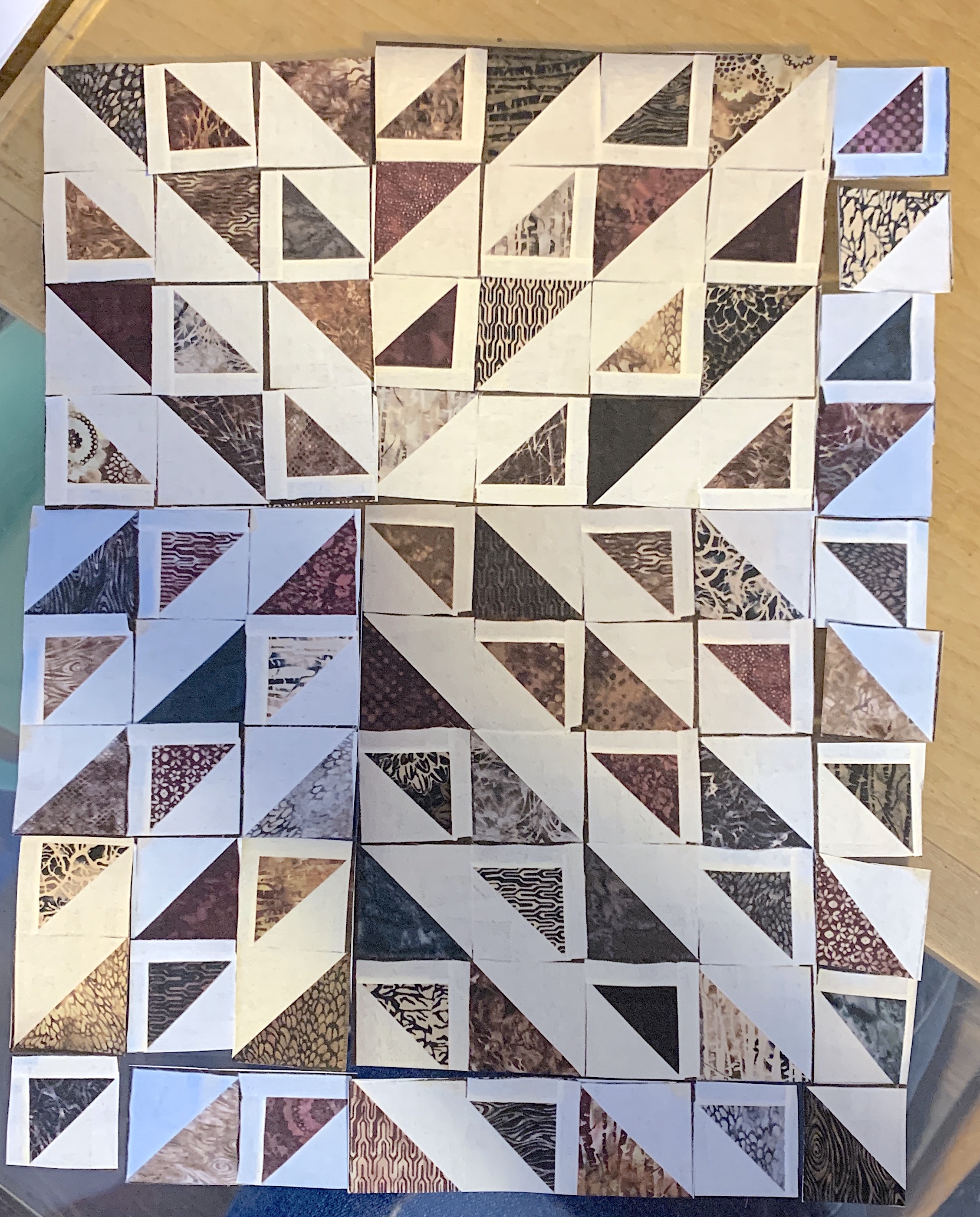
I decided to see what other arrays are possible. I took a photo, then cut the paper into sections so I could try other arrangements:

Pinwheel Array

The pinwheel is off centre (centre is at position 4/3). While the centre should provide focus, it doesn’t seem to in this case – what’s there is too busy.

Next layout:

Chevrons

The chevrons work better – the white lines draw your eye in toward the offset centre. However, this layout requires two smaller triangles which I don’t have. I have two of the larger triangles but not a single scrap of fabric to convert them into smaller triangles – no fabric to construct sashing!

I’ll probably stick with the array I currently have on the floor – I need to leave it there for a day or so to make sure I’m happy with the colour distribution.

I didn’t say the reason I’m doing this quilt is so I can demonstrate for a class in early February how to “quilt-in-the-hoop“. I need both a quilt top and back to do this. Stitched, this array is going to be on the small side (but with no more burgundy batik squares and no more backing fabric to extend the size by a row/column or two, I will enlarge the panel with an inner sashing and a wide outer border so the finished size lands somewhere between 40″-45″ x ~55″- 60”.

I have a piece of complementary burgundy fabric large enough for sashing; and the other day I bought a metre of soft grey which should work for the border. I’m thinking a hidden binding from the main backing fabric might be in order because I don’t think I want to define the outer edge of the quilt with another strong colour.

First to assemble the blocks into a panel. I’ll work on that tomorrow.


Another possible layout:
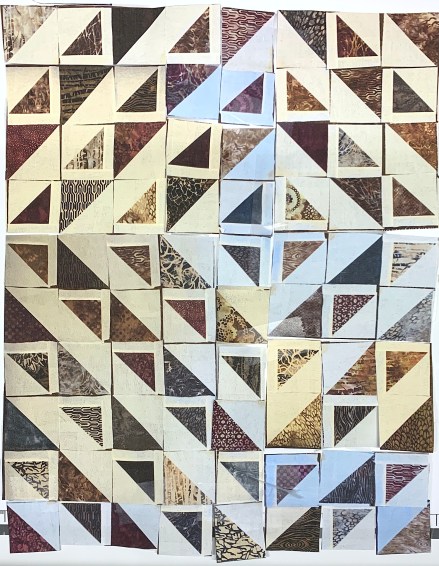
Diamond

This one works – and I’d complete the diamond on the right in the border (including a narrow sashing all around up to, but not including, that point…).

Hmmmm.

[BTW – I’ve been doing these different layouts by cutting a paper printout of the layout currently on my floor and holding it together with tape – no need to spend time on the floor arranging and rearranging blocks! The reason for placing my layout on the floor – my cutting table is too narrow to hold the width of the panel and I don’t have a space where I can hang a flannel design wall. I suppose I could set up a flannel panel and use weights to hold it in place on the floor – that could help keep the blocks from sliding around – but I’d still have to be on my knees to work with it.]
Finishing Wall Art

I’ve finally got around to creating instructions for adding borders and piping to a textile wall art panel as well as instructions for hidden bindings.

It took some time because I had forgotten to take photos as I added the borders etc. to the Iris panel last week.

This morning I took a small panel I’d made quite some time ago, removed the backing, and added borders & piping and a hidden binding – and I took pictures along the way to illustrate the process! Finally. I did it because the panel wasn’t really finished and I needed something already assembled (instead of taking the time to construct something new) so I could take photographs as I did the work.

If you’re interested here are links to the PDFs

Blue / Rust Socks

Finished these socks a couple of days ago. I have a couple of sweaters they’ll go with nicely so I decided they should live into my sock drawer.

Blue/Rust Socks

When I went to put them on they were just a bit on the long side in the foot so I threw them into the wash with the other socks I’d worn last week. (BTW, I put all my socks into a mesh bag so they don’t get beaten about in the washing machine; and I DON’T put them in the dryer. I hang them over a rack to dry.)

The important thing to remember is to change the water temperature of the load you include them in to COOL, otherwise you run the risk of matting and shrinking the yarn if the water is too warm.

I’ve put a label on my washing machine “Remember To Change Water Temperature” in large letters to remind me to set the water temp to cool when I do a load that includes socks.

If all you have is a couple of pair of wool socks then I’d recommend washing them by hand, wringing them in a towel, and hanging them to air dry somewhere. They’ll last a lot longer that way.

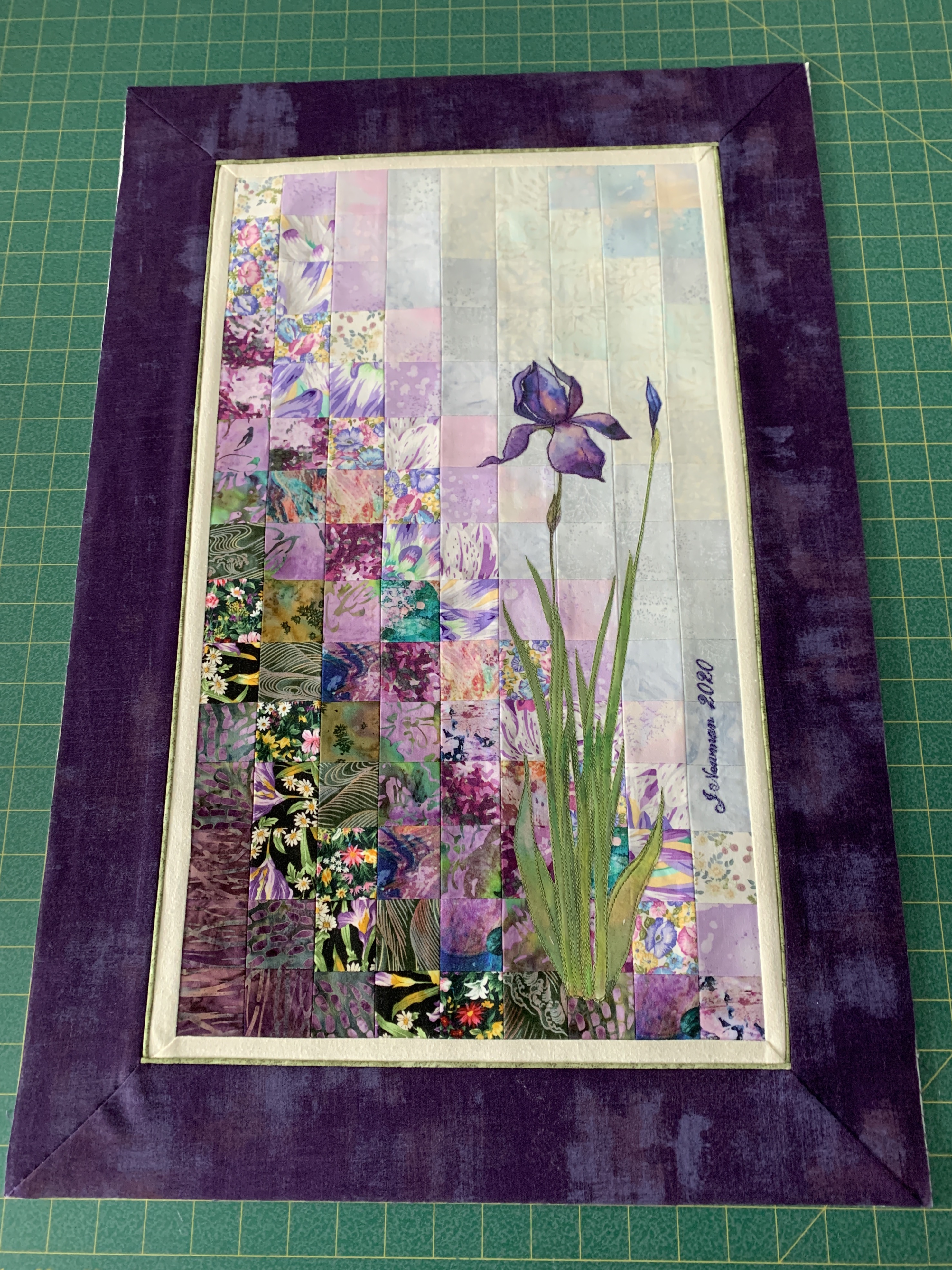
Iris

Yesterday, I enlarged and printed both the iris and its leaves on fabric then applied some Steam-a-Seam2 Lite (fusible web) to the back so the iris could be fused to the watercolour panel background. Last evening I fussy cut the iris, the bud, and the leaves.

Complete except for hidden binding

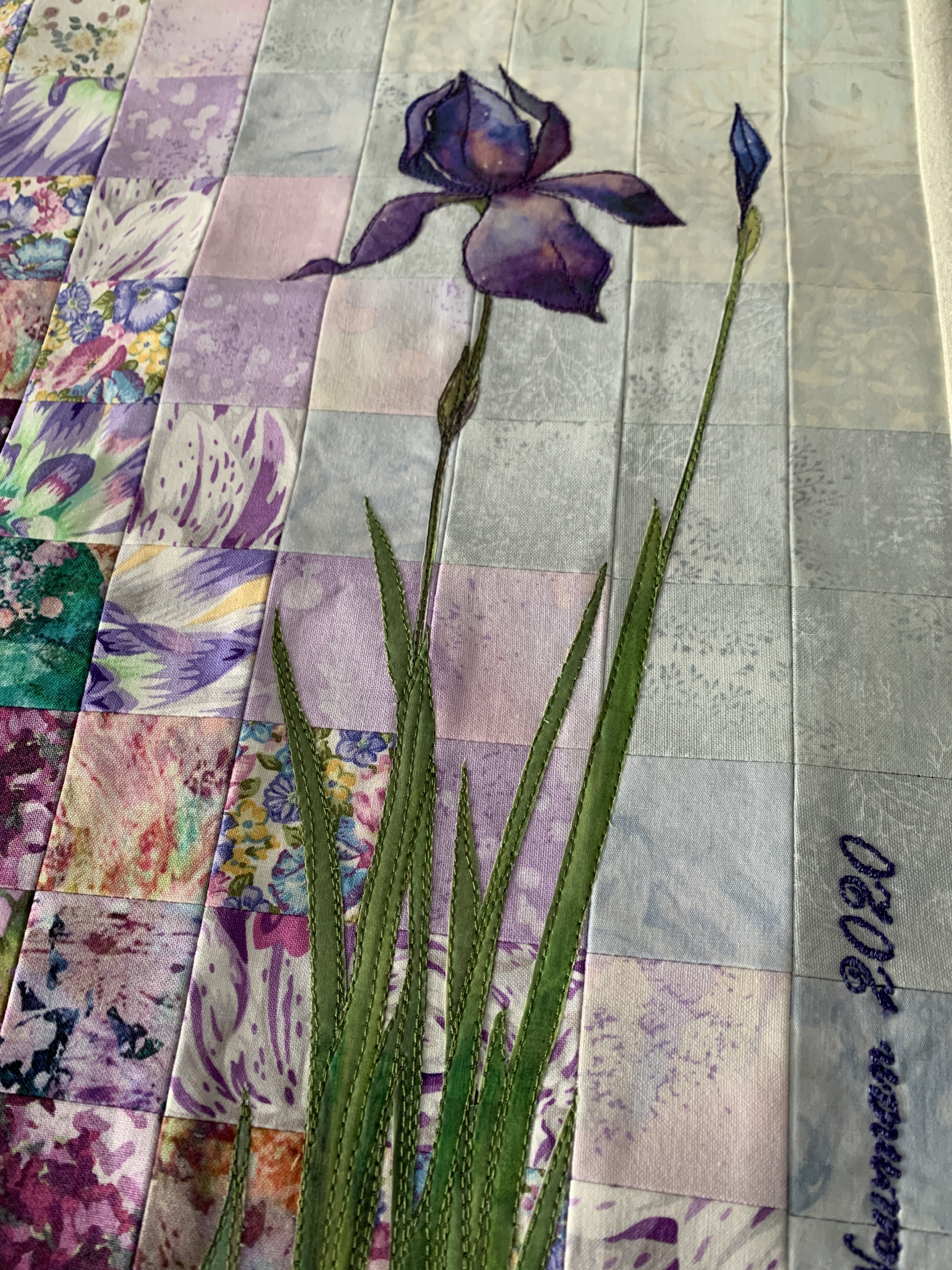
This morning I fused the appliqué elements to the panel, then thread painted them, taking care to edge stitch everything so the appliqué won’t lift  over time.

Iris – Thread Painting

Because the appliqué elements are rather small they didn’t want a great deal of stitching but I did want to work in a bit of shading on the leaves and on the flower – not so much that I obscured the shading within the appliqué.

I added a signature along the right side, then applied three border sections – first a narrow inner binding of natural raw silk, then small dotted green piping, last a 3″ purple grunge outer border.

All that’s left to do is add the hidden binding (I do have a small amount of purple grunge left but I’ll see if I can pick up 1/2m more because it’s a very useful colour to have on hand). Once the bindings are attached, I’ll insert a muslin backing and hand stitch the bindings in place on the back.

I will leave the piece as it is – while I can still lift the border to reveal the inner border construction. That will allow me to show the gals how I align the narrow border, and piping as I explain how I do it.

Yet Another Watercolour Piece

So I can demonstrate on Wednesday how I finish a hanging, I had to produce another panel for class. I had a clear idea of what I wanted to construct – a colour shading from dark purple in one bottom corner to very light in the opposite one. That was easier said than done – I had no suitable precut light colour squares; instead, I had to go back to my stash and pull out both large and small cuts of fabric in very pale colours that would blend with the purple range I was building. After considerable hunting and cutting, I was finally able to assemble a complete panel.

Once laid out, I stitched the rows (first sewing the 8″ panels together, then cutting apart each row, starting at one end, sewing and pressing each seam open).

Rows Sewn Together (Back)

Next I stitched the columns, again by cutting apart and sewing each column one at a time beginning on one side.

Columns Stitched, Seams Pressed Open

I pressed the seams open as I went along – first finger pressing, then pressing with the iron.

Completed Panel

I’m now ready to add a fused appliqué to the pale side of the panel – that’s for tomorrow. Once the appliqué is fused and thread painted, I will be ready to demonstrate how to add the three finishing layers on Wednesday.