Jeans #2

Back #1

Back #2

OK. Not impossible. I took a deep breath and unstitched the waistband (which I’d put on upside down). Turned it around, stitched it back on. Added the waistband facing and stitched it down.

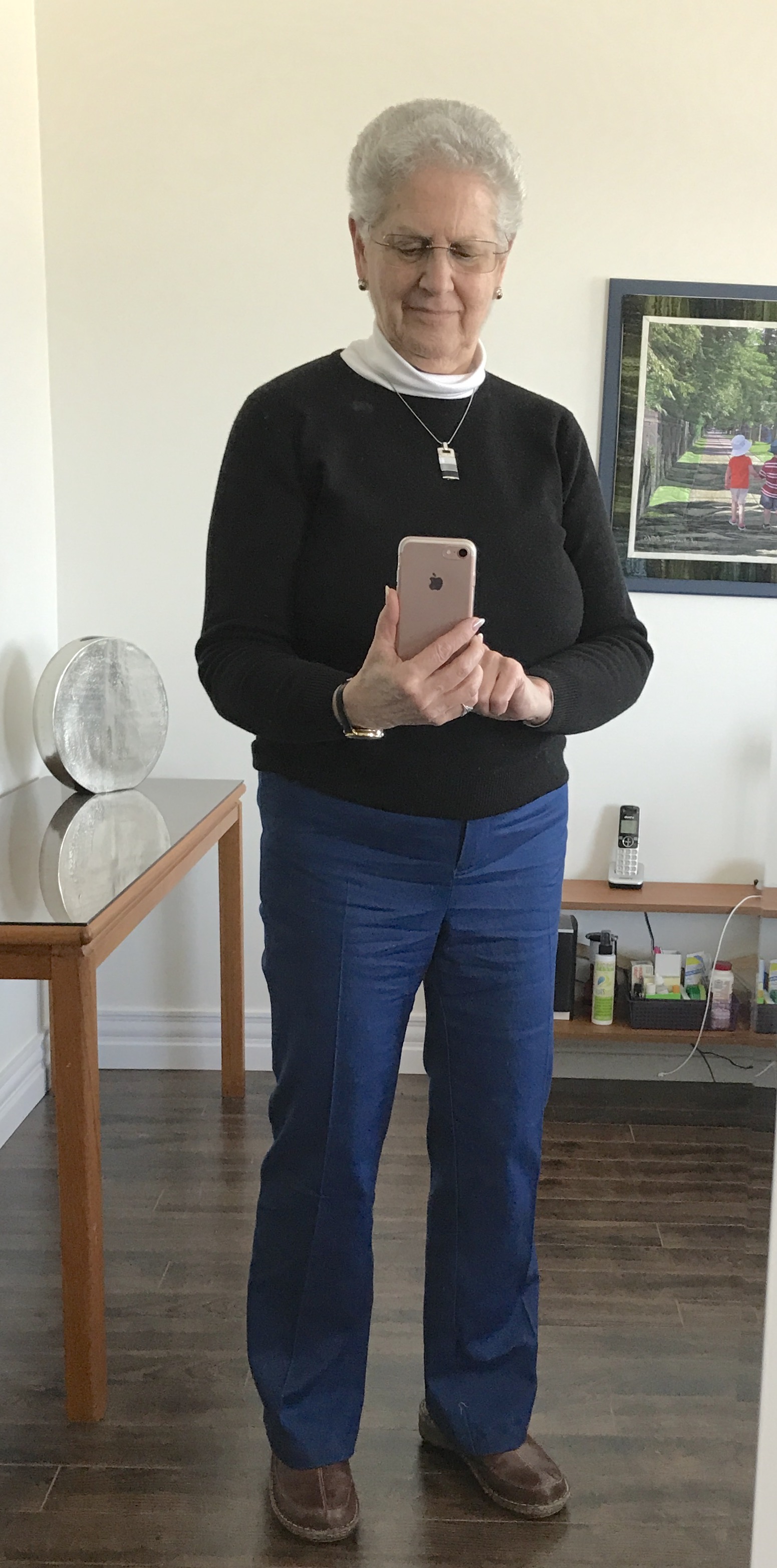
I did it, not to salvage the pants – there are problems with how the back of the legs is hanging (because of the fact that the side seams are out by 2″, right?). It’s the bum I was interested in and I can see it’s not bad (click on the images to see the fit more clearly). Had I done the construction correctly, the back would be fine – except for the pockets which are too low – for me, the pockets have to be almost on the yoke seam and not 2″ below which they are (which means I have to attach the yoke before putting the pockets on the back). If raised, the point of the pocket would be in a better location.

There’s also a problem in the front –

Pants Front

the front waistline has to be dropped half an inch – with it that bit too long, the front crotch has “smiles” – which is something I definitely don’t want. (Part of the “smiles” is because I’ve been sitting in them while writing this – but I will shorten the front rise that 1/2″ in the next pair).

Also I’m rethinking adding 1/4″ to each side seam – having had the pants on for 15 minutes I think the legs may actually be fine as they are (given the 20% stretch in the fabric).

Other than that, the pants aren’t too bad. They have served well for a muslin. Nevertheless, they’re still going into the “send to Value Village” pile – but the NEXT pair will be PERFECT! Really.

Weekend Failures

Two Failed Sewing Projects

I’ve been working at trying to get pants to fit me for a long time. I made my last pair last winter (I’m actually wearing them at the moment). Since then my waist has expanded a bit, my bum is still many sizes smaller, my inseam hasn’t changed… So instead of adapting my old pattern I decided to try a new Jeans pattern. I chose the Jalie 2908 – Women’s Stretch Jeans (I’d read good reviews).

I laid out the pattern pieces, saw I needed a size Z at the waist, a size U at the hips and a size R for the inseam. So I traced the pattern, making the adjustments between sizes using my trusty French curve, cut out the pattern pieces, cut out the light blue fabric (which I’d bought on sale and was treating as muslin) and put the pants together.

For me, the trouble with pants is I can’t baste them together and have any idea whether they fit – I have to put in the fly zipper, the pockets, add the waistband, even hem them (because the legs don’t hang correctly even pinned at the correct length) – in other words make the pants – before I know whether the pattern works or not.

I was using a stretch denim twill (20% stretch called for in the pattern) and the resulting pants were just ill-fitting! I didn’t bother with buttonholes in the waistband (all that was left to do) – I put the pants in the “off to Value Village” pile. (I will try the pattern again but probably not before the summer.)

That was Saturday.

Sunday, I went back to my Sandra Betzina Jeans pattern (V7608), redrafted the back panel yet again – last version had a long dart down the centre back of the leg from just under the bum to the top of the knee. I wanted to remove that excess fabric, instead, from the side seam and the inseam. Once I had the pattern retraced (with adjustments) I cut out my darker blue stretch denim/twill and constructed the pants.

I was doing a great job – put the decorative stitching on the pockets, attached them to the back panels, added the back yoke/waist. Attached front pockets and fly – both without a hitch. Time to join front and back – and here’s where I went disastrously wrong. I forgot to attach the front waistband before doing anything else!

I had stitched the front crotch so putting in the zipper was easier; I now stitched the back crotch (you get a slightly better fit if you sew the inseams first, then the crotch seam but in my head I was working on a second muslin and decided ease of inserting zipper trumped finessing the fit). I sewed the inseams, and the side seams – without the front waistband in place. Even though the front side seam was 2″ shorter than the back side seam (I trimmed away the excess on the back) then I stupidly serged both side seams – without questioning why the length difference. It was only when I reached to attach the waistband that I saw my mistake.

I stopped sewing. I made a quick trip to the fabric store to pick up more of both blue stretch denim/twills since I still had valid sale coupons and the fabrics were themselves still on sale. Planning on starting over – paying careful attention to what I am doing!

Today, I tried removing the “waistband” portion of the back yoke on the darker blue pants, tried adding a full waistband – only to see that I’d attached the waistband upside down! Not meant to be.

The pants would have fit quite well had I assembled them correctly. What I did learn is that although the legs fit not badly, I probably should add 1/4″ to side seam from the hip to the knee – in other words, take a bit less off the sides (I can always take them in – can’t let them out). These legs fit rather snugly.

So taking a deep breath, I’ve washed and pressed the new fabric and am ready to start over. Planning to assemble the parts in the right order this time.

Small Zippered Bags – Again

Three Different Fabrics

I made 40 small zippered bags before Christmas. During the holiday season I gave most of them away. Two days ago I went to my bag stash to pick out one to give a friend and realized I was down to just four bags. Time to make more!

Yesterday, I bought three half-meter pieces of bright fabric, raided my quilting fabric for a length I didn’t like any more to use as lining, cut batting from a large piece left over from a recent quilt, cut lengths of zipper tape, and 2 1/2″ pieces of grosgrain ribbon for a small tab on the side. An hour later I was set to go into business.

This morning I went into production – three hours later I had eighteen 6″ x 8″ bright zippered bags. 

I’m getting organized at this mass production thing – I resisted the temptation to do all the steps on individual bags; I completed each production step on all eighteen bags before moving on to the next. The whole job went quickly.

However most of my sewing/quilting is focused on unique constructions so what I’ve learned from bag production line isn’t much help for the other sewing I do.

Second Pieced Demo Pillow Cover

Finished Pillow Cover Top (Starburst arrangement)

Finished Pillow Cover Top (Starburst arrangement)

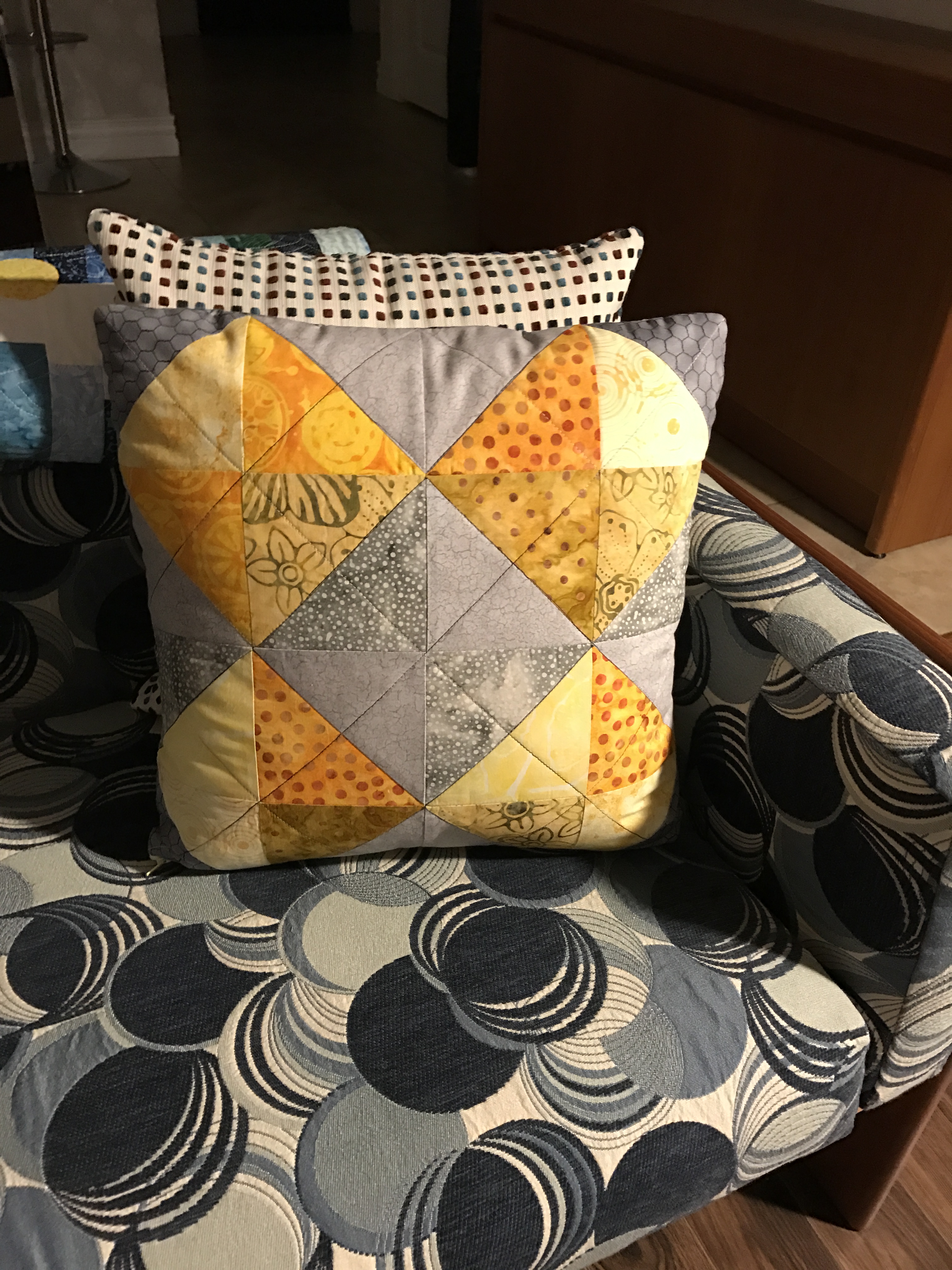
Here is the second pieced pillow cover as a demo for the gals interested in having a go at some sewing in ten days time. I had finished the 16 half-square-triangle blocks yesterday, I assembled them into a 4 x 4 array this afternoon. Added batting, stitched in the ditch around the “star” elements to quilt the cover top. Found a fabric for the back, cut batting – my original cut was 16″ – I needed 16 1/2″! so I had to cut a second piece of both batting and fabric. Quilted the cushion back along diagonal lines in both directions.

This time I applied an invisible zipper (I’m actually thinking about taking the first pillow apart and inserting an invisible zipper into that one – I bought a second one for that purpose this afternoon).

Back of Finished Pillow Cover

Back of Finished Pillow Cover

I’m about to sit down and write instructions for making a 16″ pillow cover from 10″ fabric blocks (layer cake size).

  • Step 1: Mark both diagonals
  • Step 2: Stitch 1/4″ on each side of both diagonal lines
  • Step 3: Cut along diagonal lines, then again on both the center vertical and horizontal lines which yields eight 4 1/2″ half-square triangles – perfect for this size pillow cover.
Mark Diagonals, sew 1/4" from line on each side

Mark Diagonals, sew 1/4″ from line on each side

Here’s a tip for making a pillow cover – don’t sew the corners square. I happen to own this Dritz Pillow Cover Template (I’ve had it for years!). As you can see, it rounds off the corners removing about 1/4″ – 3/8″ from the corner. This rounded corner looks square when the cover is stuffed with a pillow. You don’t get those pointy “ears” on the corners. I trimmed my corners on both the yellow pillow cover yesterday and the one I just finished.

Corner Shaping Template

Corner Shaping Template

I applied my zipper along the curved edge just fine, when finished the zipper edge looks square as do the other three sides.

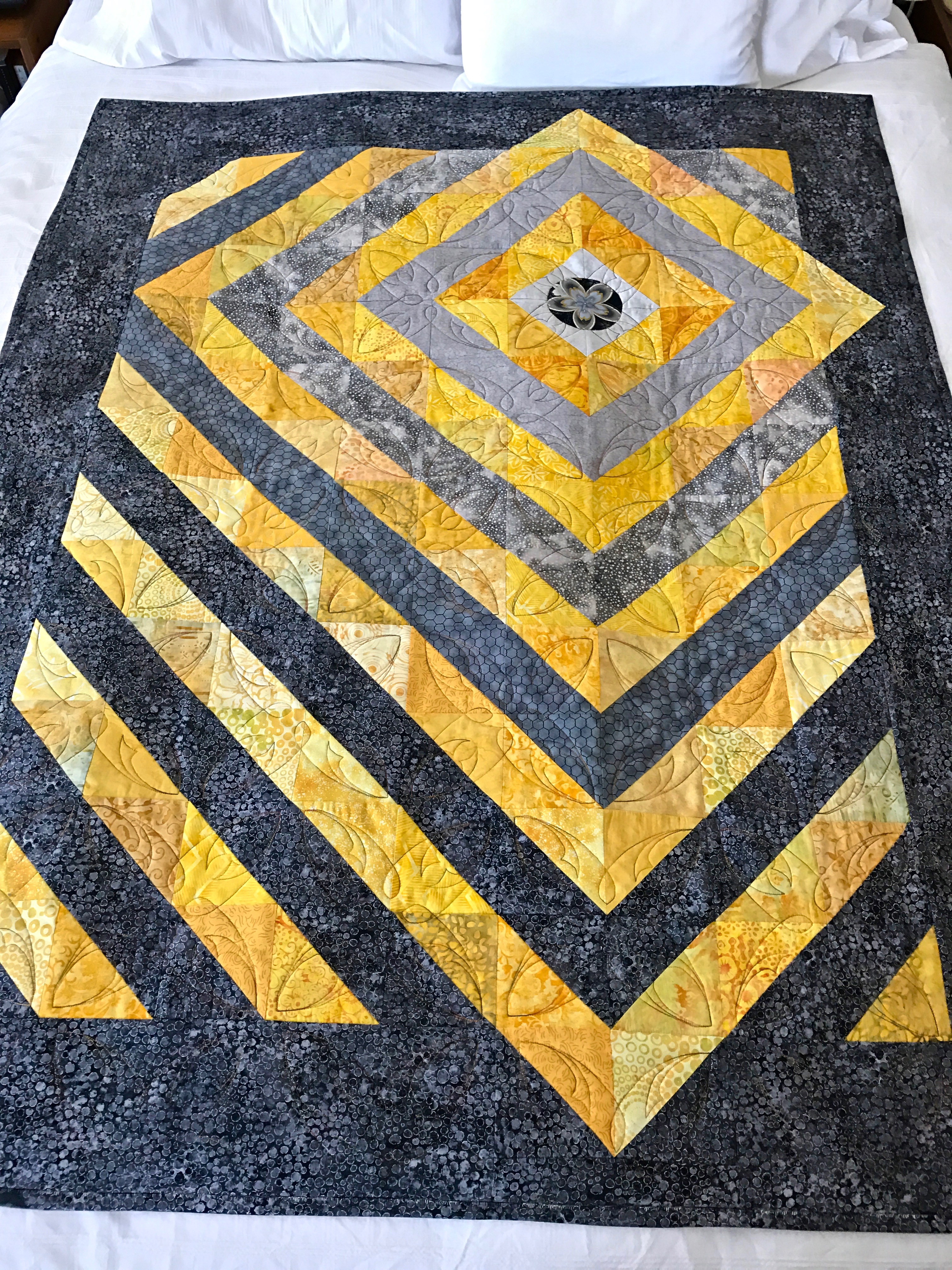
Grey-Yellow IV

The grey-yellow quilt is finally quilted and bound. Before I left for Toronto, I’d assembled the quilt sandwich, pinned the layers, intending to get back to work on it as soon as I got home. Didn’t happen. We had a couple of severe snowstorms, I came home with a dreadful cold that triggered my asthma, so I spent the better part of 10 days doing little other than coughing.

Finally, last Monday morning, I managed to go to the pool for my regular water aerobic class (I coughed quite a bit, but managed to breathe well enough to stay for the hour). Afterward, when I got home, I looked at the quilt and decided it was time to get back to work on it.

img_8519

Quilt Top

I fused and appliquéd the circle detail in position, and quilted the immediate surrounding block but didn’t get much further till the end of the week when I managed to get the rest of the central blocks quilted. Sunday, I quilted the border. This morning, I added the binding and label.

img_8524

Quilt Back

Done!

I still had a bunch of half-square triangles left over. I decided to use them for a pillow cover. Last week one of the other sewers in our Friday afternoon knitting/sewing group and I offered to assist those gals interested in making a pillow cover with piecing some half-square triangles into a 4 x 4 block. Five indicated some interest so Debbie and I are planning a sewing Friday in my sewing studio to make zippered, pieced pillow covers.
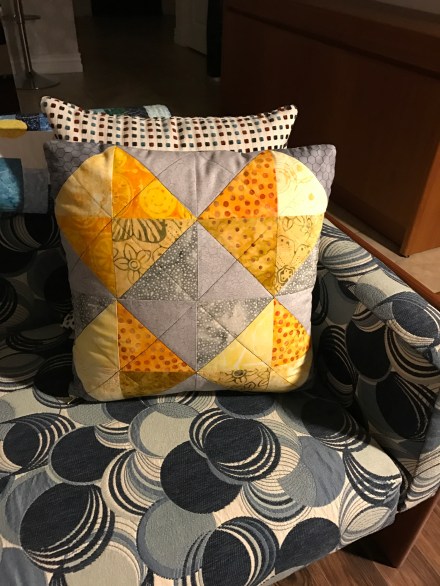
img_8525

Pillow Top

I started by gathering together all my leftover blocks – I had 13 constructed which I laid out in a 4 x 4 array – I made another four blocks being careful to use the appropriate grey fabrics so I could build some symmetry into my layout. I used my darkest grey in the corners, distributed the other two shades evenly, then sewed the blocks together. I added batting, and quilted along the diagonals to build some stability into the top. Next I cut a 16″ square piece of batik which I also backed with batting and stitched on the diagonal.

img_8527

Pillow Back

I trimmed the corners of both the top and back, slightly rounding them off, to create the illusion of ‘”squareness” when a 16″ pillow would be stuffed inside the cover. Finally, I added a zipper (a regular zipper, not an invisible one) to one end, unzipping it before sewing the two sides and the opposite bottom end.

Our instructions to the women were to purchase just two contrasting fabric from which to construct their pillow top. Here, I’ve used several yellows and three different greys. So, I decided, my next pillow cover had to be constructed from just two fabrics. I dug through my stash and came up with a somewhat dark blue/turquoise batik but I had nothing light to complement it, so back to the fabric store to buy 1/4 m. of a light batik.

I cut each of my two 10″ width-of-fabric pieces into four 10″ squares – paired light and dark blocks, marked the diagonals, placed right sides together and stitched 1/4″ on both sides of the diagonal lines. Then I cut along the diagonals and both the horizontal and vertical mid-lines to get eight 4 1/2″ half-square triangles from just two 10″ blocks! All I need for one pillow top is four 10″ blocks (two of each fabric). I’ve got those done and laid out ready to stitch, which I’ll do tomorrow.

I have already cut fabric for the pillow cover back, and batting squares for both top and back. I still could use an 18″ invisible zipper (I like using zippers that are longer than I need so I can ignore the slide when sewing them in place, trimming them after I’ve completed the side seams). It’s not that I don’t have tons of #3 zipper tape (and slides) from which to make an appropriate length zipper, but if I use an invisible one, you’ll barely see it when I’m finished. Besides, both Debbie and I think the gals will be pleased with themselves for having actually sewn in an invisible zipper which is not difficult to do.

So more tomorrow after I finish my second demonstration pillow.

Sunflower I

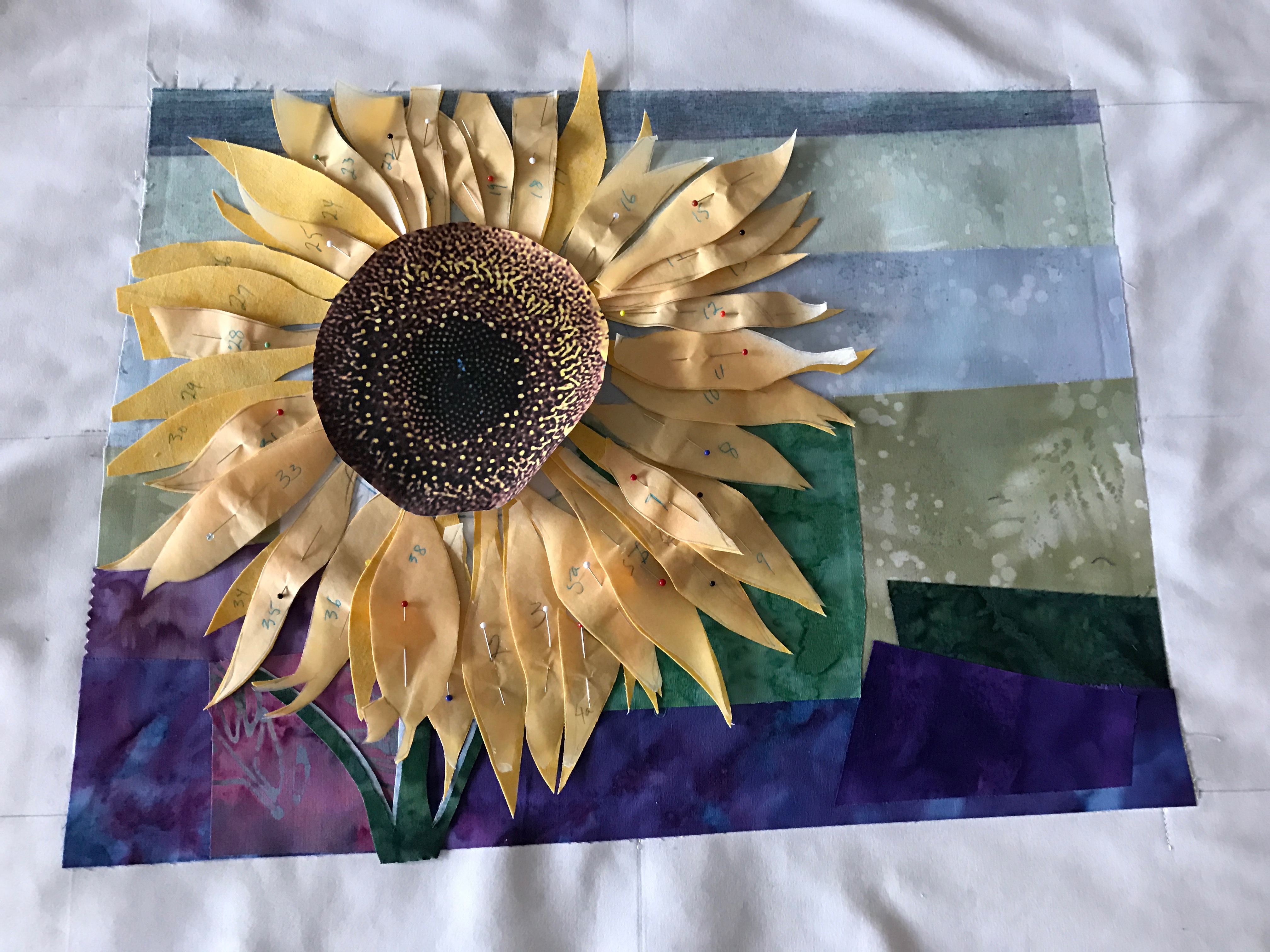
I’ve been working on the “Sunflower” art quilt for the past few days. I pencilled in the layout on the prepared muslin backed with batting, traced the flower petals from a photo enlargement on to tissue paper then placed tracing paper beneath to retrace onto the muslin, fused some Heat ‘n Bond to the back of a piece of subtly printed bright yellow fabric, cut out all 38 petals and have so far put them aside because before I can fuse them in place I need to do all the work on the background! For the moment, I’m placeholding the centre of the flower with a paper printout to scale.

img_8291

Petals Pinned In Place

I decided to create the background working from the original photo because the detail was sharper and showed the elements in the background more clearly. I fused a pale green printed fabric to the top of the image area on the muslin (having darkened the top edge using fabric pastels – very little of that band will show when the piece is finished). Below that a soft blue. I laid in a purple/blue/pinkish batik strip as background at the bottom of the piece – leaves will be overlaid on that fabric and very little of it will be visible. I filled in most of the remaining background with pieces of greens and purples. These, too, will be mostly covered. Again, I’m using tissue paper for my templates so I can see through it to the photo enlargement, and when cut out I can see the fabric pieces beneath. I want to cover all the raw edges of the background with the foliage so that only a sense of colour peeps through.

sunflower3

Original Sunflower photo taken in 2002

Once I sorted out what fabrics I wanted to use for the foliage, I returned to working from the cropped enlargement to help me retain proportions.

Version 2

Enlarged, Cropped Image

I traced the leaves and have pinned the tracings in place on the piece. I’ve selected mostly batiks here because the colour variation in it will help with the subtlety of shading I’m trying to create. In the photo, the leaves are predominantly a very light colour reflecting the sunlight. The challenge will be achieving a realistic look to the piecing of the foliage. If, in the end I don’t like what I’ve got, I may print the foliage on fabric, fussy cut the leaves and stems, fuse that printed fabric in place and thread paint it.

Planning Out Leaves and Stems

Planning Out Leaves and Stems

I’m calling it quits for today – tomorrow I’ll begin crafting the leaves and stems hoping they will turn out as I imagine them.

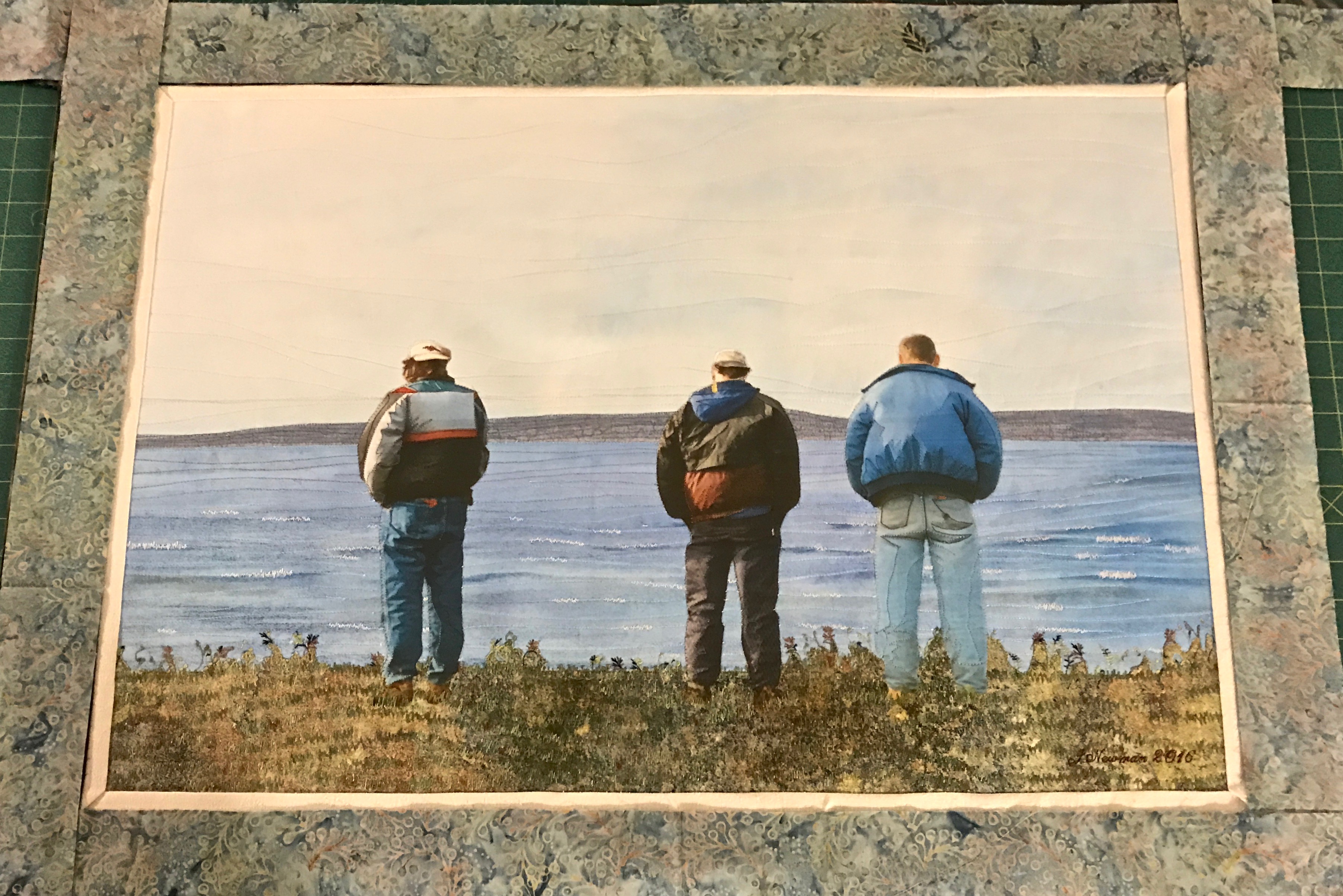
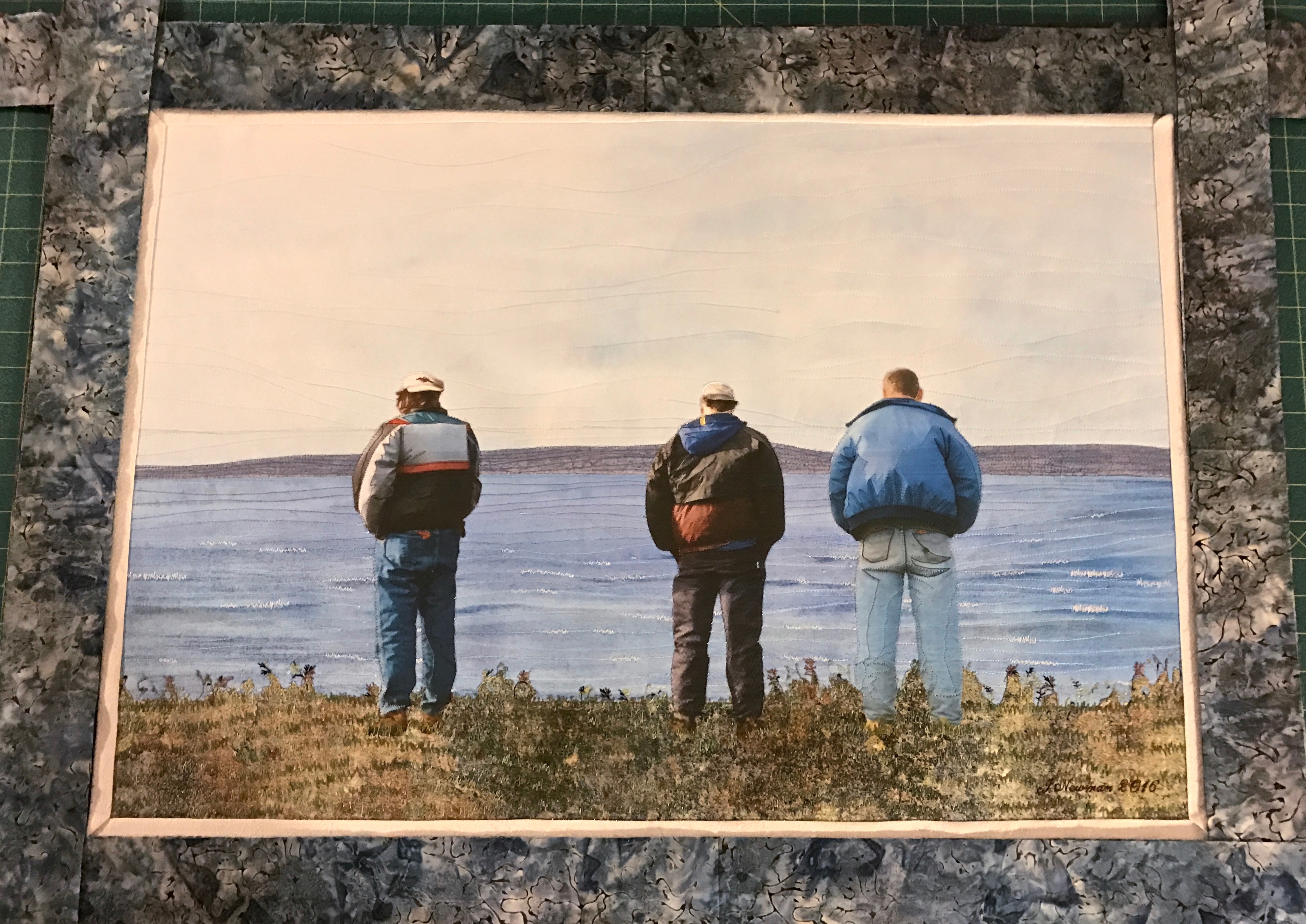
Wind Waiting – Done!

img_8272

Wind Waiting, 2017

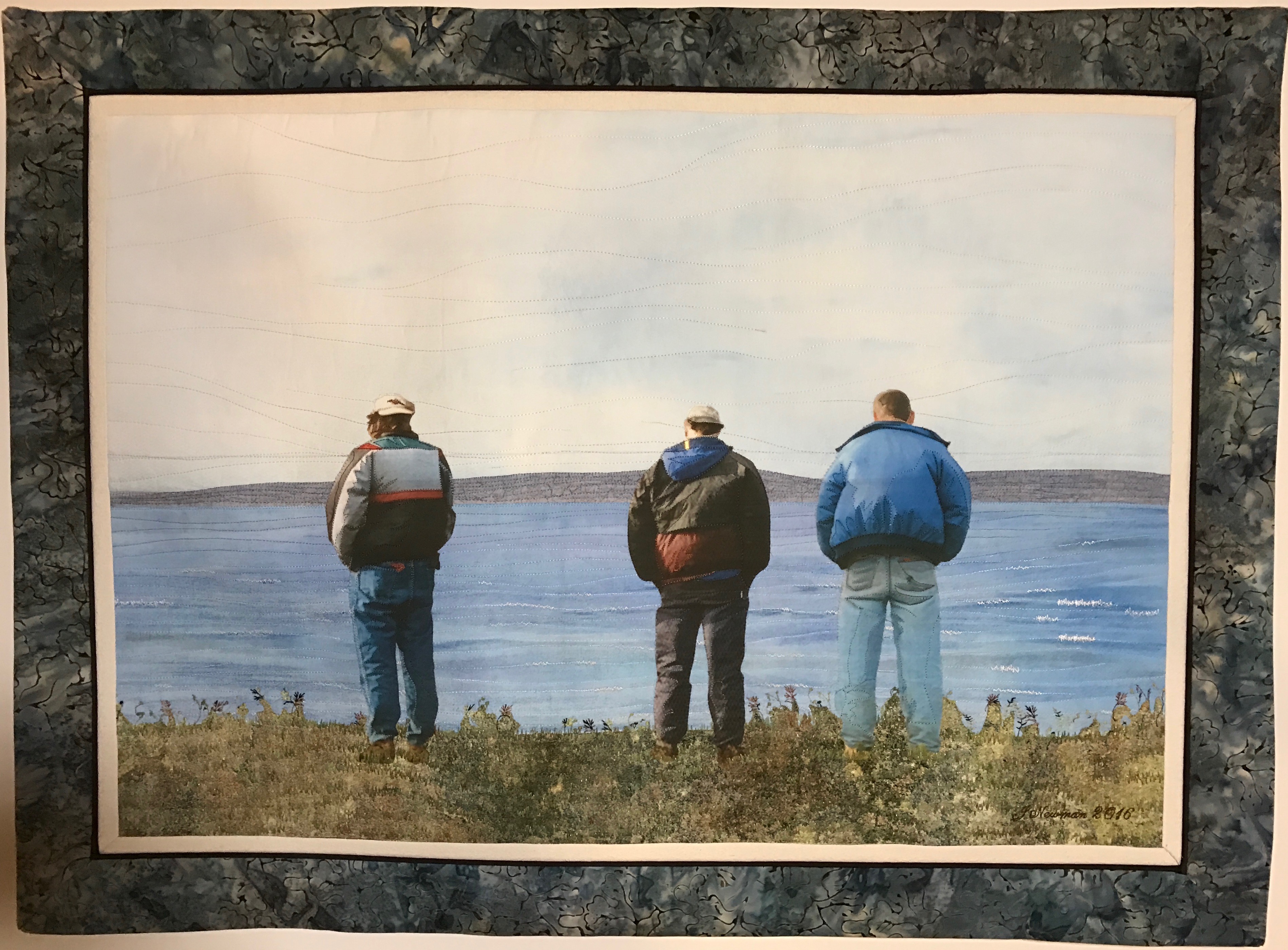
Just finished! (Click on photo to see the enlarged photo – the panel is laying on my bed which accounts for the receding top)

This morning, I trimmed some threads, added a bit more stitching to the guys. Then off to the fabric store to see what I might find in the way of fabric for the border. Neither fabric store near me had anything better than the three possibilities I’d pulled from my stash. In the end, after consulting with the gals at Sew With Vision, I decided on the “mid” colour intensity option. One of the gals had a good suggestion – what about adding piping between the inner and outer borders?

Great idea! Sew With Vision didn’t have any solid fabrics that worked, so I went down the street to Atlantic Fabrics. They had a dark grey/brown Kona cotton which matched the browns in the border fabric perfectly. I auditioned various shades of blue, some greens. I even tried a black, but the best choice was definitely the brown.

img_8273

Piping detail

I knew before I started I’d have to make the piping – actually it’s not a difficult job when you’re using a piping foot – I turned out four strips of piping very quickly. The secret to applying the piping is to do it in two steps – attach piping first, then border fabric on top of that. I measured 1/2″ from the inner edge of the inner border, marked it with a heat erasable pen, lined the inner edge of the piping against my line and stitched it in place. I trimmed the excess piping as close to each corner as I dared, then marked 1/4″ on the piping fabric, aligned an edge of the border fabric (2 1/2″ strips) and stitched a second time. I ended with a very neat, narrow piping with the border fabric abutted directly against it.

Then I added a muslin backing. I trimmed my muslin to the same dimensions as the panel, pinned it, and stitched the layers with the muslin on the bottom so it would not shift position. I added a sleeve for a dowel/curtain rod at the top, incorporating it into the top seam. Finally, I turned the panel right side out, pushed out the corners, pressed it flat, hand stitched the opening in the panel bottom as well as the bottom edge of the rod sleeve at the top. When the wall hanging was turned right side out, the muslin backing was a wee bit larger than than the panel, so using a zipper foot, I carefully pulled back the piping from the inner border and stitched all layers as close to the piping as I could so it wouldn’t show. That seam was successful – the muslin doesn’t peep out along the bottom edge of the panel.

Now to find a place to hang it!

img_8276

On the wall

Wind Waiting – Almost Finished

I spent the entire day working on the pilots wall hanging. It took a good part of the morning strengthening the white caps on the Bay of Fundy which is always windy. More difficult than doing this embroidery work without the pilots in place – I had to work up to the edge of a figure, end the thread, start again on the other side. When done in the right order it’s clear sailing.

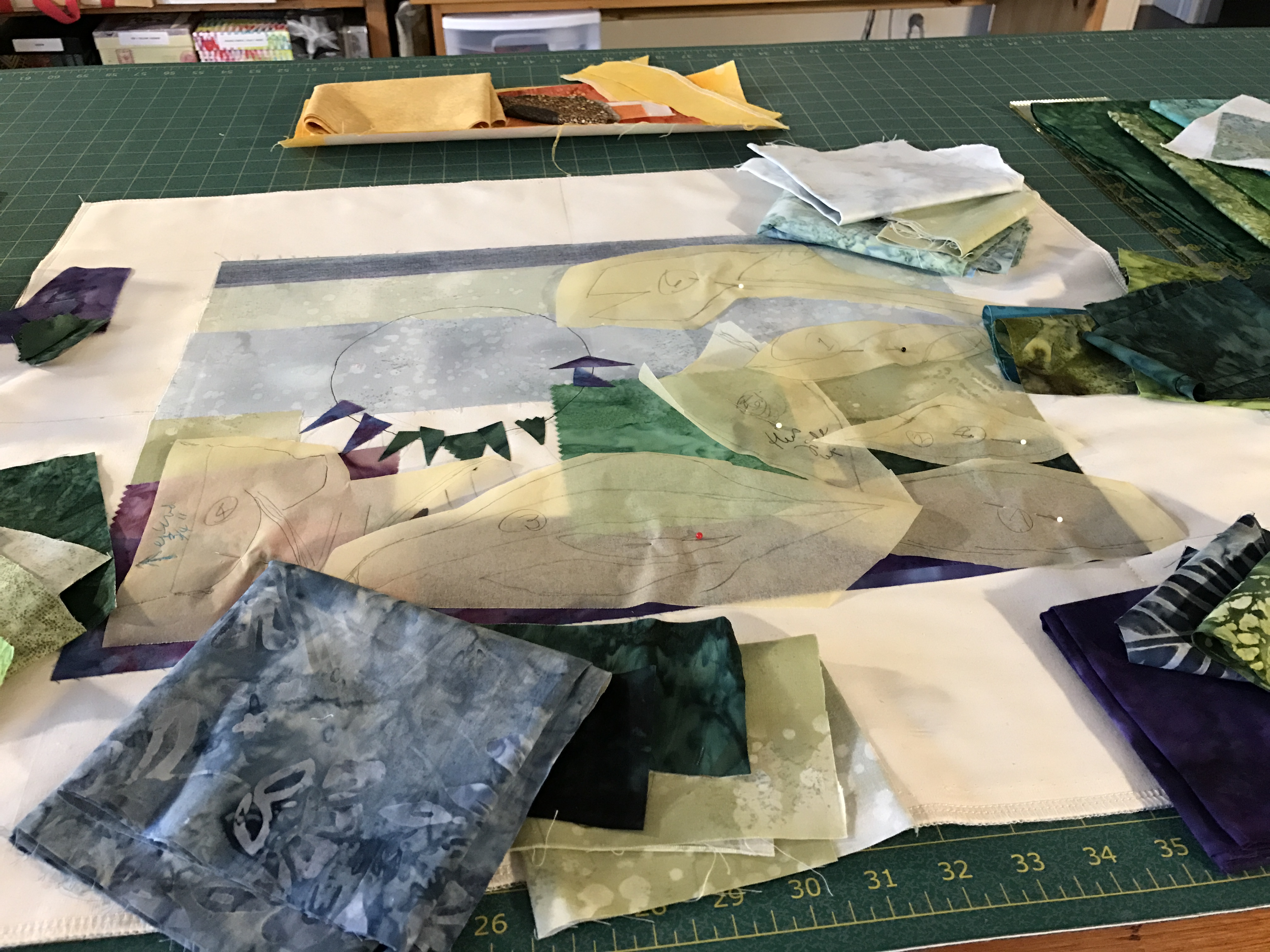
Then I took a deep breath and started stitching around the colour areas. Here they’re shown on the black and white prints on paper. My plan was to stitch around the outlines of all the coloured areas using coloured thread to blend with the fabric in the clothing.

pilots-detail

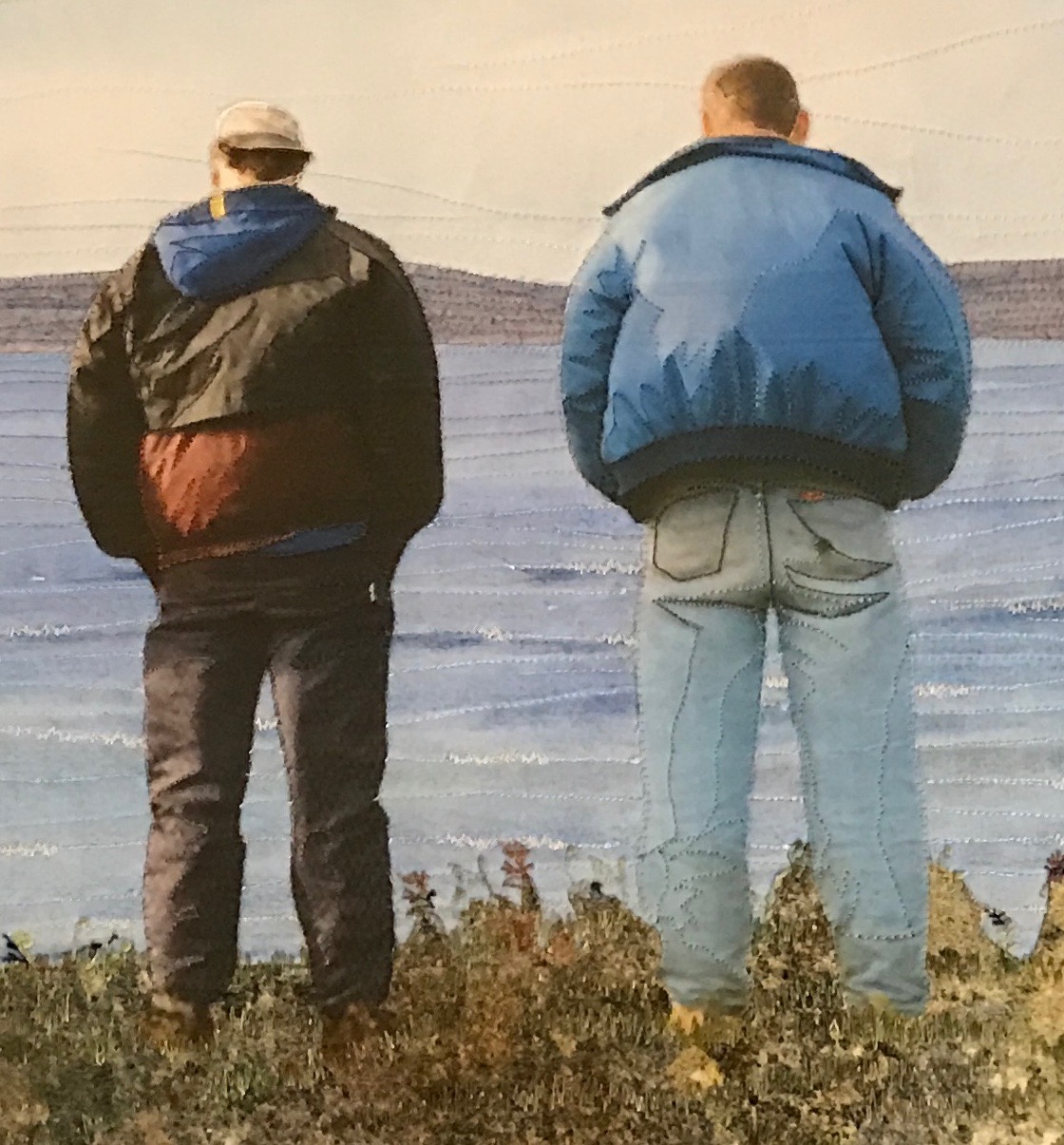
Somewhat more difficult to do on the machine than with a pen! Click on the photo below and you’ll see the stitching – I didn’t quite capture as much detail as I did on paper, but the stitching does bring out the boundaries between the differently shaded areas. You don’t notice the stitching when you  stand back but it’s evident when you’re close up.

Version 2

Stitching Detail

I added an inner “mat” using 2 1/2″ raw silk strips, carefully positioning them and stitching them in place (with mitred corners folded and pressed).

Now the piece needs a border/outer mat. I have several sets of 4 of various fabrics the question is whether any of them actually enhance the piece or do all of them detract and I should go shopping for something better.

This is a dark border:

img_8266

Dark Border

Here is a lighter border:

img_8267

Light Border

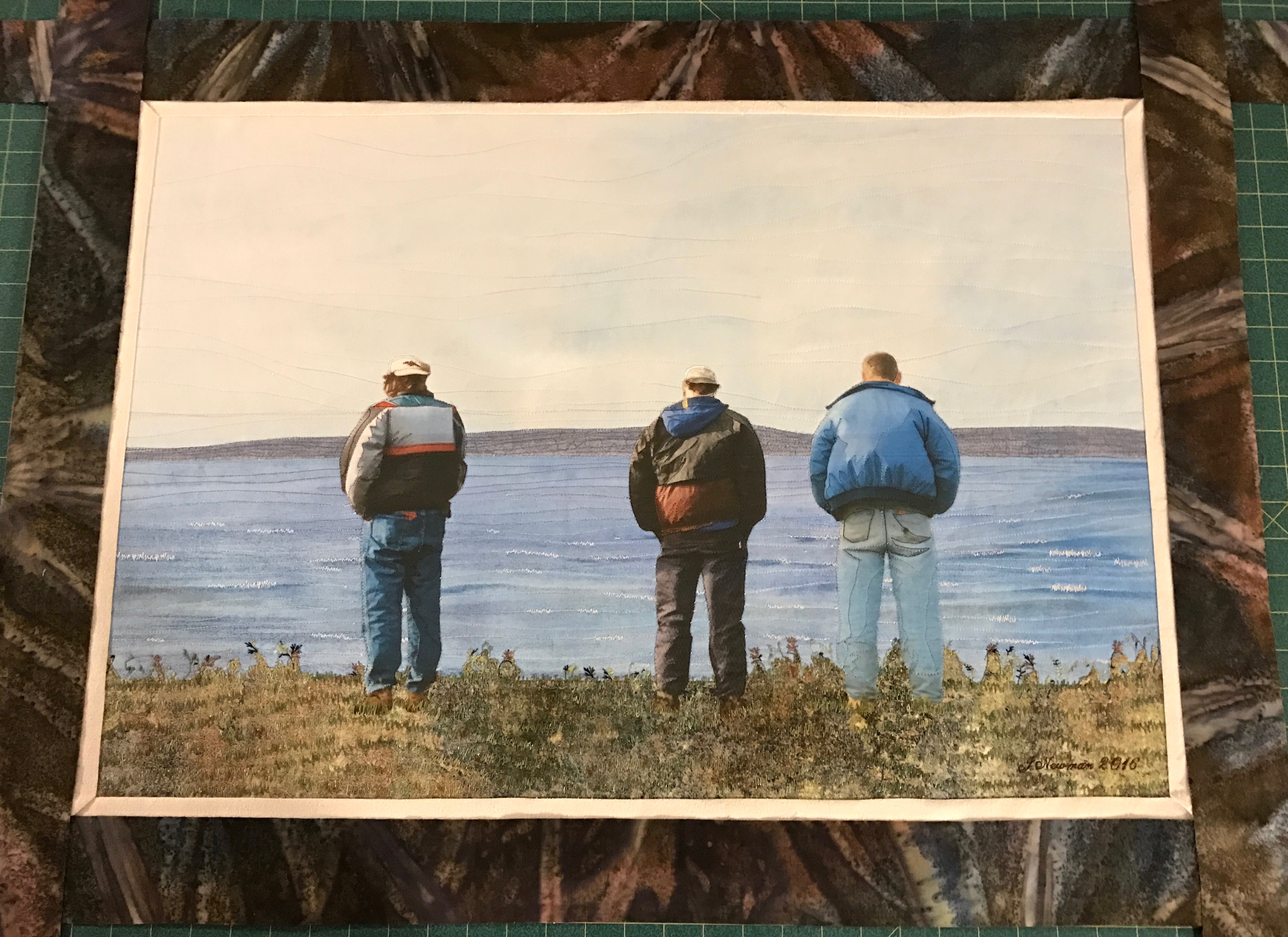
This is a medium border that brings out the blues and greys – what I can’t decide is whether it’s too busy or not.

img_8269

Medium Border

This is one to sleep on. I need to see all three in daylight – then it will be easier to assess the colours and degree of busyness of the batik pattern.

Maybe I should bring out some solid Kona cotton and give that a try – I find “storm” a very useful colour – I’ll do that tomorrow.

Striped Leggings with Top

img_8252

OK, here are the wacky striped leggings and the black knit tunic I just finished to go with them! Not too bad. This top is a bit shorter and somewhat more flowing than the previous tunics. The small embroidered bag is to hold my phone – no pockets in the leggings or the tunic (the fabric is too stretchy to use a pocket to hold my phone – the small purse is colourful and works well).

I’m even going to wear the outfit out to dinner with a couple of friends this evening!

And that’s it for garment sewing right now. Back to finish the wall piece I began a couple of months ago and I’m thinking about a modern quilt of some sort.

Needle Books

Needle Books

Needle Books

On Friday afternoon I knit with a group of women – this Friday we will be celebrating birthdays for four of us, mine among them. There was one birthday on December 25; mine was today – January 2. There’s another on Thursday and a fourth on Friday. So we’ll likely have some wine (a couple of the women are involved in wine making) and some nibbles to celebrate.

I wanted to make a small something to give the others – I keep a small “needle” book beside each sewing machine with a variety of hand sewing needles in it – I like shortish large eye embroidery needles (rather than small eye sharps) for sewing. I also have a couple of “self threading” needles (which are handy for tucking in end threads when I’m machine quilting), as well I keep a couple of used machine needle for those situations where I want to carefully pick out a seam – the machine needle is just that bit larger and stronger than a hand needle for the job.

[I just looked up a hand sewing “needle guide” – John James makes fine quality hand sewing needles of all types and sizes – turns out my preferred hand sewing needle is a size 7-8 “embroidery” (sharp with a large eye to accommodate embroidery floss), rather than a comparable “sharp” which has a small eye which I find difficult to thread. Darners also have a large eye but I find them too long and too thick to be comfortable to work with. I also keep some “easy threading/calyx eye” needles – these are self-threading needles which are threaded by pushing the thread through an opening at the top of the needle rather than through the eye.]

So I whipped up three needle books and have outfitted them with a few straight pins (with glass heads – the iron doesn’t melt the bead head), three quilting pins (I don’t have any safety pins on hand – just curved quilting pins), four different needles (embroidery and sharps), a calyx eye, and a blunt tapestry/cross stitch. I also included one used machine needle. I’ve closed the book using a quilting clip.

I’m sure the gals all have places where they stick their sewing needles but I’m betting none of them has a needle book. A small gift that I’m sure will be useful for these women who knit/sew.

I also keep a “machine needle” book at each machine – for those needles that haven’t had much use – the problem is keeping track of what kind of needle and its size. The machine needle book solves that problem for me. So if I need a slightly used needle for a small job that’s where I head first. If I know I’m going to use the needle for an entire project, it’s a new needle each time.

Machine Needle Book

Machine Needle Book

And in case you wondered – because I do a LOT of machine sewing I have a complete selection of machine needles for each different job!

img_8243

Machine Needle Collection