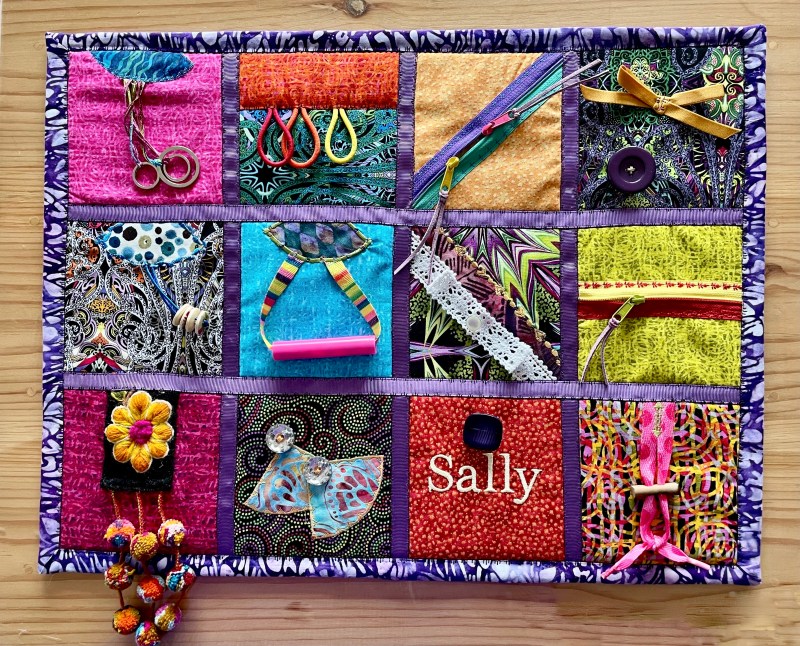
Fidget Quilt

Fidget Quilt 20″ x 16″

The wife of a friend of mine has recently moved to a full care facility. Her Alzheimer’s and other chronic ailments finally made it impossible to look after her at home. Looking for ways to stimulate her, her husband came across an article in a local newspaper about “fidget” quilts and sent it along to me. Easy to make.

Yesterday, I gathered some leftover charms (5″ fabric squares), laid them out in a 4×3 array, then dug around in my stash of “stuff” to see what I could find. Lots of zipper tape scraps – I selected the long pulls (for arthritic hands which have difficulty grasping) – big buttons, shoelaces, toggles, small buttons, hair elastics, key rings, ribbon, lace, an empty thread spool (I keep them, they’re useful for something now and again), some leftover cutouts from the back of the latest Drunkard’s Path quilt.

I began constructing blocks by adding stuff, one block at a time. I threaded four wooden buttons on some bright blue elastic (leftover from making face masks) and attached them with one of the quarter circles. I threaded one shoelace through the empty thread spool and attached that with another quarter circle (using a decorative edge stitch). A piece of lace which I left loose in the middle, adding a stemmed button in the centre to hold it in place. I mixed and matched pieces of zipper tape with contrasting slides (a single slide on one zipper, two slides meeting in the middle on the second).

Some elements I arranged across the background square, some on the diagonal. I found a woven, embroidered, woolen belt with small pompoms from my Peru trip, cut off one end and attached that. I used a buttonhole stitch to attach a pink shoelace to another charm slipped a toggle on, tied the ends with a reef knot (didn’t I manage to cut off one of the plastic ends while trimming the whole thing – grrrr – I stitched it, wrapped it in thread, and dipped it in glue to stiffen it, Not as good as the original shrunk plastic, but I’d gone too far to replace the square and do it over again).

I set up an embroidery with Sally’s name and stitched it out. The hair elastics I attached beside one another on another background square. I added ties to the zipper pulls (and a dab of glue to keep the ties from slipping off). I looped three key rings onto some thin ribbon. I used contrasting polyester embroidery thread to attach the elements – another textural element.

I stitched the squares to a piece of quilt batting, added grosgrain ribbon to cover the joins, then cut a very heavy weight craft interfacing to stiffen the project. Finally I added backing fabric and binding.

There you have it – a fidget quilt. The whole project took 5-6 hours. Now to find out which aspects Sally is drawn to and which she ignores.

I suggested to the family a couple of other possibilities – playlists of her favorite music on some device which she can operate herself or one of the staff could turn on for her regularly. Photo books made from family photos, favorite places she’s lived/visited, etc. Children’s picture books with good illustration, simple story, interesting ending. Children’s audio books.

There are lots of possibilities for stimulating her and keeping her in touch with her life.
More Escher Quilt Information

Mar 29 2023:

There continues to be interest in how I constructed the Escher Quilt. Specifically, Ina Veurink wanted more information about the size of the trapezoid elements. I just assembled one from scraps so I could answer her question. 

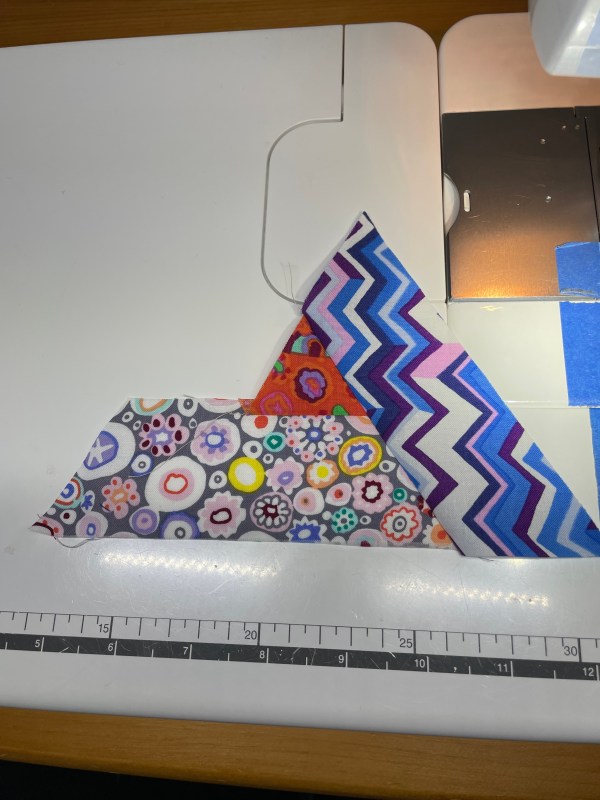
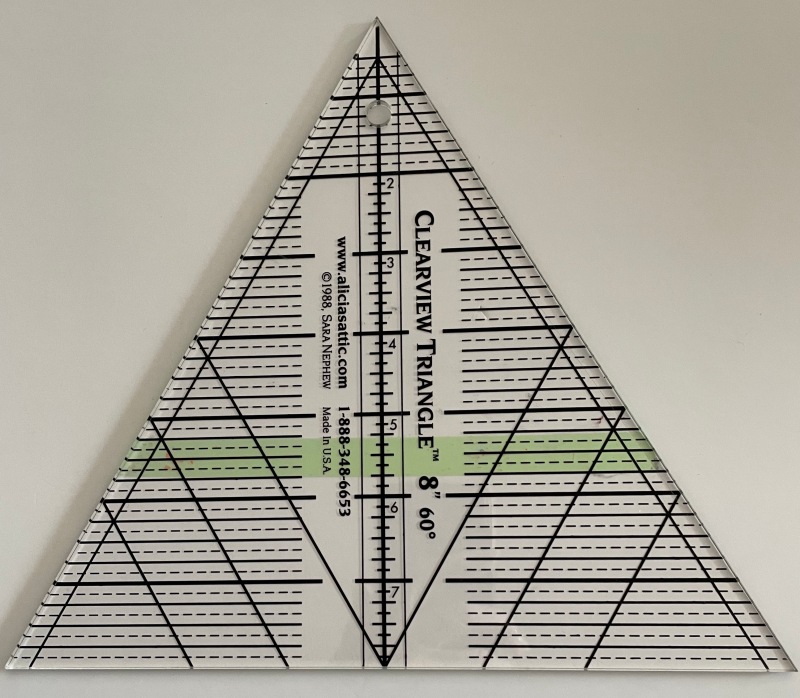
I cut 2″ fabric strips to start, from the fabrics I was going to use for the trapezoids. So each trapezoid starts out 2″ tall. Next I trimmed the angles on each side using an equilateral triangle acrylic template which I’d marked with green tape at the 5 1/4″ line:

Acrylic Equilateral Triangle Template – Marked at 5 1/4″

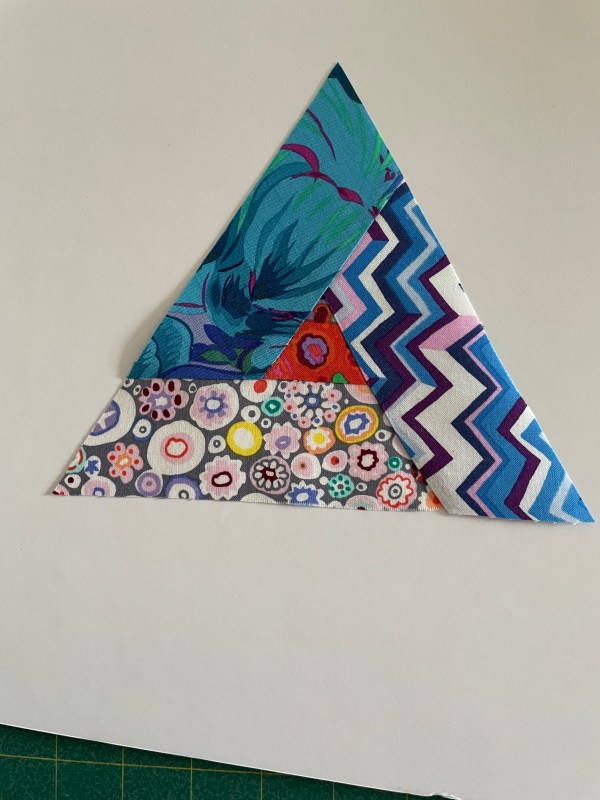
I laid out the 4 pieces: a 2″ triangle (in the quilt all the triangles are cut from the same dark fabric), 3 trapezoids (each 2″ tall, 5 1/4″ on the long, bottom side). I partially sewed the triangle to one end of one trapezoid 

(NOTE: half the finished triangle blocks begin with the small triangle on the right, half on the left – I talked about that somewhere in the posts as I went along). It’s a partial seam because to fit the final trapezoid in, you have to be able to lift that first side of the small triangle to sew that seam. Next I attached a second trapezoid, then I fit in the third trapezoid, last I finished by completing the partial seam. Pressed and trimmed.

Finished triangle size: each side should end up at 6 3/8″ (although if your sewing was more accurate than mine on this test triangle you might actually end up closer to 6 1/2″). Whatever your final triangle size, all the triangles should finish the same size.

“ILoveQuiltingForever.com” created a tutorial for the quilt from my 8 blog entries: https://ilovequiltingforever.com/free-quilt-tutorial-escher-quilt/#comment-3584. Click on each link in her tutorial in order and you should be able to figure out how to assemble the quilt rows yourself.

I ended the “Escher” series with a final comment: https://jmncreativeendeavours.ca/2022/10/20/the-escher-quilt-revisited/

This is an advanced intermediate quilt (definitely not for a beginner, even with instructions). 

Another note you wouldn’t pick up if you didn’t read through the comments is this one:

Just keep in mind you need 25 fabrics – one solid for the “background” triangles and any borders you plan on adding; 24 patterned fabrics – 8 light, 8 medium, 8 dark (https://jmncreativeendeavours.ca/2021/05/08/the-escher-quilt-2/)…. You’ll likely do a lot of auditioning to build a collection of 24 fabrics. As for the background, I suggest a navy (which is what I used given the colour blend of my fabrics) but black is certainly a good option (that was the background colour in the original photo I saw). All the best with this quilt. One other thought, because trying to pull together a collection of 24 fabrics can be daunting you might consider a kit that has selected fabrics for you (these quilt kits are reasonably priced: https://www.quilt-agious.com/shop/Kits/p/Escher—Batik-x46838321.htm).

Kantha to Jacket – Finished

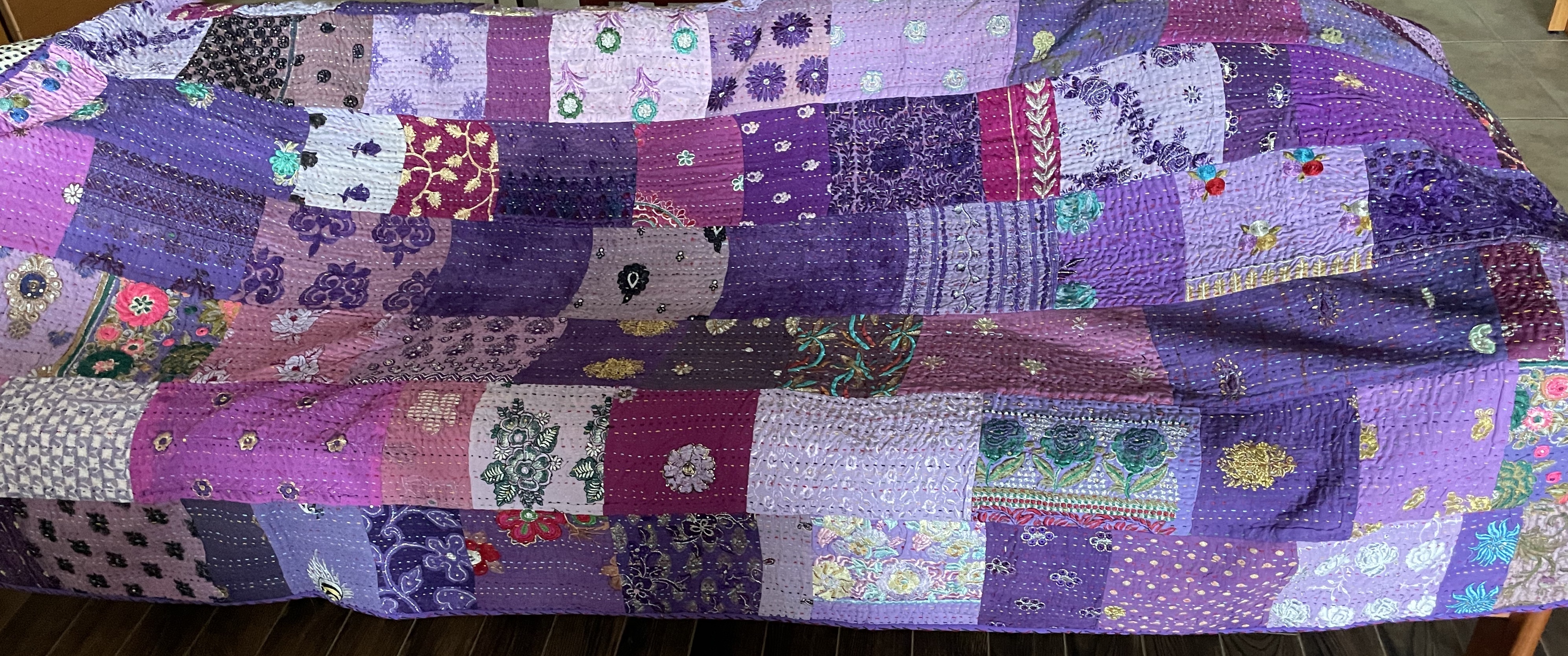
I started with a Kantha bedspread which I’d purchased six or more months ago in preparation for doing a workshop on making garments from these textiles.

I did the workshop at the end of February. I started by cutting out a jacket for myself – two fronts, a back, two sleeves, two cuffs, a collar, two pocket backing pieces. Then I cut out front facings, a collar facing, a hem facing, and narrow bias strips for binding the seams.

Prior to the workshop, I sewed the bound/double welt openings for the slash pockets – so I could show the gals attending the workshop how I did that. I bound each pocket back piece, and attached one to each front behind the pocket opening. Then I attached the front facings, sewed and bound the shoulder seams before adding the mandarin collar. I bound the collar seam. That was as far as I got with the jacket – I didn’t want to finish it, I wanted to be able to use my garment to show how I stitched and bound the seams, how I faced the jacket hem and so on.

Since the workshop, the jacket has sat on one side of my cutting table waiting for me to complete it. First I finished the Moons/Planets quilt, then I constructed the baby quilt. This week I got back to work on the Kantha jacket.

I set up and sewed the buttonholes on the right front “placket”. That’s easier to do when the fronts are relatively unattached to the rest of the garment. (In fact I should have added buttonholes before sewing the shoulder seams and adding the collar!) Then I sewed in the sleeves, bound and top stitched them. I sewed the sleeve underarm/side seams, bound and top stitched those seams as well. I sewed the side seam of each cuff (to which I’d already added an edge facing), then serged the cuffs to the sleeve ends. I didn’t bother binding that seam since it’s concealed under the cuff which folds back over the sleeve.

I finished the bottom with a facing and then I added five buttons – all 23mm metal buttons, each one different. (You can see that if you click on the jacket front to get to an enlargement of the photo.)

The thing I had to be careful of were the beads that were either glued or sewn to the heavily embroidered Kantha. I removed any which were in the way of the seam allowances – I didn’t want to hit one with a sewing machine needle! I left beading in the centre of the pieces alone.

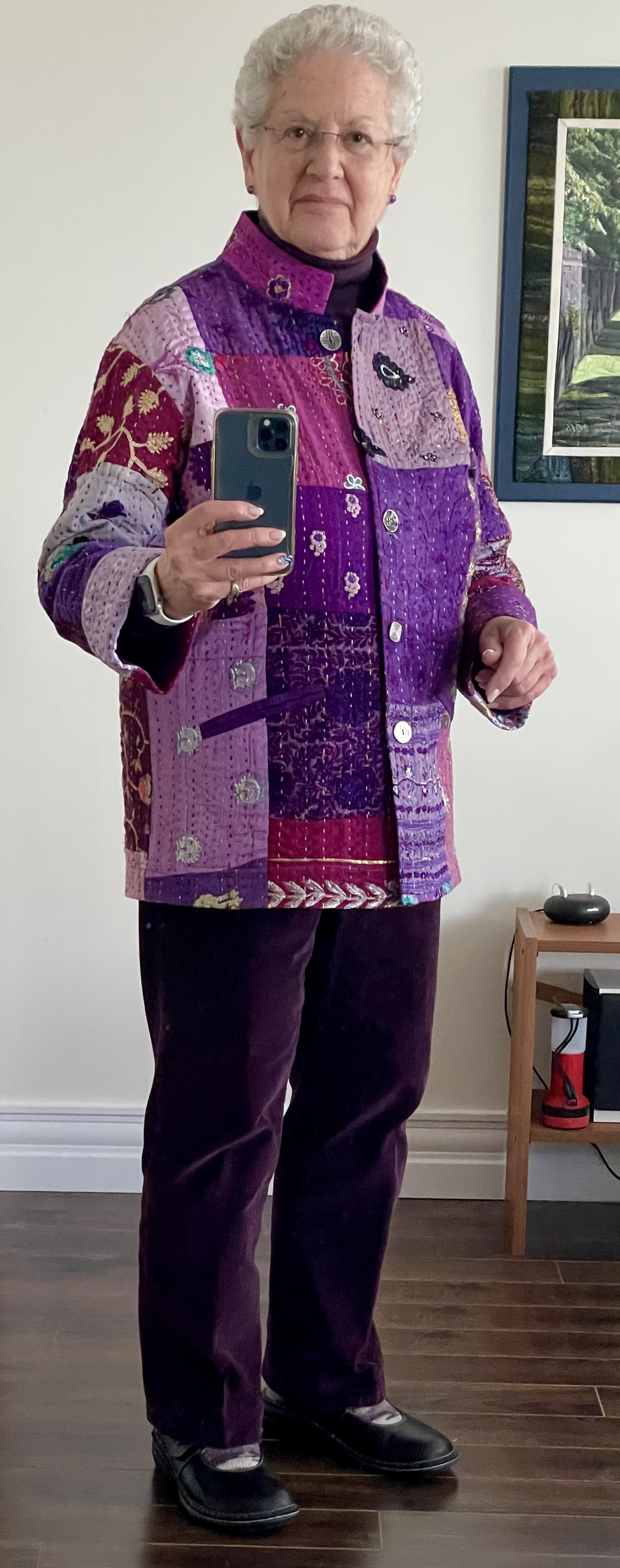
The jacket is now finished. All I need is an opportunity to wear it. I will likely just put it on one day with a pair of jeans.

PS – With the jacket on:

Socks Again

Colourful Socks

I knit these socks for my niece’s stepdaughter who’s studying biomedical engineering at university. She wears a size 9 shoe – people always think it odd when I ask their shoe size – but that’s how I know how long to make the foot of a sock. I checked my sock stash and I did have a couple of pairs of socks that would have fit her, but they were rather dull, more suitable for a man (men generally prefer sedate socks rather than bright ones – except for one of my brothers-in-law who has a collection of quite wild socks – two drawers worth, I understand, although I’ve never seen them except when he’s wearing a pair). So I looked through my sock yarn, chose what looked like a bright yarn and started knitting.

I finished the socks three days ago. Put them in the mail straight away. They should arrive by the middle of next week.

From Shirt To Heritage Nightgown

Embroidery Salvaged From White Shirt

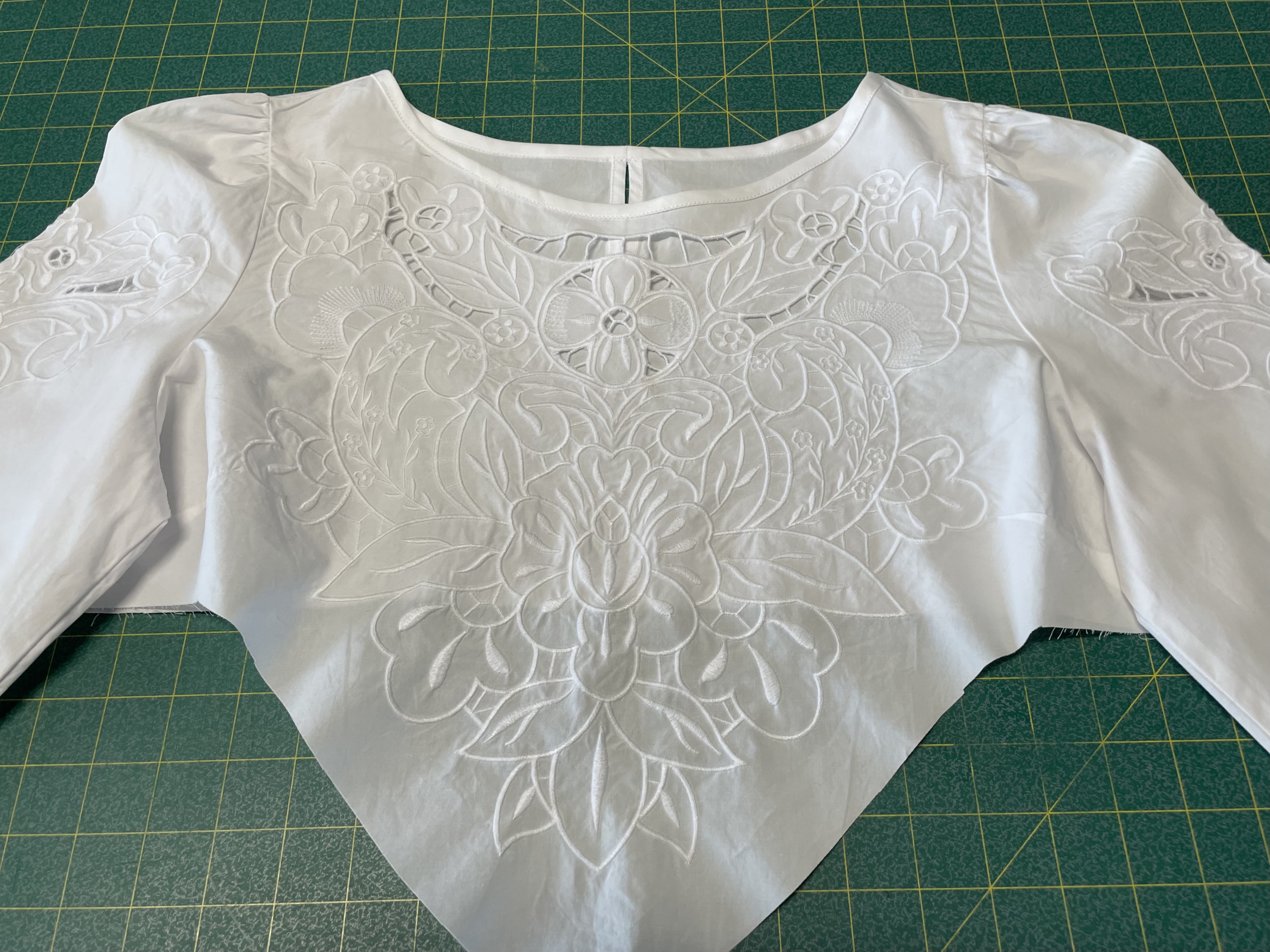
Is it a week ago? Two weeks? I can’t remember, exactly. I took a drive on a sunny Sunday toward “the valley” with a friend. We moseyed our way along until we reached Wolfville. We browsed in some shops, Marie bought some summer tops in one. I came across a Talbot’s embroidered white shirt (size M) in a second hand shop that shouted “heritage nightgown” so I bought it (hoping size M would actually fit across my chest – holding it against my body it looked as if it would).

Without trying the shirt on first, (how silly was that) I cut off the ruffled neck and replaced it with a binding, cut the sleeves shorter and hemmed them, then trimmed away the bottom of the shirt intending to add a long “skirt” to complete the nightgown.

Finished Heritage Gown

I finished the nightgown yesterday. My reconstruction was focused on salvaging the entire embroidery. A mistake. The shirt had bust darts which pointed toward the flower in the middle of the embroidery. In my attempt to keep the embroidery intact I cut below the darts. I should have bitten the bullet, cut above the darts and across the embroidery – the finished garment would have fit better.

As it is, I wore the nightgown last night and it’s reasonably comfortable even though the embroidered “yoke” comes too low and hits the fullness of my bosom rather than sitting at underarm depth. Given the density of the embroidery I’m not sure how I would actually have cut it – no easy way to fussy cut across it and have it make any sense.

The gown is not a write-off. I’ve added it to my collection and will wear it in rotation with the others in the drawer. And it cost me $28 rather than the $120 at one of the clothing stores we visited which had some April Cornell nightgowns for sale.

Canada Capers – Baby Quilt

Finished except for a label on the back.

Do the photos ever show up the imperfections! You can see the back strip isn’t perfectly horizontal; there are wobbles in the layout of the quilt top. None of this is obvious when you’re looking at the quilt draped on the bed, however. I know nobody looking at it will notice any of what I see.

The quilting I set up as an edge-to-edge design, working in the width of the strips – the embroidery for the animals was one width, the embroidery for the blocks was narrower – again, that something I can see but nobody else will notice.

I finally “mastered” precise positioning while I was working on the quilting. After all this time, I discovered how to set the opening (pivot) stitch and how to rotate the design a smidgeon so the embroidery would end up in the right spot for me to begin the next. This is the best edge-to-edge work I’ve done. I managed to align the start needle position with the finish needle position of the previous stitch out each time. What made this quilting relatively easy is that I didn’t have to worry about nesting the embroideries – I’ve done that a couple of times in the past – a lot of math and measuring to make that work. Here, all I had to do was centre the embroidery in each strip.

I completed the quilt with a folded French binding using 2 1/2″ strips. What I learned (having never bound a quilt like this before) is that if I wanted a 5/8″ binding front and back, I’d need to cut my strips 3 3/4″ wide. Here, I attached the binding with a 1/4″ seam, folded it over so I would end up with close to 5/8″on the front. I stitched the binding in place with a decorative stitch at the very edge of the binding. Because the binding was attached on the back with a 1/4″ seam allowance, the binding in the back ends up at just under 3/8″ wide and the decorative stitching is inside and separate from the narrow binding. I probably won’t finish a quilt like this again – I’ll go back to using the binding open rather than folded and finish both front and back at 5/8″.

I learn something with each new project.

Sunday, March 12 2023

Bernie had questions about the decorative stitch I used to bind the quilt. Here’s what it looks like on the top of the quilt (binding a smidgeon less than 5/8″); and on the quilt back (binding 3/8″ wide). [To have a 5/8″ folded binding top and back would need a binding of 3 3/4″!] The stitch is an edited version of one of the standard quilting stitches on my Pfaff Creative Icon 2.

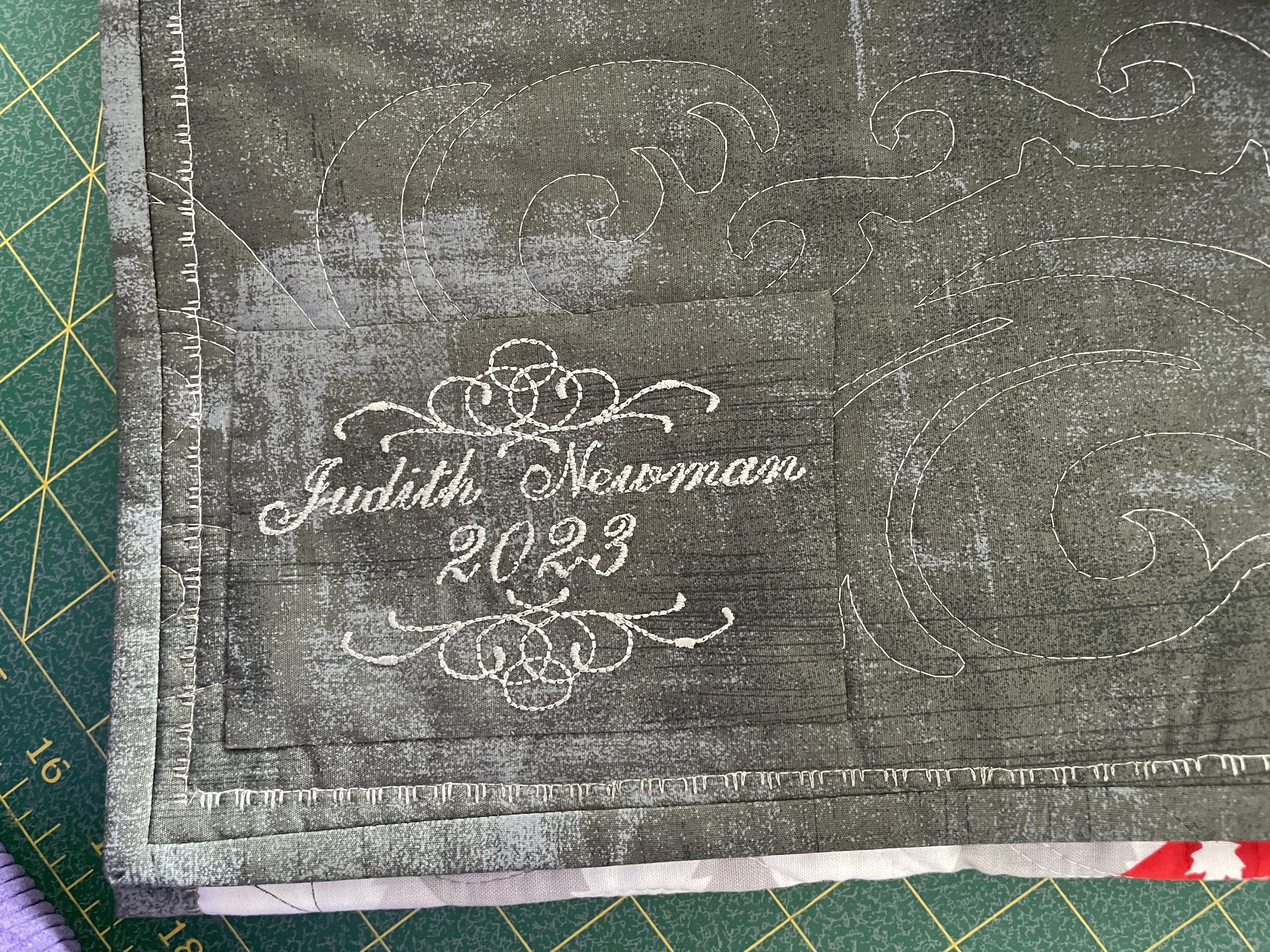
From start to finish the quilt took me 10 days. I just finished hand sewing on a label on the quilt back.

Baby Quilt

Quilt Top

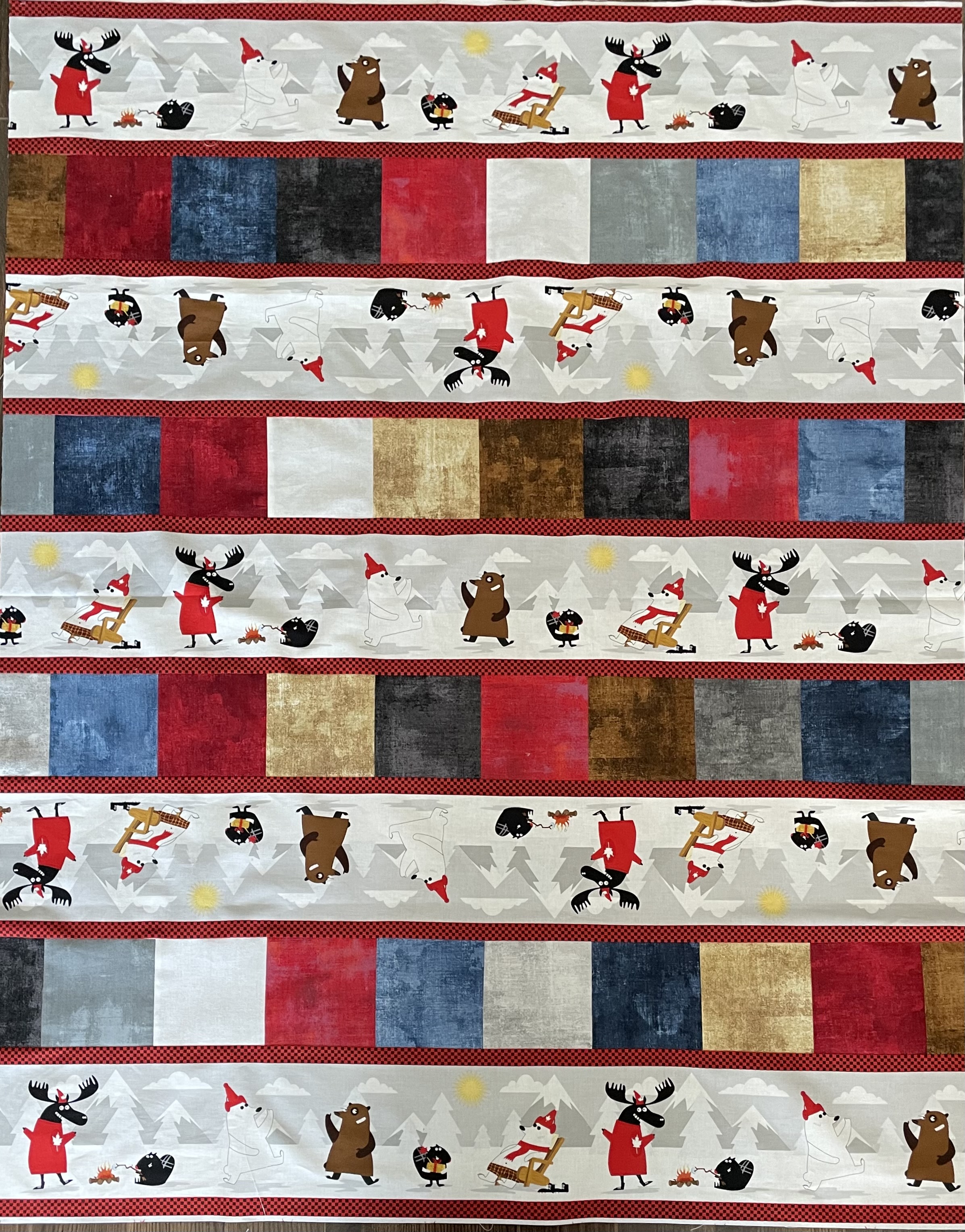
I bought this crazy animal fabric before Christmas on sale. I figured I’d be able to do something with it, whether I cut the strips into blocks or used them intact in some way. I had two layer cakes of mottled background fabrics, I chose the colours from the animal strips, cut the 10″ squares into 5″ squares and assembled them somewhat randomly.

I was going to cut the remaining 5″ blocks into 2 1/2″ rectangles for a border, but the top is definitely large enough as it is. I wasn’t going to do anything on the back side but I still have one strip of the animals left along with two stacks of the 5″ squares so I will assemble them and incorporate them into the second side. I’ll never use this fabric for anything else so I might as well use up as much of it as I can.

I’m planning a dark grey backing fabric. I’ll bind the quilt with it as well which will give definition to the quilt top which it doesn’t have at the moment.

It’s a lovely sunny day today. Time to get showered and dressed. Going for a drive in the countryside to enjoy the rest of the day!

Drunkard’s Path – Completed!

I started working on this quilt around Jan 22. It’s gone more slowly than some quilts because there were decisions along the way I found difficult to make – but I completed it last night. Yesterday I finished quilting the wide outer border, added the facing/hidden binding and hand sewed it on the back. Label added last.

I’ve tentatively called the quilt “Planets with Moons”. The finished dimensions: 49 1/2″ wide by 68″ long – a rather large throw, a bit too long to hang on a wall unless you have rather high ceilings. It certainly is a good length if you’re a tall person!

I’m particularly pleased with the back strip. In fact, I’m thinking I might do an entire quilt based on that idea – a 6″ drunkard’s path block attached to two 3″ drunkard’s path blocks. The resulting oval shape is interesting. I wonder what it would look like if I limited my colour palette to two colours (blending various shades). Something to think about.

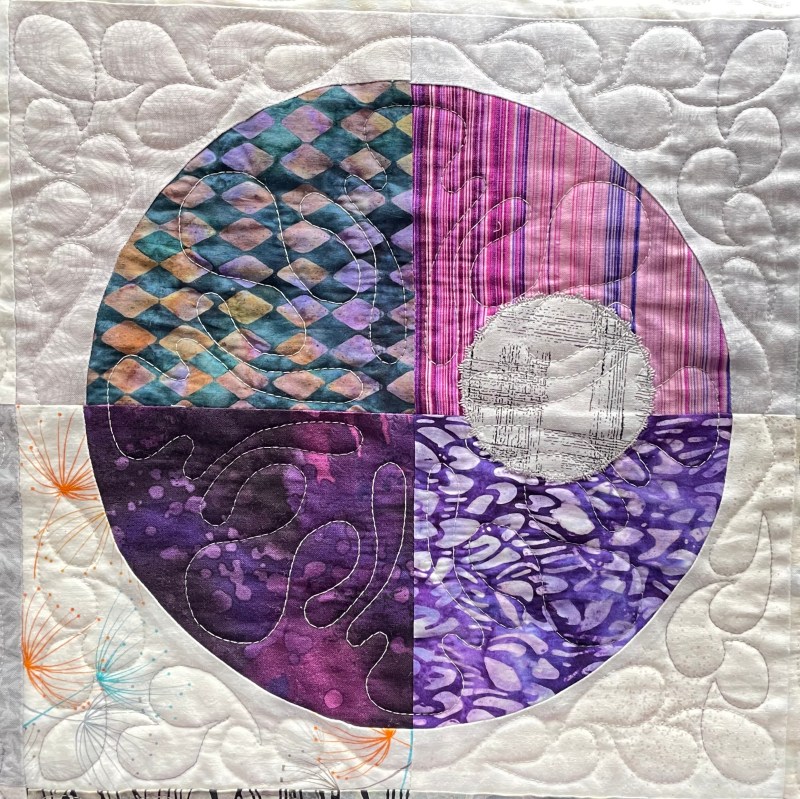
Quilting the project was somewhat complicated. I started by setting up a circular embroidery to fill the individual large circles and quilted them all. Next I had to design an embroidery to fill half the background square (I could only embroider two sections at a time (either left two or right two) because of the hoops I have. Filling the background took three days – a total of 35 embroidery repeats. Then I decided to adapt the circular embroidery into a long narrow element for the border. That left a small corner embroidery which I added to finish each corner.

The challenge with quitting in the hoop is getting the embroideries to line up and join. Lots of math involved in trying to position and adjust the size of each embroidery so the stitching is precisely where you want it (my Pfaff Creative Icon 2 has a “precise positioning” capability which makes quilting in the hoop possible). I did “touch” the large circles in a few spots but for the most part I managed to avoid crossing the circle/square boundary. I stitched both sides of the narrow batik sashing in the ditch but chose not to add a quilting to that element, it was narrow enough that it didn’t require quilting.

With this quilt now done, I can put it in the pile for the Art Labs showing in the summer. I will hang it with several other quilts I’ve made using Drunkard’s Path, showcasing the technique as an artistic choice. The other grouping I have ready includes three “Convergence” quilts. So far, then, I have seven quilts set aside for that show. I will now turn to working on smaller wall art pieces, including a set of 6″ x 6″ which I’ll show at Art Labs, but they’ll really be for next December in Tatamagouche!

It’s being able to show my art that keeps me working at it. There’s always some time pressure – keeping in mind how much I need to actually produce for a show to work. Fortunately, I don’t need all new pieces for each show, I’m able to show older pieces along with a few newer ones which creates a new context for each piece.