50 Blocks

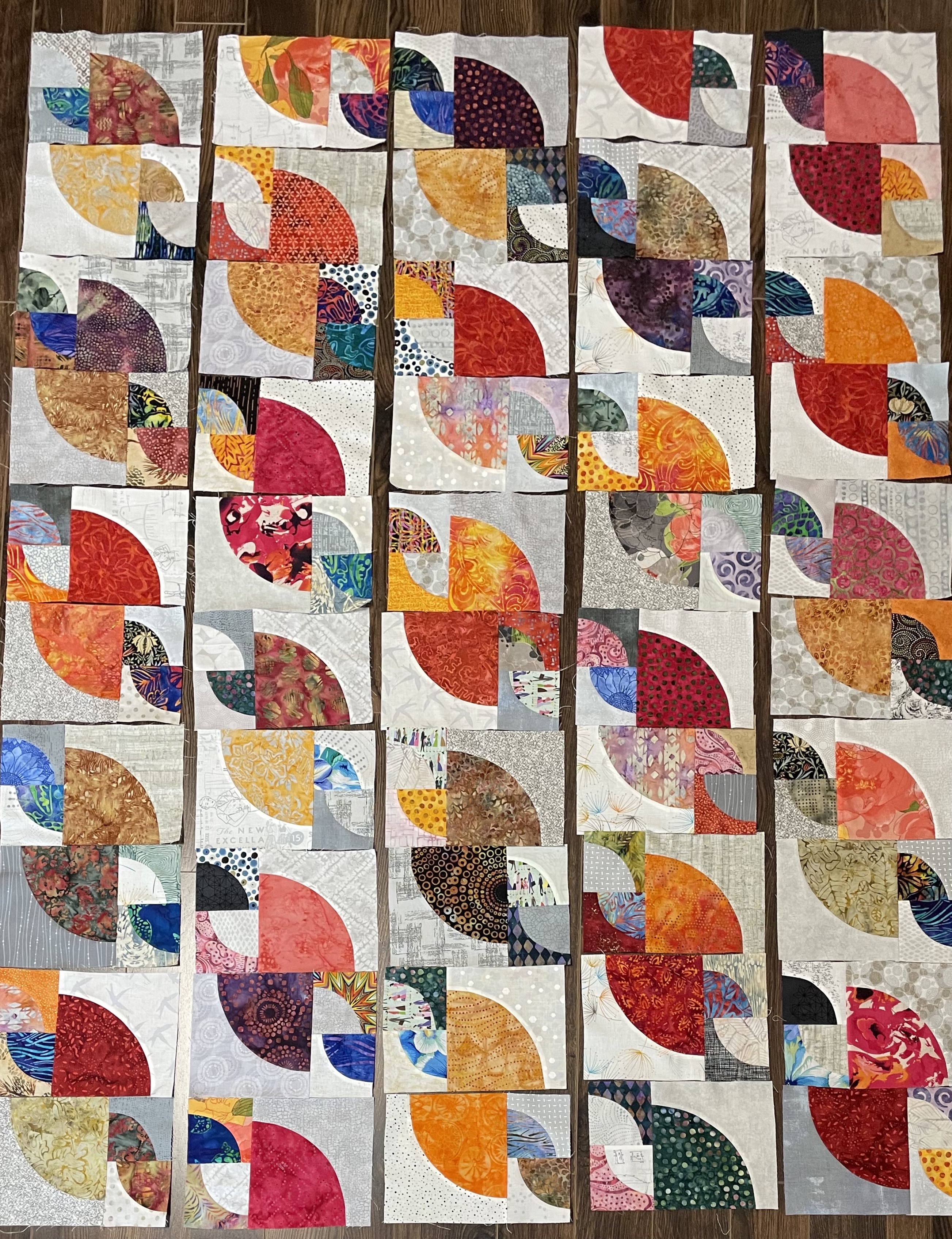
50 Blocks Assembled

I’ve just finished sewing and trimming the last of the small blocks, attaching them to the larger blocks, trimming the resulting blocks and auditioning them on the floor. (I don’t have a flannel hanging wall in my apartment – there isn’t a spare wall to set one – so I use the floor space beside my cutting table for laying out quilt blocks. Good thing I can still get down on my knees and back up again!)

Before I laid out the last column, I removed the palest yellow blocks – they stood out as weak. I had enough large blocks assembled that I could draw in stronger ones. Having arranged all fifty, I began moving them around. I’m trying to avoid duplication in both columns and rows.

here are two diagonals happening here – completely unanticipated when I started out. There are the “top left – bottom right” diagonals – I’m also trying to avoid duplication along those rows. The large pie shapes on the “top right-bottom left” diagonals also stand out – not as obviously as the other diagonals but they’re visible, so I have to take time tomorrow to examine the array closely for duplication and colour flow.

I’d say, I’m about on schedule for this quilt. Once I’m happy with the layout, assembling the top won’t take long – sew the columns, add sashing between the columns – 3-4 hours.

I’m already thinking about the back panel. The temptation would be to add a bordered strip of Drunkard’s Path blocks (which I did in the previous quilt), but I want to come up with something different, yet complementary. I’ll sleep on that. It shouldn’t take more than a day or two to get the backing done.

I expect quilting the quilt sandwich (once it’s set up) should take about a week. I have 2 weeks before the Parrsboro exhibit. I’ll be cutting it fine, but I should be able to finish this quilt so I can include it in the collection.

Getting Somewhere

Auditioning 4 Rows and Sashing/Binding Fabric

At the moment I have four rows of 9 blocks (I’ll probably make it 10; that was what I planned initially). I’ve finished 40 of 60 half-blocks. Now that I have evolved a technique for sewing the small Drunkard’s Path blocks I’m going more quickly.

The array is, at the moment, an audition. I won’t do much moving around until I finish the remaining 24 semi-blocks. Then I will be able to decide what to put where.

With this much laid out, I started thinking about sashing and borders. These three fabrics were in my “backing” collection. I tried several grey printed fabrics for the sashing/inner border but the dense black dots on white will be neutral, yet strong enough, to make the colours stand out. I have a hunch the white with fewer dots might be best as my wide outer border.

Just thinkin’ about it all as a rest from sewing those small blocks!

The New Quilt

How The Finished Block Will Look

I have all 60 large blocks sewn together. I’ve begun working on the small quarter size ones. So far I have stitched thirty – leaving me ninety small blocks to go.

The 6 1/2″ Drunkard’s Path block is relatively easy to sew – with the “L” piece on top, three pins, one on each end, one in the middle, the fabric spreads itself out so the opposing curved edges more or less align themselves. Sewing slowly, I get a nice 1/4″ seam on the curve.

The 3 1/2″ block is DIFFICULT! Because it’s small it’s hard to put in three pins to hold the centre and the ends. I think I’ve figured out how to sew them more efficiently. Again, with the “L” piece on top, I just use two pins, one on each end, then sewing slowly, using my fine point tweezers, (with lots of stopping to realign the opposing curved edges), I adjust top and bottom as I go. I’ve just finished a dozen this way – it took me about 12 minutes to sew the batch.

The 3 1/2″ Blocks

Each large block is sewn to two small ones to set up a half-block element. Two half-block elements go together to make a block. I intend to assemble 5 blocks into a strip. The strip width will finish at 9″. For the moment, I think I want five strips (5 x 9″ = 45″), with 1″ sashing I’ll end up with 49″ width; add 2 1/2″ border I finish at 55″. Finished length I will worry about once I have the strips sewn.

Movin’ along here.

More Escher Quilt Information

Mar 29 2023:

There continues to be interest in how I constructed the Escher Quilt. Specifically, Ina Veurink wanted more information about the size of the trapezoid elements. I just assembled one from scraps so I could answer her question. 

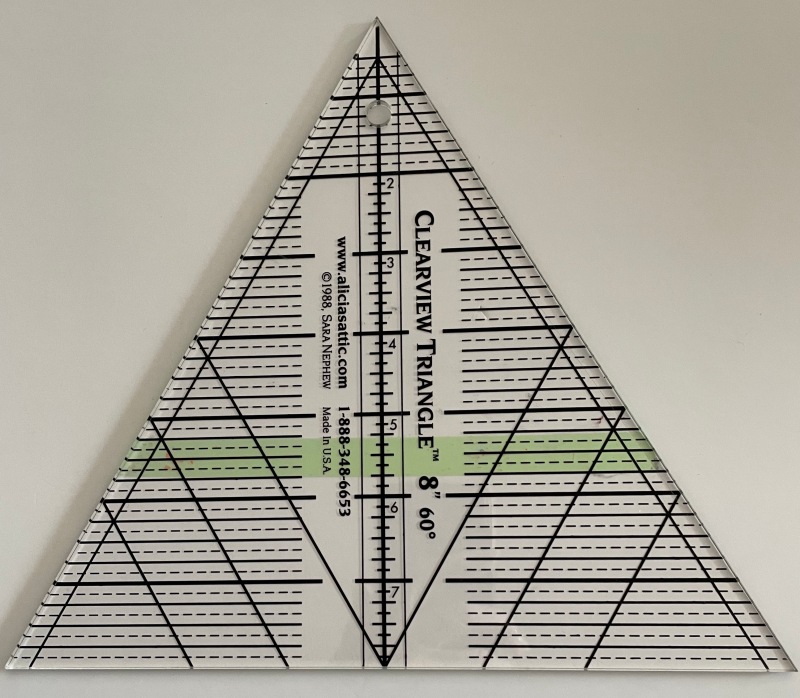
I cut 2″ fabric strips to start, from the fabrics I was going to use for the trapezoids. So each trapezoid starts out 2″ tall. Next I trimmed the angles on each side using an equilateral triangle acrylic template which I’d marked with green tape at the 5 1/4″ line:

Acrylic Equilateral Triangle Template – Marked at 5 1/4″

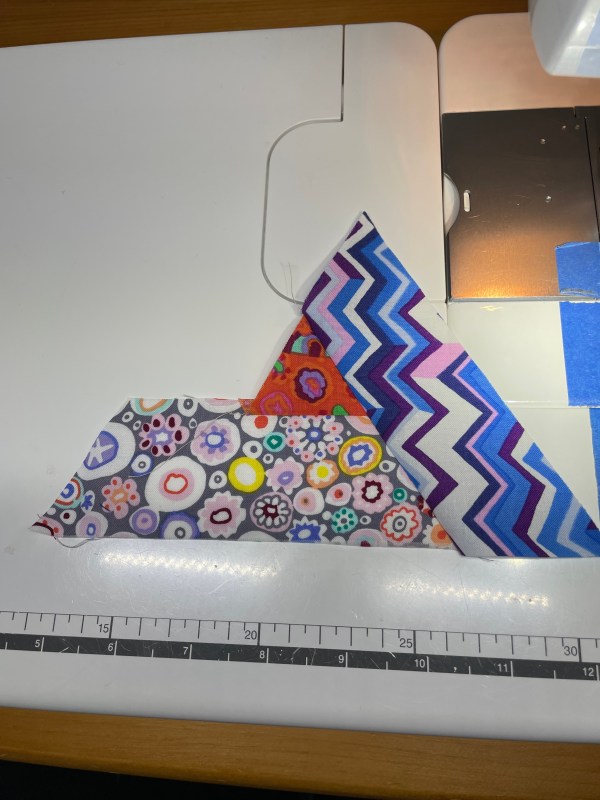
I laid out the 4 pieces: a 2″ triangle (in the quilt all the triangles are cut from the same dark fabric), 3 trapezoids (each 2″ tall, 5 1/4″ on the long, bottom side). I partially sewed the triangle to one end of one trapezoid 

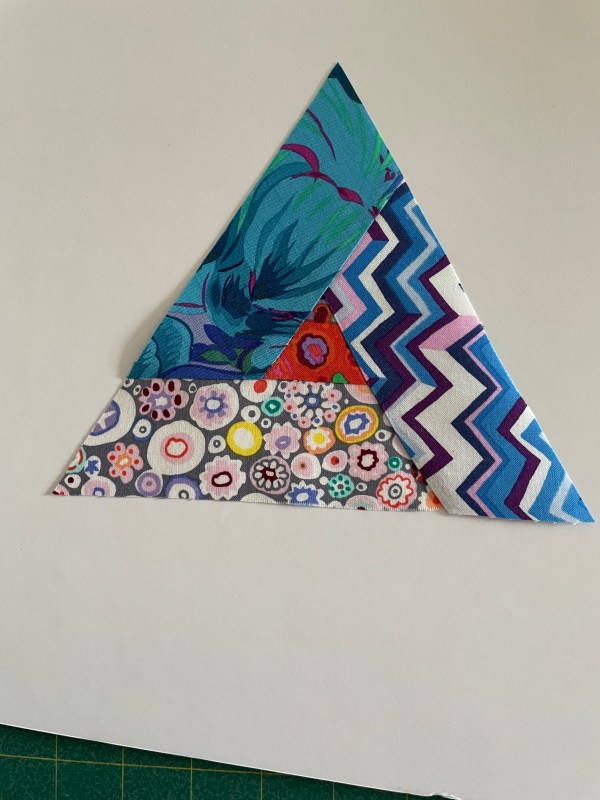
(NOTE: half the finished triangle blocks begin with the small triangle on the right, half on the left – I talked about that somewhere in the posts as I went along). It’s a partial seam because to fit the final trapezoid in, you have to be able to lift that first side of the small triangle to sew that seam. Next I attached a second trapezoid, then I fit in the third trapezoid, last I finished by completing the partial seam. Pressed and trimmed.

Finished triangle size: each side should end up at 6 3/8″ (although if your sewing was more accurate than mine on this test triangle you might actually end up closer to 6 1/2″). Whatever your final triangle size, all the triangles should finish the same size.

“ILoveQuiltingForever.com” created a tutorial for the quilt from my 8 blog entries: https://ilovequiltingforever.com/free-quilt-tutorial-escher-quilt/#comment-3584. Click on each link in her tutorial in order and you should be able to figure out how to assemble the quilt rows yourself.

I ended the “Escher” series with a final comment: https://jmncreativeendeavours.ca/2022/10/20/the-escher-quilt-revisited/

This is an advanced intermediate quilt (definitely not for a beginner, even with instructions). 

Another note you wouldn’t pick up if you didn’t read through the comments is this one:

Just keep in mind you need 25 fabrics – one solid for the “background” triangles and any borders you plan on adding; 24 patterned fabrics – 8 light, 8 medium, 8 dark (https://jmncreativeendeavours.ca/2021/05/08/the-escher-quilt-2/)…. You’ll likely do a lot of auditioning to build a collection of 24 fabrics. As for the background, I suggest a navy (which is what I used given the colour blend of my fabrics) but black is certainly a good option (that was the background colour in the original photo I saw). All the best with this quilt. One other thought, because trying to pull together a collection of 24 fabrics can be daunting you might consider a kit that has selected fabrics for you (these quilt kits are reasonably priced: https://www.quilt-agious.com/shop/Kits/p/Escher—Batik-x46838321.htm).

Convergence 4 – Completed

I finally finished the quilt yesterday. It’s taken days to decide what to do within the narrow turquoise border. It was just a tad too wide to leave unquilted but too narrow to mirror the quilt block embroidery. I finally set up a half block I thought would work and got it done. Adding the hidden binding took little time (including the mitred corners). I hand stitched it down last night.

With the two previous Convergence quilts in my collection I will have three possible quilts to show together next summer. I may not use all of them, that depends on what I manage to create between now and then.

I’m happy with the appliquĂ© work – the edge stitching is barely noticeable, you have to look very closely to see it. I like how it extends the bright colours to the the bottom right of the quilt without hitting you in the face, leaving the upper right corner the unadorned turquoise.

Appliqué Detail

I’m also pleased that my extending the square into a rectangle worked. I might play with that again sometime.

Now onto a bunch of unfinished projects sitting in my studio needing attention. First the fleece pants for my friend Joan; next the Kantha jacket remodelling for my friend Marlene, third the stack of six unfinished zippered bags from nearly a year ago – I did two last week, I’ll finish the rest up in a few days. There’s an Heirloom sewing workshop on my calendar but I don’t think enough people have signed up for that – I still want to use the panel I made a month or so ago to complete a nightgown, so that’s also on my ToDo list.

When those projects are completed I want to move on to some new wall art – I’ve just lined up a second summer showing – this one in Truro – I’ll need six or so pieces to display. They won’t be hung, they have to be attached to something firm in order to “stand” on a wide shelf – either some foamcore board or thin plywood. I have no idea how I’ll do that yet, but I’ll figure something out.

Lots to get done. Better get moving.

The Back – Shaping Up

The Back – Shaping Up

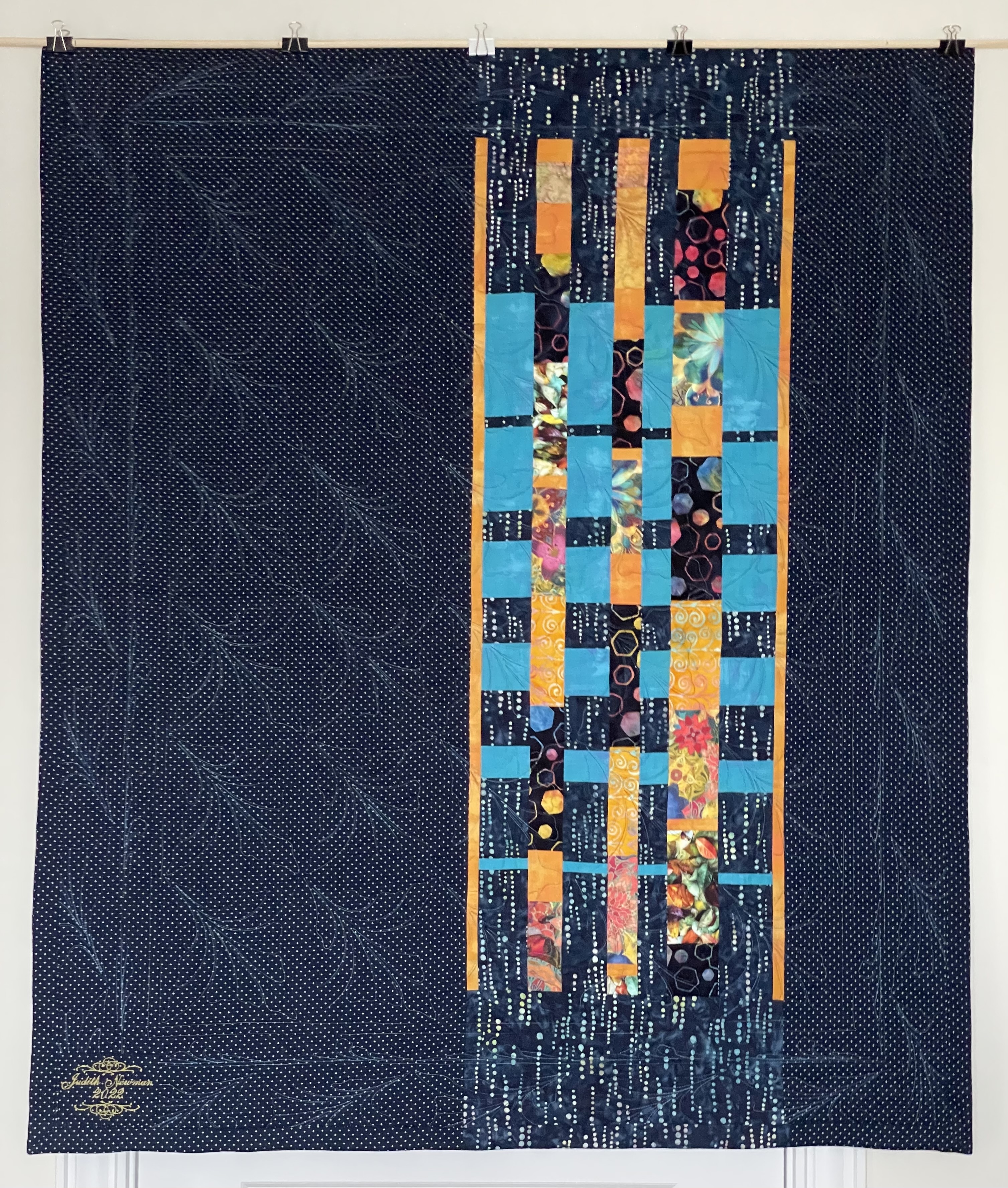
I’ve been pondering the quilt back for many days – I have the four long strips assembled from the 2 1/2″ batik pieces which I’d originally intended using on the front and I wanted to incorporate them in some way on the back. I picked up what could have been some batik backing fabric at Atlantic Fabrics on Friday – there wasn’t quite enough of it for a single length but I thought it brought out the colours in the small strips so I bought what was there. I also picked up this blue batik on Sunday at Heidi Wulffrat’s shop in Mahone Bay – just enough for a single strip. However this quilt (because it’s a square) needs ~60″ in width – close to 20″ needed to augment this strip I’ve assembled so far.

I’ve attached one of the long strips to the right side, the second is sitting on the floor beside it. I’m going to intersperse something between those two long strips and I intend using a third but I also want to integrate the fabric I bought on Friday which also needs to be broken up in some way.

I’ll just keep working at this. I’m thinking about this – if I get it more or less pieced in an interesting way – as possibly the front of the quilt! I have to see how it all turns out.

I also don’t have a name for this quilt, either! Maybe something will come to me when I get it completed.

Delft #2 – Finished

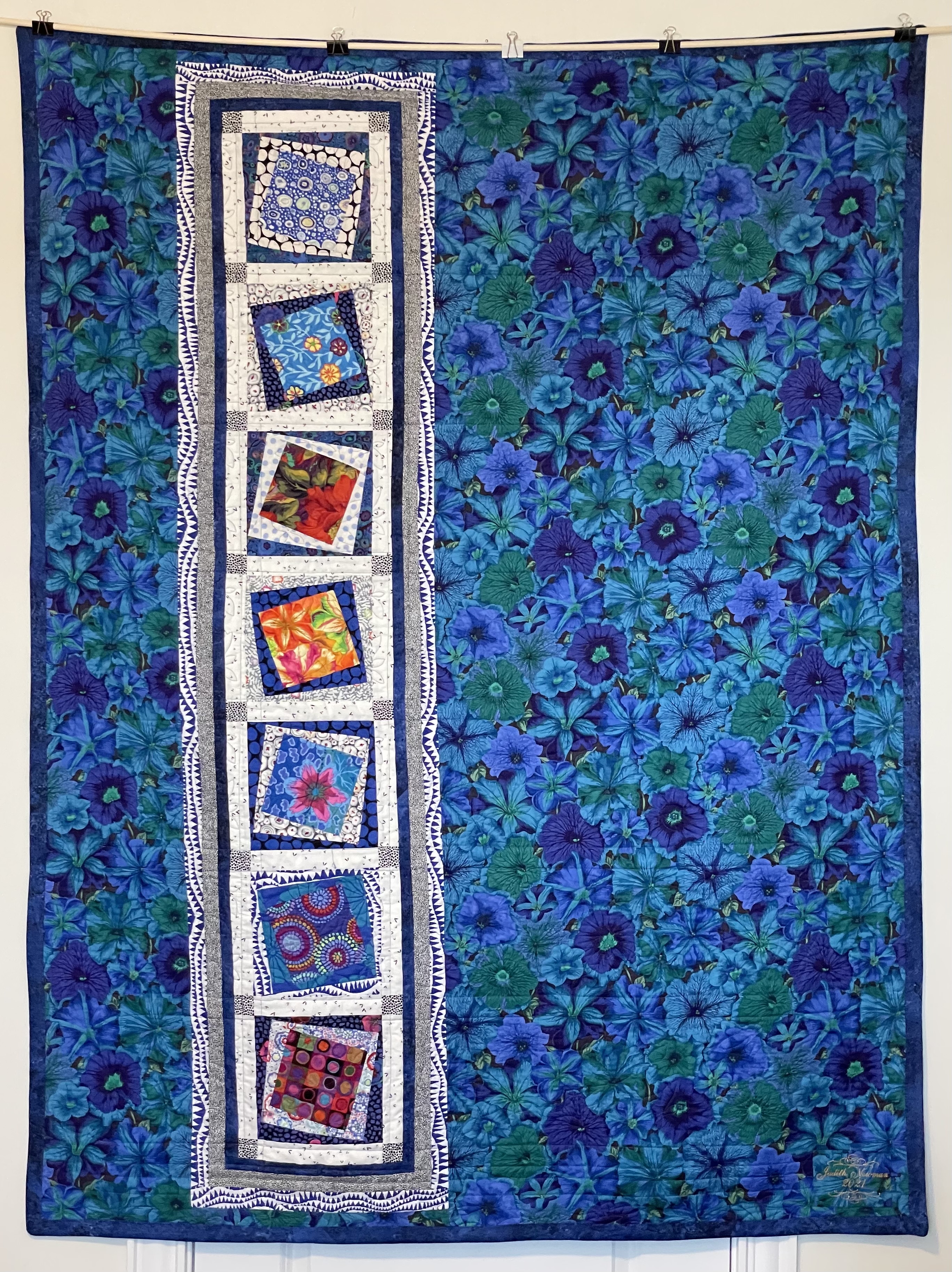
Finished this quilt last evening.

Delft #2 – Quilt Top
Delft #2 – Quilt Back

The photos don’t do it justice – the colours are more vibrant, the relationships among the elements on the quilt top are much clearer.

I finished with a hidden binding – I didn’t think the quilt front wanted another edge element. Besides, I didn’t have any more “petunia” fabric and used the darker blue stonehenge to finish the edge on the back.

The quilting turned out well. I chose to quilt the blocks excluding the sashing – in part because I’d have been left with an unattached row of sashing either at the top or the bottom. It was simpler to just quilt the blocks themselves. I stitched-in-the-ditch along all sashing edges, then quilted the outer border with a modification of the block design to fit the border width.

That’s it for quilts at the moment. I’m now picking up the Kantha bedspread and making another jacket – this time, the back without any flare. I need buttons – will go looking for some this afternoon.

BTW I have written instructions for making this Lap/Throw quilt top: https://jmncreativeendeavours.ca/wp-content/uploads/2022/07/delft-2.pdf

Delft #2 Quilt Top Completed

Once again, it’s a “blue” quilt. The borders change the colour focus from “white” to blue. Adding the borders has resulted in a somewhat large throw quilt (55″ x 73″)!

Now I have to piece the backing – the insert strip needs borders which I will do now; I just have to make sure the panel with borders is wider than 13″.

That’s it. Nothing more to say about this project right now. I’ll do a hidden binding (maybe in the black dots fabric – don’t know yet).

Delft #2 – Top Almost Complete

Blocks and Sashing Complete

I just finished adding the sashing/corners to the blocks and now have a completed panel. I find it interesting how much the sashing overpowers the blocks. Were I to leave the top as is, it would be a predominantly “white” quilt. To offset that, I plan on adding three borders: a narrow inner border using the dark blue/black stonehenge fabric (at the bottom of the photo), another even narrower border using the black dots/pepper fabric I used for the sashing corners (that’s on the way from Newfoundland – hope it arrives late this week/early next), and finally a wider outer border using the blue/green petunias at the bottom of the photo. Those borders will turn it back into a blue quilt, and downgrade the intensity of the white sashing.

The back will use the petunias with the strip I created on the weekend, also bordered with a narrow piece of stonehenge and maybe also the dots/pepper fabric as well.

Pieced Strip for Quilt Backing

In order to carry on, I have to go back to Mahone Bay to pick up another metre of the petunias! I ordered 2 yards which would have been enough for the backing but isn’t enough to do the borders on the front as well. I’m not going to cut the 2 yard piece I have, I will cut the front border pieces from the new piece I have to buy! Besides, I’m having to wait for the black/white fabric to arrive from Newfoundland!

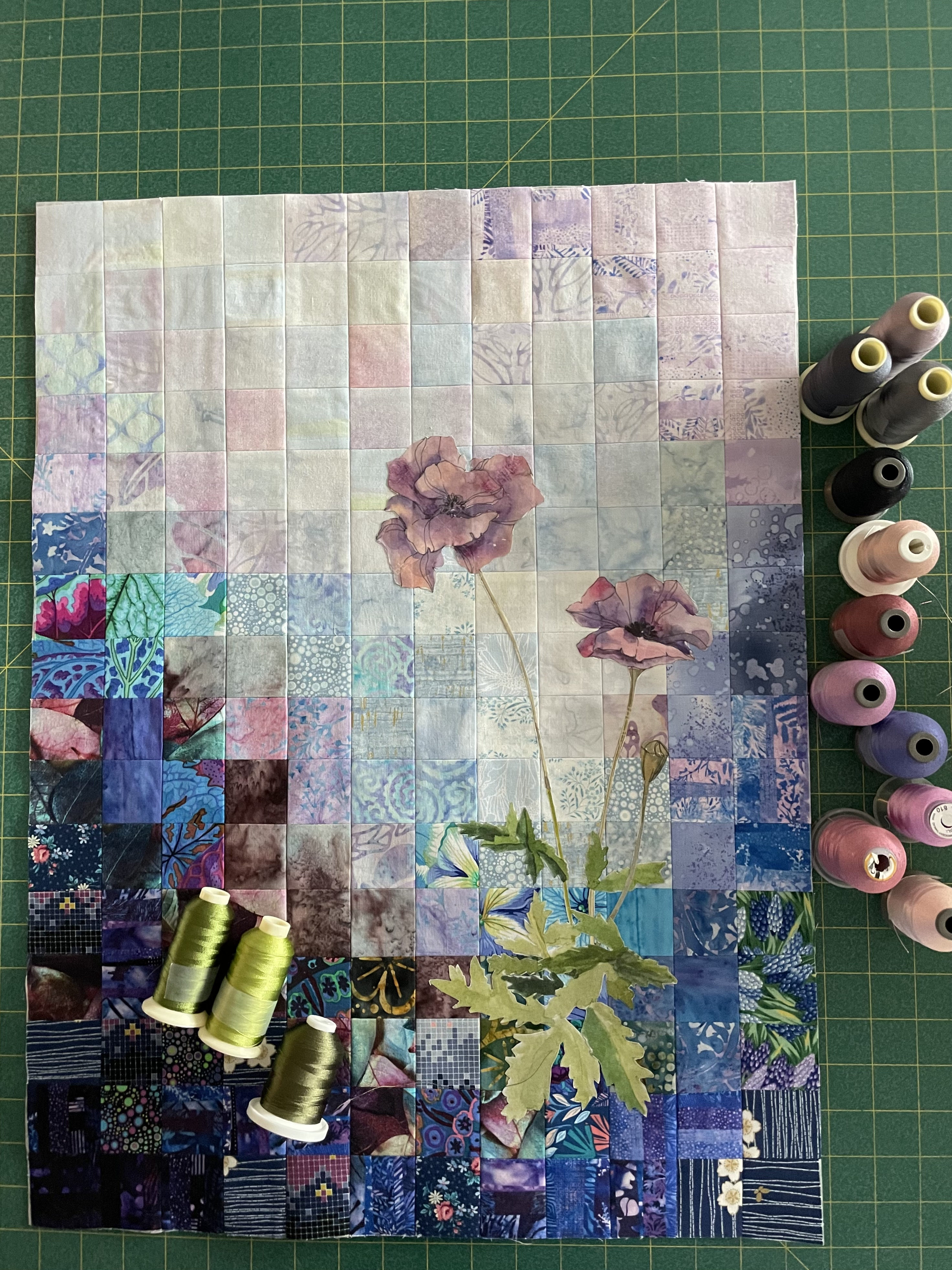
In the meantime, I’ll go back to the purple poppies wall piece I was working on several weeks ago. This will give me time to work on thread painting the poppies.

Purple Poppies

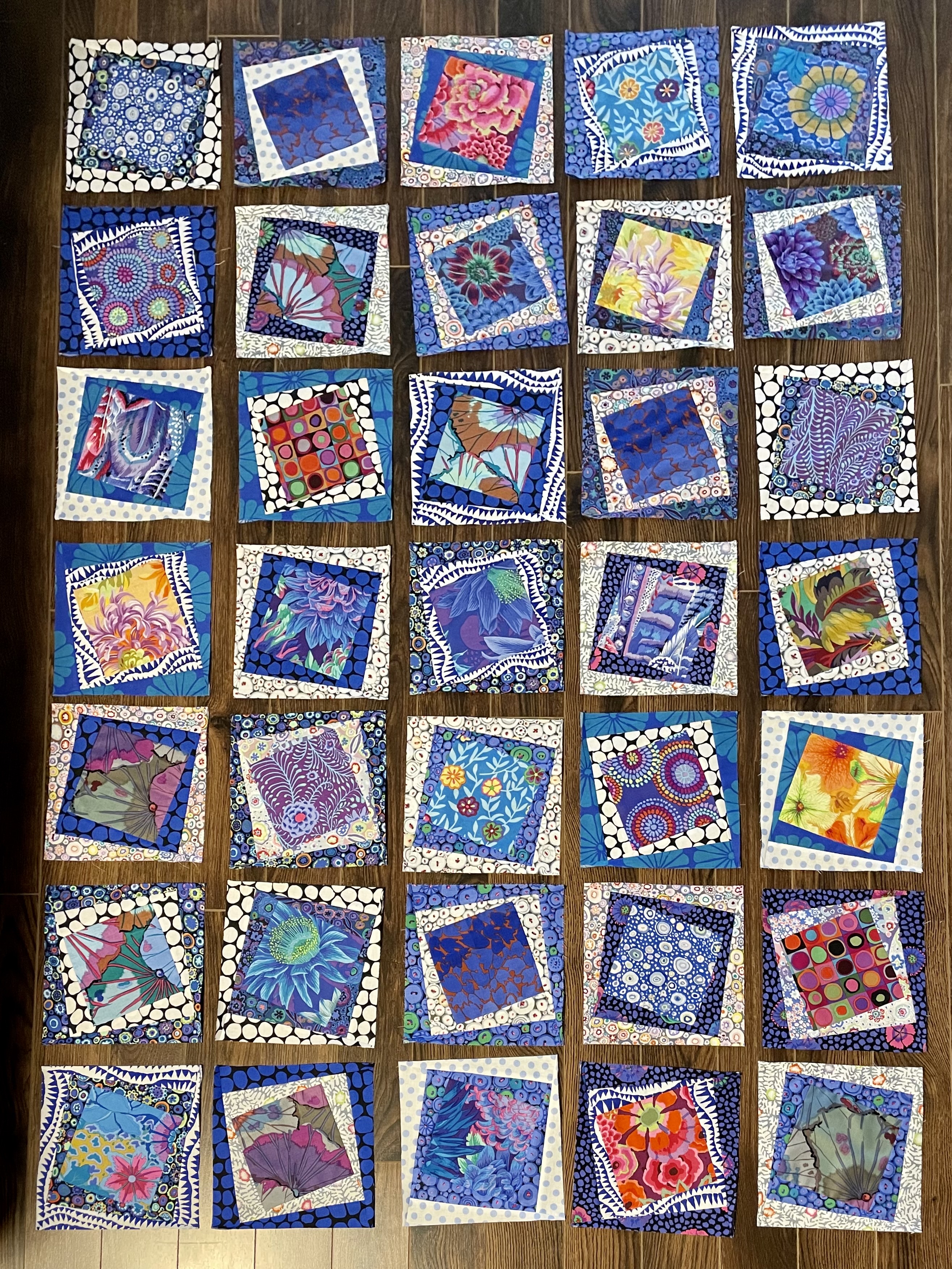
Delft #2 – Laid Out

Now I have to spend some time looking at the blocks and their position in the array! There are three variables in play – the fabrics of the inner square, the fabrics of the first triangle, the fabrics of the second triangle. I’m trying to keep them all different so there are no two centre fabrics in a row or column; then I’m trying to have not two same fabrics touching. I’ve almost got it – I see three spots where the inner and outer triangles are the same fabric and I may not be able to move anything more to alleviate that. There are also some adjacent diagonals (which I’ve decided to ignore). More important is whether I have the colour distributed broadly around the array – it’s not bad – I will have to look at the blocks tomorrow to see if I still feel that way.

The issue is at this point I have almost no degrees of freedom – the only way I can gain more is the make the seven blocks for the quilt back and see if that combination accommodates some swaps. It’s probably a good idea to do that before I attach the sashing because once the sashing is attached I’m not going to be able to do any moving around!

The quilt is going to be colourful, for sure.

PS: I’ve been asked about measurements for the block. If you’re interested in constructing a quilt top like this, click here for information/measurements for creating/setting up the blocks. If you decide to try it, be sure to make a couple of test blocks using scrap fabric.